Tag: UK

  • Witton educates on sex without vilifying it – Review: Doing It

    Witton educates on sex without vilifying it – Review: Doing It

    I first came across Hannah Witton on YouTube some years ago, 2012/13 I think. I subscribed and watched occasionally, and thought her Hormone Diaries was such a great idea. While, I confess, I haven’t followed it as avidly as I wish I had, the beginning of it was remarkably similar to my own hormone experience, in fact I must go back and continue watching to see just how similar it has been.

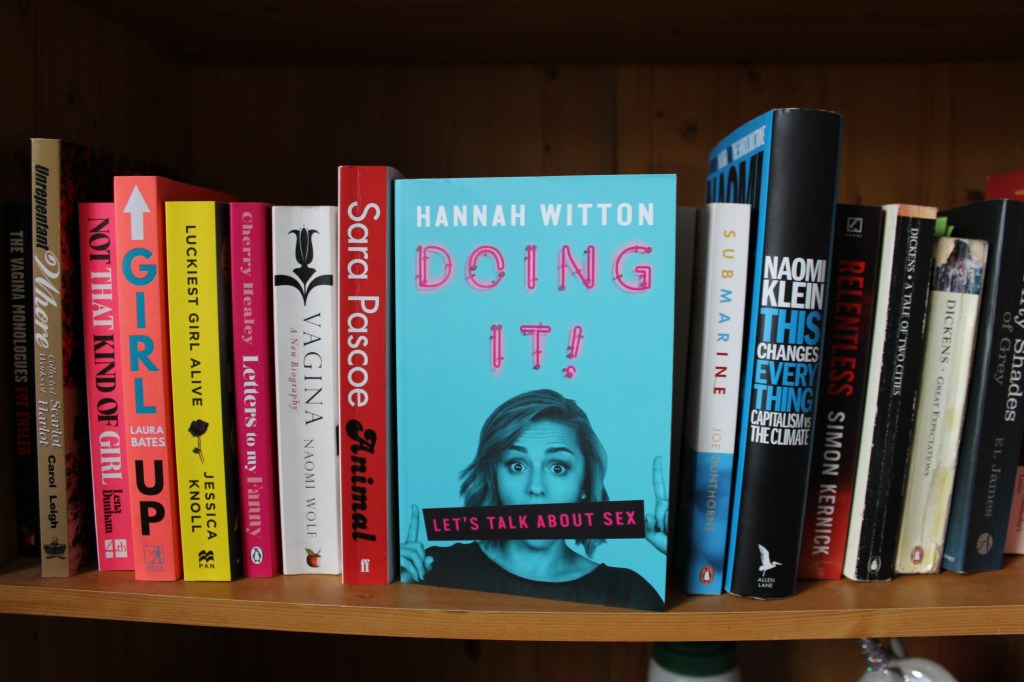
    IMG_7647

    A week or two ago I was reading Animal (brilliant, highly recommend) by comedian Sara Pascoe when I saw Witton tweet out a video of hers featuring Animal  in the thumbnail. I watched and was fascinated to find that our sex related bookshelves were quite similar. This particular video was part of the promo for Witton’s debut book Doing It – I had no idea she was writing a book! The book was out at the end of the week so I preordered it.

    An Adolescent’s Guide to Sex and Sexuality

    Doing It is a super refreshing guide to sex. I say ‘guide’ very loosely, a bit like the Hitchhikers Guide to the Galaxy except it’s an Adolescent’s Guide to Sex and Sexuality. It covers everything from LGBTQ+ relationships to contraception, body confidence to consent, masturbation to sexting.

    For the most part it is all written by Witton, but there are many contributive essays by guest writers. I think my favourite thing about the entire book is her repeat insistence on readers to ‘check your privilege’. It is such an important message, and Witton explains it so clearly yet eloquently that there’s no doubt about what she means. She uses her privilege to promote the voices of others, as the guest writers discuss very personal issues from situation specific perspectives. While in Doing It this is specific to LGBTQ+ and other sex specific scenarios, the mantra of ‘check your privilege’ is brilliant.

    What stands out for me with Doing It is how sex positive it is. The book deals with everything one expects from a ‘let’s talk about sex’ genre of book; STIs, consent, contraceptives and the nitty gritty biology, but unlike other books of its kind it also talks about how good sex can be. Rather than just the ‘don’t have sex, you will die’ narrative young people have drilled into them (pardon the pun) Witton instead proposes: sex is great, fun and exciting, don’t do these things, try out these other things, off you go and enjoy yourself on your own or with another consenting individual(s).

    It’s not patronising either, which is nice. It explains almost everything in a readable and simple tone, yet in places, such as consent and sexting, it explains the exact details of the law, so everyone can understand where the legal, not just moral, lines are – fab!

    There could be more said about everything in the book (Hannah, if you write another, hit me up for a little more about menstruation?) but for the most part it’s a pretty extensive handbook on sexuality, for everyone. Plus, if there had been more detail there would have been less room for Witton’s cracking anecdotes, and no one wants that.

    I can’t say I learnt a whole lot of new information, but I wish I could have read something like Doing It when I was 15/16/17. I live in some sort of weird student bubble where I don’t seem to know anyone between the ages of 1 and 18, but if I knew a teenager I would definitely give them this book.

    The beauty of books like Doing It and Pascoe’s Animal is that they are brutally honest, inspiringly detailed but, most importantly, accessible. They cut the crap of scientific and legal jargon and make sexuality understandable.

    Witton talks about hoping one day being able to contribute to a national curriculum for sex-ed (same, Hannah). I can’t help feeling that if Doing It became compulsory reading for all year 9s in the UK, we would see a generation develop with a far healthier attitude to their own bodies, the bodies of their peers and lovers, and a generally healthier attitude towards sex.

    Top work, Witton.

    4.5/5

    P.S. bravo to both Witton and Pascoe for their sketches of human anatomy *leads round of applause*.

     

  • Set texts from my degree at Swansea

    Set texts from my degree at Swansea

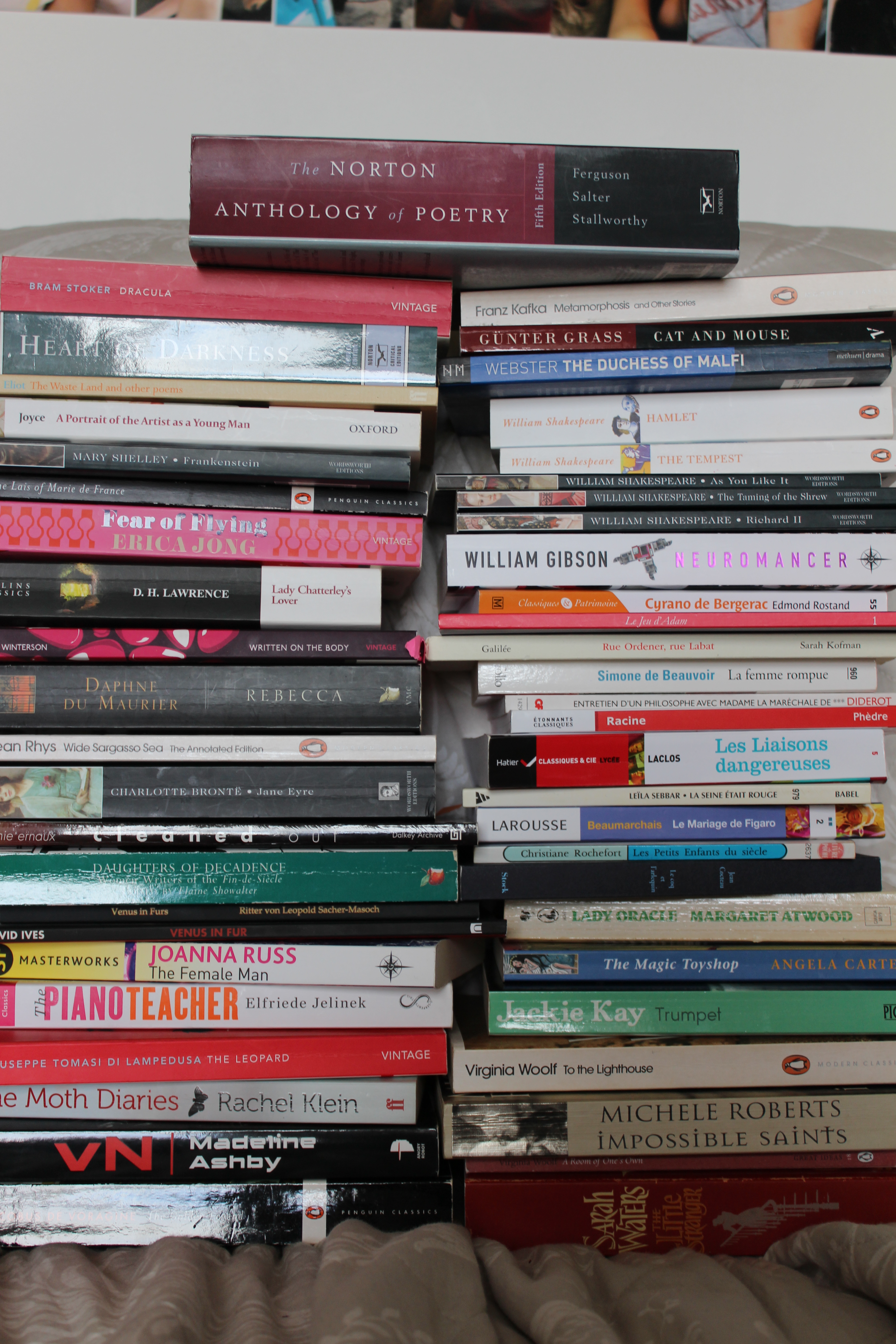
    Some say that your essays, or your certificate, or your experiences are the accumulation of your time at university. For me however, I would say my bursting bookshelves are the product of my degree (and demise of my student loan). This blog is a list of the 59 books from my reading lists over four years at university. To clarify these are the set texts I have studied and my dissertation texts, god knows how many other books I’ve read for fun, recommended and secondary reading, or those I read during my year abroad.

    Some are in French, most are in English, some are translations of other European languages. Some poems have probably been left off but chances are they can be found in the Norton Anthology. Some books, like Jane Eyre, reoccured throughout my degree haunting me like bloody Bertha. Others I would never have picked up if it hadn’t of been for a module I reluctantly took and I’m so grateful that university led me to them.

    They’re roughly in a chronological order, mostly by module, over the last four years. I can’t comment on every single book, that would make this a never ending blog. There’s also a long list of films I’ve studied but again, this blog will need to end at some point.

    I’m half way through the final book Neuromancer, and as much as I’m enjoying it, and have enjoyed this entire reading list, a little part of me is giddy with excitement over the fact that once I finish this last book, I am free to read whatever I want whenever I want, as quickly or as slowly as I like for the first time since I was 14! Eek! That’s such an exciting prospect! So without further ado, here’s my reading list from a degree in English Literature and French at Swansea University, and what a reading list it’s been.

    IMG_6982

    1. La femme rompue – Simone de Beauvoir
    2. Entretien d’un philosophe avec la Maréchale de *** – Denis Diderot My first philosophical text and I got an awful grade for the essay I wrote on it too… though I was also given kudos for attempting a harder text. Because kudos are exactly what every first year student wants.
    3. Against Nature – Joris-Karl Huysmans
    4. Tonio Kröger – Thomas Mann
    5. Metamorphosis – Franz Kafka This was the point in my degree when I became convinced I was living my dream of becoming Rory Gilmore. 
    6. The Cloven Viscount – Italo Calvino
    7. Cat and Mouse – Günter Grass
    8. Cleaned Out – Annie Ernaux This started a love affair with Ernaux. Absolutely love her and have continued to read her books in French but still need to read Cleaned Out in the original French. 
    9. The Garden of Secrets – Juan Goytisolo
    10. Norton Anthology of Poetry (Fifth Edition) I don’t want to talk about it… 
    11.  Lady Oracle Margaret Atwood Is any reading list complete without Atwood? 
    12. The Yellow Wallpaper – Charlotte Perkins Gilman
    13. Trumpet – Jackie Kay READ IT. READ IT NOW. 
    14. A Room of One’s Own – Virginia Woolf Woolf cropped up many times throughout my degree, in fact we recently translated part of A Room in our French grammar class which was a total joy. This speech was hugely influential on the world, but also on me. IMG_6994
    15. Daughters of Decadence: Women Writers of the Fin de Siècle – ed. Elaine Showalter
    16. Frankenstein – Mary Shelley
    17. Dracula – Bram Stoker
    18. Jane Eyre – Charlotte Brontë I REALLY don’t want to talk about it. 
    19. Wide Sargasso Sea – Jean Rhys
    20. Le Coq et l’Arlequin – Jean Cocteau
    21. Rue Ordener, Rue Labat – Sarah Kofman
    22. Les Petits Enfants du siècle – Christiane Rochefort Know those books you mostly like simply because of how passionate your lecturer was about the course material? No? Just me then. This was one of those… I can’t even read the title or hear Christiane Rochefort without reminiscing to that fortnight of second year classes.
    23. La Seine était rouge – Leila Sebbar I’d never heard of the Algerian massacre in Paris on May 8th 1945 until I studied this book. It opened up a whole part of history to me, it’s cool when a book can do that. 
    24. The Taming of the Shrew – William Shakespeare
    25. As You Like It -William Shakespeare
    26. Richard III -William Shakespeare These five were, clearly, part of a Shakespeare module. Since I studied Romeo and Juliet every year from year 6 to year 11, it was so refreshing to mix it up in the Shakespeare department. A lecture on Richard III actually led me to watching House of Cards so that was cool. 
    27. Hamlet -William Shakespeare
    28. The Tempest -William Shakespeare
    29. Charles Perrault’s Fairy Tales
    30. The Bloody Chamber and Other Stories – Angela Carter
    31. The Golden Legend – Jacobus de Voragine Maybe it’s the former Catholic School Girl in me but I really enjoyed studying some of these stories. 
    32. The Lais of Marie de France Cropped up many, many times in English and French modules alike. 
    33. Chaucer’s Clerk’s Tale
    34. The Duchess of Malfi – John Webster
    35. Rebecca – Daphne du Maurier
    36. Impossible Saints – Michèle Roberts Ditto to The Golden Legend but perhaps because I am a former Catholic School Girl… 
    37. Heart of Darkness – Joseph Conrad Let’s not… 
    38. A Portrait of the Artist as a Young Man – James Joyce The books around this part of the list come from a Modernist module, a module which came from Hell. Portrait was the solace in the storm though as I enjoyed it more than anything else in the module even more than To The Lighthouse! 
    39. To the Lighthouse – Virginia Woolf
    40. Le Jeu d’Adam 
    41. L’école des femmes – Jean Baptiste Molière
    42. Phèdre – Jean Racine I just really enjoyed revising this for the exam… is that weird? 
    43. Le Mariage de Figaro – Beaumarcharais
    44. Les Liaisons Dangereuses – Pierre Choderlos de Laclos Love, love, love. 
    45. The Magic Toyshop – Angela Carter
    46. The Little Stranger – Sarah Waters Was so excited when I saw Waters on the reading list for this module. I had tried and failed to get her into my dissertation so jumped at the chance to write about her. 
    47. The Moth Diaries – Rachel Klein
    48. The Female Man – Joanna Russ
    49. vN – Madeleine Ashby Rekindled a love for Sci-Fi that I forgot I had! 
    50. Neuromancer – William Gibson
    51. Cyrano de Bergerac – Edmond Rostand
    52. Venus in Furs – Leopold Sacher-Masoch When it comes to S&M everyone seems to focus on de Sade, so it was really interesting the learn and understand the origin of Masochism. 
    53. Venus in Fur – David Ives
    54. The Leopard – Guisspe Tomasi di Lampedusa
    55. The Piano Teacher – Elfriede Jelinek Disturbing but really damn enjoyable. 
    56. Blood Wedding – Frederico Garcia Lorca
    57. Lady Chatterley’s Lover – D. H. Lawrence
    58. Written on the Body – Jeanette Winterson
    59. Fear of Flying – Erica Jong These final three texts are my core dissertation books… so while they weren’t set by the university they’ve been a huge part, if not the biggest part, of my final year at Swansea. I now have a total love-hate relationship with Lady Chatterley’s Lover but I am more in love with Fear of Flying than I think is healthy… 

    diss books


  • Review: Hunger Makes Me a Modern Girl

    Review: Hunger Makes Me a Modern Girl

    Hunger Makes Me a Modern Girl – Carrie Brownstein

    CB

    I must say that I had no idea who Carrie Brownstein was, nor had I heard of Sleater-Kinney, when Emma Watson suggested Hunger Makes me a Modern Girl for her Good Reads book club: Our Shared Shelf. I hadn’t actually joined the club, I just saw Watson share something about the book and in my blind loyalty I added it to my TBR. And I’m so glad that I did.

    Friends of mine will know I have a pretty odd, dated and specific music taste, and typically Sleater-Kinney does not tick any of my boxes. Reading Hunger was a weird experience though, as I read about the songs and the musicians before I heard what any of it sounded like. As Brownstein mentions different songs, albums, tours and concerts throughout the book I would search them on YouTube to hear and see them for the first time.

    This meant that music I would normally have had nothing to do with was telling a story about ‘characters’ I had already become invested in. It was a reading experience like nothing I’ve had before. My appreciation for autobiographies grows and grows and after Brownstein’s I’m thinking I’ll add a few musicians as well as actors to my TBR.

    P. S. It’s a testament to Brownstein’s convincing and heartfelt writing that she managed to make me feel sad about a cat… that’s no mean feat.

    4/5