Tag: Sex Education

  • Subtle signs that my repro health ain’t healthy #Periodically 3

    Subtle signs that my repro health ain’t healthy #Periodically 3

    Thanks to the wonders of modern technology, specifically the app Clue, I have every cycle that I’ve had in the last three and a half years tracked with excessive detail. But hang on, the maths doesn’t quite add up… three years is 42 months… and I’ve only had 18 cycles… right well there’s warning sign number one – irregular periods. Throughout this blog I’ll illustrate a couple of points with information from my Clue which is almost definitely a gross overshare but hey, here we go.

    Remarkably, my quest for treatment began during the last year where I have, for the first time ever, had a natural and regular cycle. But, with my period finally having regulated to a monthly cycle, it made all the symptoms I had been experiencing over a long period of time, condense into a month. Highlighting their severity and increasing their impact.

    Acne is the most obvious, but my sisters and my mother have/had normal cycles and acne long into adulthood. It was only once I became very aware of horrible chin acne during the same point in every cycle that I noticed it was, at least, hormonal acne.

    Painful and heavy periods have gone hand in hand since menarche (my first period). The more pain I’m in then the heavier I tend to be bleeding. This, has over the years, often resulted in at least two days of doubling up tampons with sanitary pads, frequent changes and dozens of destroyed pyjamas and bedsheets… (I’m still waiting for that TMI filter to kick in). This has become easier to manage with a menstrual cup, if only it could cure the pain too – so far, only ibuprofen can do that. One thing that put me off seeking advice was that I was ‘running’ a lot and irregular periods and even amenorrhea (disappearance of periods) can be caused by frequent exercise, especially running. However, when I say ‘run’ I mean a light jog that usually turns into a long walk and I think it is highly unlikely that my shoddy exercise habits had anything to do with anything. Here you can see how my cramps and painkiller use have increased over time.

    Ovulation pain is something I’ve only experienced during the last ten months or so, but while it seems to be somewhere in the vicinity of my ovaries it isn’t as strict time wise. It now is a pain I experience three out of four weeks of my cycle, particularly when I step on my right leg.

    IMG_5556
    An indication that my ovulatory pain must be something more sinister was that I couldn’t be ovulating this often…

    Random cramping, leg pain and fatigue are a few new dramas to deal with three out of four weeks of my cycle, particularly if I run. The leg pain is particularly strange as it is a bit like growing pains but in my upper thighs. Over the last four months in particular, lethargy has begun to accompany pain – though whether I’m tired because I’m in pain or whether the fatigue is coming from somewhere else, I do not know. I am a pretty lethargic person anyway so it’s taken a big move in my energy levels for me to notice.

    Back pain is something I’ve dealt with since I was about eleven and I actually think might have been the earliest sign. I remember my mum taking me to the doctors and chiropractors to try and ease this dull achey pain in my lower back, particularly when standing for a long time, but nothing ever worked. When I started my period four years later, it was weird to find that this pain that had plagued me for so long, was now part of my period pain every ‘month’.

    There are a few other things, some that I’ve discussed in my last blog like pain during sex and constipation before my period and after sex, and some that I’ve only experienced rarely or recently like occasional bleeding during/after sex and spotting. 

    Thanks for sticking with #Periodically thus far. I’m excited, now that I’ve got all the depressing symptoms and nitty gritty details out of the way, I can really delve in and write about what happens now and why more attention needs to be paid to reproductive and sexual health. 
     

  • When I KNEW Something Was Wrong #Periodically 2

    When I KNEW Something Was Wrong #Periodically 2


    First of all, thank you to everyone who has reached out in person and online to say nice things about the first ‘instalment’ of this new blogging venture. While writing these blogs I’ve been momentarily worried about where the TMI line is – but I’ve decided that line doesn’t exist. So prepare for gruesome details – MUM.

    Looking back, there were dozens of signs that something wasn’t quite right with my reproductive and sexual health and I’ll discuss those signs next time, but in this blog I want to fast-track slightly, and talk about when there was no longer any doubt.

    When did I know for certain that something was up with my reproductive health?

    Pain is the answer. Horrible, horrible pain during sex. It had been a long time since my last sexual encounter, but there was no way I could pin that kind of pain on a period of celibacy nor on my partner’s ‘proportions’ (hello, if you’re reading!) There was nothing normal or healthy about that level of pain. Yet, I persisted, at the advice of my friends and doctors, and I tried for a short period of time to try other positions, to take ibuprofen before sex, but there was little relief.

    The two other signals that this pain wasn’t entirely normal was that it continued for one to three days after sex and that it’s location was similar to where I feel period pain, deep in my gut and lower back. This was not how I anticipated my return to sex to be at all and it certainly put a bummer on a revived love-life.

    My period pains, already bad, had become worse since I had sex too. No longer just knocking me out for a couple of days, but they were now sharp, stabbing and breathtaking, before and during my period. Constipation had become trend after sex and the week before my period and the pain also began to present itself when I ran. Today I am struggling with period and ovulation pain three out of four weeks – that to me is a clear a sign as any that something ain’t right.

    What made doctors take notice?

    One complaint I frequently hear from women with issues with their reproductive health is that they are not taken seriously by their doctors. I was lucky to fall into the care of a doctor who herself has endometriosis, a consideration that I think has been invaluable to my positive experience with the doctors.

    After explaining my irregular periods and this new found pain to a doctor I was, understandably, first sent for a full sexual health check. I was also having this test as I toyed with the idea of getting an IUD. A different doctor, let’s call her Dr H, carried this out and became my GP and port-of-call for all things uterus related. She was asking the routine questions when she asked ‘any pain during sex?’ To which I replied ‘ohhhh yes’. She then began to quiz me about the pain and she asked ‘it’s not a deep pain, is it?’ I said, ‘actually, that is exactly how I would describe it’. Polycystic ovaries had already been mentioned but this was the first occasion endometriosis was suggested.

    The next part of the sexual health test was a pelvic exam. There’s something both incredibly funny and concerning about at doctor, who’s hand is way up in you looking up at you between your legs and saying, ‘I can’t seem to find your cervix, has anyone ever had trouble finding it before?’ Laughing, I said, ‘no – no one’s ever looked!’ Two speculums later she found my cervix but concluded that my uterus was slightly retroverted – tipped. She also suggested that if it is endometriosis, sometimes scar tissue can build up and tip the uterus. I’ve never read anything to support that though. This discovery also meant the IUD or IUS was no longer a contraceptive option for me as my cervix sits ‘too far back’.

    Once the sexual health test came back negative we began discussing in depth my symptoms and the patterns in my pain. The next red flag was raised at the trend of sex and the arrival of my period with constipation. From here, I was referred onto a gynaecology appointment – a story for another day.


  • Witton educates on sex without vilifying it – Review: Doing It

    Witton educates on sex without vilifying it – Review: Doing It

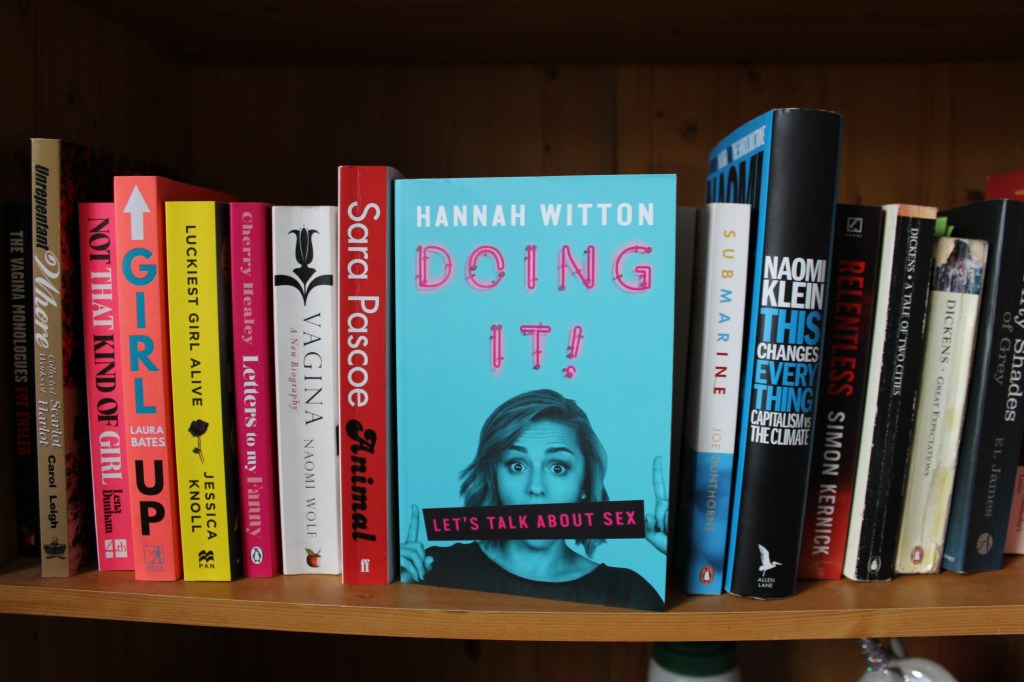
    I first came across Hannah Witton on YouTube some years ago, 2012/13 I think. I subscribed and watched occasionally, and thought her Hormone Diaries was such a great idea. While, I confess, I haven’t followed it as avidly as I wish I had, the beginning of it was remarkably similar to my own hormone experience, in fact I must go back and continue watching to see just how similar it has been.

    IMG_7647

    A week or two ago I was reading Animal (brilliant, highly recommend) by comedian Sara Pascoe when I saw Witton tweet out a video of hers featuring Animal  in the thumbnail. I watched and was fascinated to find that our sex related bookshelves were quite similar. This particular video was part of the promo for Witton’s debut book Doing It – I had no idea she was writing a book! The book was out at the end of the week so I preordered it.

    An Adolescent’s Guide to Sex and Sexuality

    Doing It is a super refreshing guide to sex. I say ‘guide’ very loosely, a bit like the Hitchhikers Guide to the Galaxy except it’s an Adolescent’s Guide to Sex and Sexuality. It covers everything from LGBTQ+ relationships to contraception, body confidence to consent, masturbation to sexting.

    For the most part it is all written by Witton, but there are many contributive essays by guest writers. I think my favourite thing about the entire book is her repeat insistence on readers to ‘check your privilege’. It is such an important message, and Witton explains it so clearly yet eloquently that there’s no doubt about what she means. She uses her privilege to promote the voices of others, as the guest writers discuss very personal issues from situation specific perspectives. While in Doing It this is specific to LGBTQ+ and other sex specific scenarios, the mantra of ‘check your privilege’ is brilliant.

    What stands out for me with Doing It is how sex positive it is. The book deals with everything one expects from a ‘let’s talk about sex’ genre of book; STIs, consent, contraceptives and the nitty gritty biology, but unlike other books of its kind it also talks about how good sex can be. Rather than just the ‘don’t have sex, you will die’ narrative young people have drilled into them (pardon the pun) Witton instead proposes: sex is great, fun and exciting, don’t do these things, try out these other things, off you go and enjoy yourself on your own or with another consenting individual(s).

    It’s not patronising either, which is nice. It explains almost everything in a readable and simple tone, yet in places, such as consent and sexting, it explains the exact details of the law, so everyone can understand where the legal, not just moral, lines are – fab!

    There could be more said about everything in the book (Hannah, if you write another, hit me up for a little more about menstruation?) but for the most part it’s a pretty extensive handbook on sexuality, for everyone. Plus, if there had been more detail there would have been less room for Witton’s cracking anecdotes, and no one wants that.

    I can’t say I learnt a whole lot of new information, but I wish I could have read something like Doing It when I was 15/16/17. I live in some sort of weird student bubble where I don’t seem to know anyone between the ages of 1 and 18, but if I knew a teenager I would definitely give them this book.

    The beauty of books like Doing It and Pascoe’s Animal is that they are brutally honest, inspiringly detailed but, most importantly, accessible. They cut the crap of scientific and legal jargon and make sexuality understandable.

    Witton talks about hoping one day being able to contribute to a national curriculum for sex-ed (same, Hannah). I can’t help feeling that if Doing It became compulsory reading for all year 9s in the UK, we would see a generation develop with a far healthier attitude to their own bodies, the bodies of their peers and lovers, and a generally healthier attitude towards sex.

    Top work, Witton.

    4.5/5

    P.S. bravo to both Witton and Pascoe for their sketches of human anatomy *leads round of applause*.