Tag: Literature

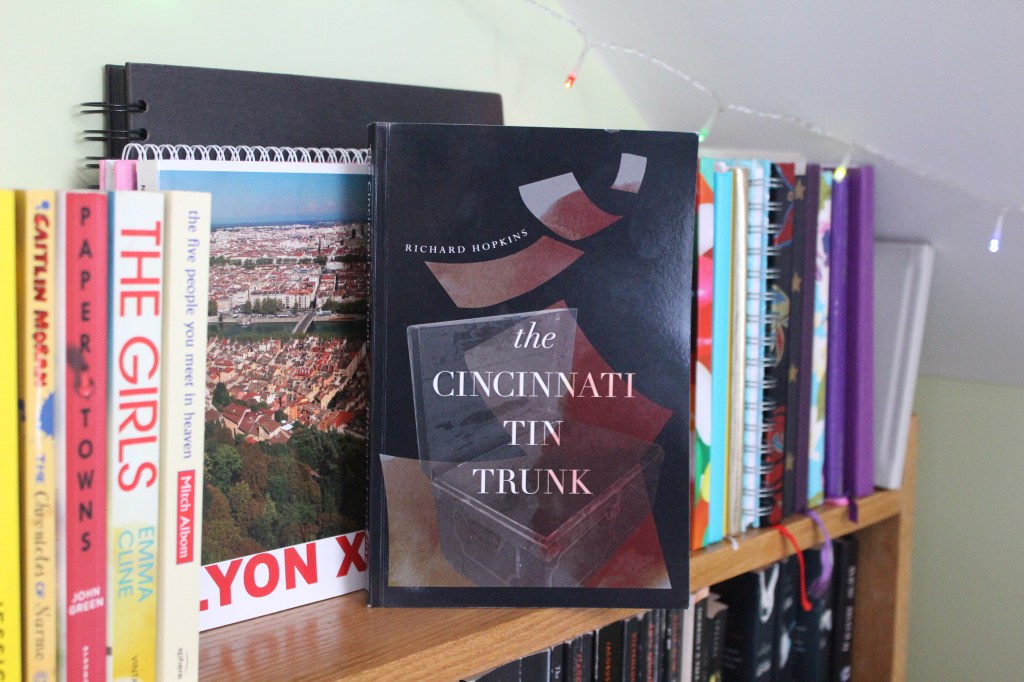
  • Review: The Cincinnati Tin Trunk – Richard Hopkins

    Review: The Cincinnati Tin Trunk – Richard Hopkins

    Those who have been around for the long haul might remember that in my 2016 Favourites I mentioned the first book written and published by my friend Richard Hopkins – Interleaving. It’s now my pleasure to let you know that the second book in what is going to be a trilogy is out now!

    “Readers are taken on a historical treasure hunt”

    It’s always nice to be able to give a friend’s projects some airtime, and it’s even nicer when I really enjoyed the book. The Cincinnati Tin Trunk is like Interleaving in many ways, and totally different in others. I’ve talked before about how my relationship with historical fiction has been a bit rocky, but Richard’s books are a really great way to ease yourself into history – by literally immersing yourself in the past. Inspired by the life and work of a real nineteenth century Dutch photographic Assistant, Nicolaas Henneman, the novel follows the journey of one twenty-first century historian’s physical, literary and photographic quest to learn more. Together with Tom, his wife Libby and adult daughters, readers are taken on a historical treasure hunt across the US, Holland, France, the UK and back again.

    Both a product of its time (2016 – yikes!) and a captivating exploration of early photography, nineteenth century life and migration The Cincinnati Tin Trunk can’t help but take you on a walking tour of Henneman’s life. Like Interleaving Richard drops you into London, both then and now, and guides you around the places that you might otherwise not have noticed. The book is both a form of escapism and a reminder that every story have many sides, some of which still need to be uncovered.

    Despite the fact that the characters are all new in this second instalment of the trilogy, it does what all good middle trilogy books do – it leaves you pondering about the third. Once again the profits from the book are going towards charities that help homeless people in London. Both Interleaving and The Cincinnati Tin Trunk are available on Amazon in Kindle and paperback format, so check them out if you’re interested!

    The book I reviewed last week (Tigerish Waters)  is also giving its profits to charity – Christmas presents with a side of social justice anyone?   

    IMG_9837


  • Review: Tigerish Waters – Sophie Reilly

    Review: Tigerish Waters – Sophie Reilly

    Launching this week is a stirring book written from the front line of a bright young woman’s battle with her mental health. Tigerish Waters is the selected writings of Glasgow-born Sophie Reilly, edited by her brother Samuel Reilly after Sophie took her life last year. This striking combination of poetry, prose and fiction is both an upsetting marker of a waste of talent and a celebration of a short but thoughtful life.

    Knowing the context around Tigerish Waters you might not expect the book to be so funny, but Sophie’s voice and style is a lot of really wonderful things, and comic is one of them. Having suffered with a plethora of mental illnesses including Anorexia Nervosa, Bipolar Affective Disorder and Emotionally Unstable Personality Disorder, her writing speaks of unfathomable pain and hardship as well as total euphoria. By articulating her relationship with her mental health through drama, poetry, short stories and diary entries, Tigerish Waters offers insight into a gritty reality of extreme highs and the lowest of lows.

    The dark, ironic and humorous style leaves you wanting more from this talented young writer, but then you remember the context of the book’s publication and it all begins to feel desperately sad. Throughout, Sophie talks about the future, specifically about when she’s written a play or a memoir or a novel. “Nobody who attempts or commits suicide wants to die” she writes, and we think of how a book was always supposed to be part of Sophie’s future, but the reality is not how anyone, least of all Sophie, would have wanted it to come about. And yet, the publication of Tigerish Waters does come with barrels of hope. All profits made by the book are being donated to the Scottish Association for Mental Health (SAMH). The book passes comment on the “non-existence” of Dundee’s mental health services and the counter-productive support Sophie felt she received. Tigerish Waters has the power to serve as a real wake up call to a revolution that needs to happen with the treatment of mental illness in Scotland and beyond.

    For me personally, I was deeply effected by the normality of Sophie’s life. At first glance it is all very relatable. In her diary entries she talks about Gavin and Stacey, Harry Potter, Orange is the New Black, even her crush on the show’s star. She expresses her concerns about the overbearing presence of social media on girls’ self-esteem and she hesitates over whether or not she really needs a smartphone. She was a normal young woman with a promising future (she had been accepted to study Theology and Literature at St Andrews). If one ever needs a reminder of how mental health issues can and do impact everyone and anyone, Tigerish Waters is a prime example. In one diary entry Sophie calls us to take pride in our mental health issues. Taking inspiration from some of the triumphs of the Gay Pride movement Sophie titles the essay “Mental Health Pride”. It is a confident approach to mental illness that could have a really positive effect in my opinion, and I hope that message will be another positive thing to come from Sophie’s life.

    “If one ever needs a reminder of how mental health issues can and do impact everyone and anyone, Tigerish Waters is a prime example.”

    For me, the two most poignant parts of the book were the short play “Before the Snuff of the Lights” and the poem “Birth & Growth.” While both play an important part in telling Sophie’s story, they are also standout for their quality and creativity. (Update: I just heard a performance of “Before the Snuff of Lights” at the book’s London launch, which only affirmed my opinion that it is really extraordinary and mindful piece of writing.)

    It is easy to get swept up in the circumstances of Tigerish Waters’ publication, when perhaps the emphasis should be on the phenomenal talent the lies in the sentences and verses of Sophie’s writing. Anyone who has ever lived and wondered why will find something in this book that makes them say “I thought it was just me.” From that, I hope they will be motivated to demand help, receive it and share their unique voice with the world.

    Tigerish Waters, the selected writings of Sophie Reilly, edited by Samuel Reilly, is available on Amazon for £6.99. Published by Mad Weir Books, all profits from the book will be donated the Scottish Association for Mental Health.

  • My 5 Favourite Potter en Français Translations PART 1

    My 5 Favourite Potter en Français Translations PART 1

    As promised in my mid-year resolution that I made in September, I have been reading Harry Potter in French for the first time lately. This afternoon, as I picked up Le Prisonnier d’Azkaban, I was excited, not just because it has been a pleasure to return to the wizarding world, but because some of the translations for names and places have been half of the entertainment. So far I’ve found it spooky how even though I’m reading these books for the first time in years and in a different language, seeing the chapter titles is enough to fill me with the same excited glee as ever. Gilderoy Lockhart, is still just as arrogantly and ironically maddening as he is in English.

    Apologies to anyone who doesn’t like Harry Potter but honestly, what is wrong with you? For those who don’t speak French I’ll do my best to explain why I’m tickled. Without further ado, here are my favourite French translations from Harry Potter 1 and 2 – L’école des Sorciers and La Chambre des Secrets.

    Le Choixpeau Magique

    Now of course any new student at Hogwarts (or Poudlard, I should say) must be sorted into the correct house. I’ll touch upon the title of the houses in a moment, but let’s talk about the sorting process first, shall we? The infamous Sorting Hat is translated to le Choixpeau Magique, which honestly brings me an absurd amount of joy. “Choix” meaning choice, and “chapeau” meaning hat, it is an excellent squashing together of words that I fully support. It makes “Sorting Hat” suddenly seeming extraordinarily dull, for a talking hat, that is.

    giphy

    Touffu

    Now what’s better than Hagrid having named his giant three-headed dog Fluffy? The fact that in the French version, he names it Touffu. While it pretty much just a literal translation (it sort of means “dense-y”), I think it’s extra amusing for English readers of the French version (confused yet?) because it becomes a sickly sweet name, as well as just being totally mad.

    Deauclaire, Dubois, Chouvrage & Quasi-Sans-Téte

    A couple of names I randomly enjoyed the very literal translations of were Penelope Clearwater to Penelope Deauclaire, Oliver Wood to Olivier Dubois and Professor Sprout to Proffesseur Chouvrage. Simple, exact translations that just sound even better in French. The other really great example is Nick Quasi-Sans-Tête. Any guesses? Nearly Headless Nick, of course!

    giphy (1).gif

    Poufsouffle

    Now Hogwarts isn’t Hogwarts in French, which does bother me slightly, but what is more fascinating is how some of the house names have been changed. Gryffindor becomes Gryffondor, Slytherin becomes Serpentard (both fair translations) but then Ravenclaw becomes Serdaigle and Hufflepuff becomes Poufsouffle. While they do literally translate to “claw of eagle” and “puffy puff”,  I do however get a little mad that the translator (Jean-François Ménard) doesn’t change their first names to keep the alliteration. It’s maddening to me to have Helga Poufsouffle and Rowena Serdaigle.

    Malefoy

    At first I didn’t think anything of the added “e” in Malfoy, but then I’m became suspicious that it might be a philosophy thing. I assume that Harry Potter and the Philosopher’s Stone couldn’t be translated directly because France has such a long and complicated relationship with philosophy (Beauvoir, Satre etc.). Now I’m wondering if the same tradition has anything to do with Malfoy’s name too. “Mauvais foi” (bad faith) is an existential idea conceptualised by Beauvoir and Satre, and I’m sure I’ve read it as “mal foi” somewhere too. I may be wrong, and it could just be a pronunciation aid but I like to think it’s a little cooler than that. Malfoy’s character certainly has a little mauvais foi about him, I’m not sure the “e” is necessary…

    giphy (2).gif

    Let me know if you’ve enjoyed this blog and I’ll highlight a few more of my favourites as I continue to read the series in French. 

    Now read Part 2, featuring Padfoot, Prongs, Grindylows & more