Tag: France

  • City by the Book: Death at the Château Bremont

    City by the Book: Death at the Château Bremont

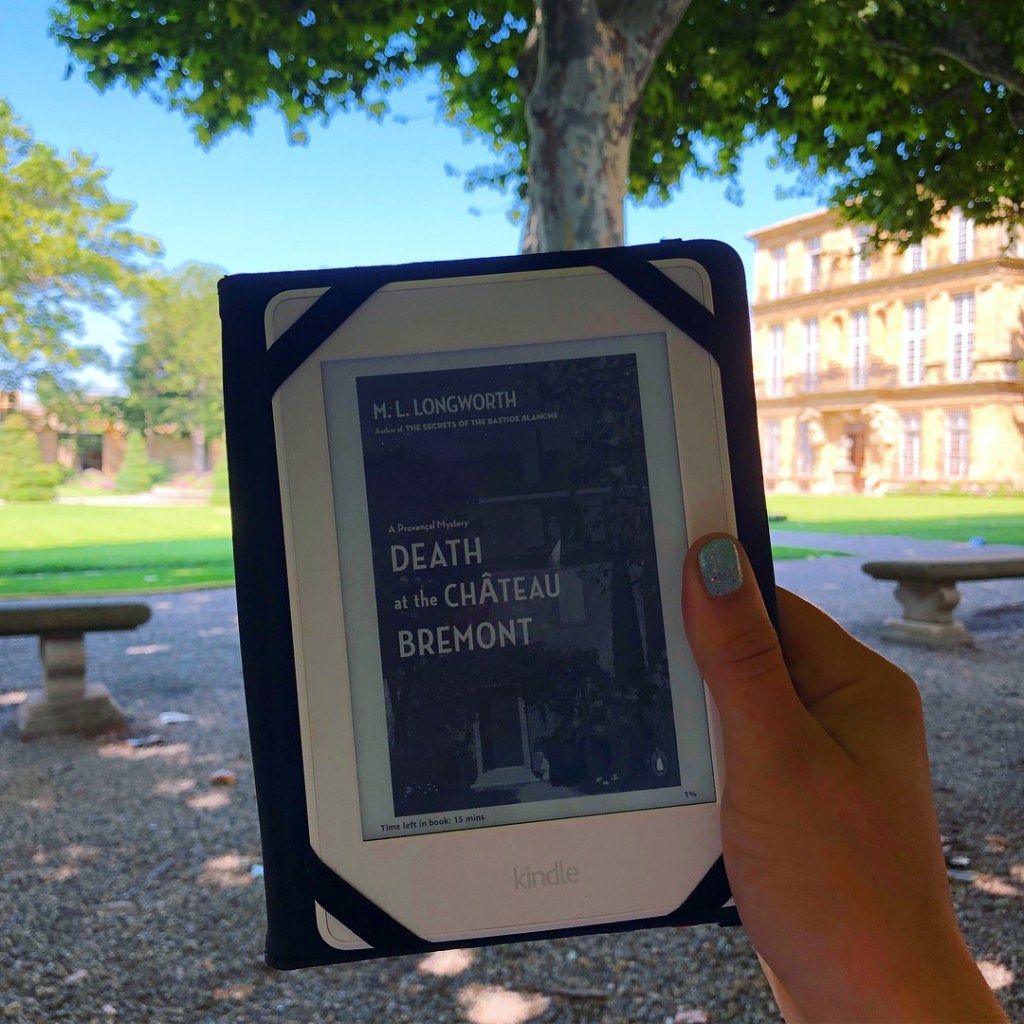
    The final City by the Book from my most recent trip takes us to Aix-en-Provence, a city my travel companion knew well, but that I didn’t know at all. Well, it’s much easier to get to know a city in two days when a) you have a private tour guide and b) you have a book as brilliant as M L Longworth’s Death at the Chateau Bremont. The book is actually the first in a series of provençal murder mysteries, all set in and around Aix-en-Provence. And I don’t mean loosely, I was recognising street names and restaurants all over the place thanks to Longworth’s book.

    I’m not a huge murder mystery reader, but living with my dad means that exposure to it is inevitable, so I’m always pleasantly surprised by how much I enjoy them. The series has the usual cryptic detective, Antoine Verlaque, who is clearly not handling some unknown inner turmoil, but refreshingly, he is joined by university professor Marine Bonnet.

    When we first hit cours Mirabeau in the daylight, Aix’s iconic street, my friend felt like something was different — the trees. The street wasn’t how she remembered it, lined with trees so densely that they formed a cover over the street itself. A few hours later, I think we might have been in Parc Jourdan, I read the following passage in Longworth’s book.

    “One hundred years ago double rows of plane trees had been planted on both sides of the street, and by the summer they would shade the sidewalks and the street itself. But the cours had been in a state of construction, or “decontruction,” as Slyvie, Marine’s best friend, a photographer and art historian, liked to say. No sooner was the top of the street completed than the workmen would start jack-hammering the bottom, and then someone at city hall would change his or her mind and the bottom would be hurridedly finished so the construction team could tear up the newly finished work at the top.” — M L Longworth, Death at the Chateau Bremont 

    It’s not a particularly happy anecdote, but isn’t it nice when a novel can fill in the blanks on why a landmark, plastered on every postcard and fridge magnet, looks so completely different?

    Books like Death at the Chateau Bremont are why I like writing the City by the Book blogs — it can transform how you experience a trip. It was also really easy for me to find thanks to the Aix Centric blog, which has a list of books set in Aix — I wish it was as easy for every city! The same blog also has a post about the tree situation, find it here.

    I expect I’ll read some more of the Verlaque and Bonnet series, but I almost want to wait until I can visit Aix again — reading becomes an even more immersive experience when you get to read a book in the city in which it’s set. 

    The last City by the Book looks at Toulouse, Montpellier and Henry James, read it here
  • City by the Book: A Little Tour in France

    City by the Book: A Little Tour in France

    As soon as my friend and I planned this summer’s France trip I was excited to get back on it with the City by the Book blogs, and here we are! I thought it’d be easy to find books by authors from the cities we were visiting, or at least set there, but it was much harder than I expected. Especially once I was limited to e-books for the sake baggage allowances.

    And then I came across a non-fiction book by Henry James – A Little Tour in France. Well that was exactly what we were doing, so it sounded like a good fit. I knew it reached Toulouse, which was our first stop, but I hadn’t expected our second and third stops, Montpellier and Aix-en-Provence, to come up too. There wasn’t much Aix coverage, but the book was a great companion for Toulouse and Montpellier.

    Toulouse

    James, it seems, wasn’t overly impressed with Toulouse. I was, but after the rest of the trip, it certainly wasn’t the high point.

    “But the city, it must be confessed, is less pictorial than the word, in spite of Place du Capitole, in spite of quay of the Garonne, in spite of the curious cloister of the old museum.” – Henry James, A Little Tour in France.

    At present, Toulouse is a city under construction. Undoubtedly, it’s very different from how James saw it, but for me, the city is now irrevocably associated with the sound of drills and piles of scaffolding, all, of course, surrounded by ancient churches and convents. I think I’ll have to return to Toulouse in a few years to see how the development has enhanced the city, rather than making it the dustiest and noisiest part of our trip.

    IMG_2330
    Hmm, Toulouse’s most spectacular church was presented a little differently to how James would have seen it…

    Montpellier

    Here’s where James and I agree. For some reason, I had it in my mind that Montpellier was a bit of a British tourist trap — how wrong I was. We could’ve spent all summer there, exploring and eating. We had snails and wandered its little streets — we even became incredibly frustrated when a shop we found one morning disappeared without a trace in the afternoon. It took a treasure hunt before our train left the next morning to find it (it had been hidden down a secret adjacent street the whole time).

    “I spent two days there, mostly in the rain, and even under these circumstances I carried away a kindly impression.” – Henry James, A Little Tour in France. 

    We popped into the museum (Musée Fabre) James loved so much but didn’t explore it with his level of unrestrained detail. It’s a really special city (with excellent seafood) and I don’t doubt I’ll be back for a longer visit at some point in the future.

    A Little Tour of France was published in the nineteenth century, but because history is such a key part of any holiday in France nearly everything James mentioned was still there, there was just more around it. It was fun to read his caricatures of the people he encountered in each city of his tour, which really puts the buildings and landscapes you’re visiting into a unique context.

    Another City by the Book from this trip will be coming soon! 

  • My 5 Favourite Potter en Français Translations – PART 4

    My 5 Favourite Potter en Français Translations – PART 4

    As you probably know by now, I recently read the Potter books one through seven for the first time in years and it’s been a ride — even more so than normal because this time I’ve done it in French. I’ve loved sharing my favourite translations on Fictitiously Hilary and I’m sad to say that this is the last blog I’ll be adding to the collection. Catch up with the others by clicking here:

    Part One     Part Two     Part Three

    Here are my final favourite French Harry Potter translations, taken from across the seven books.

    Image result for quidditch gif

    Le Quidditch

    The title of everyone’s favourite wizarding sport remains the same in French, but the same can’t be said for the rest of the game’s elements. The players’ roles are directly translated as chasers become “poursuiveurs,” beaters become “batteurs” and the seeker becomes “l’attrapeur.” I can’t for the life of me figure out the logic behind the Quaffle translation, which becomes “Souafle” – I guess both words are kind of onomatopoeic in their respective languages? Bludgers become “Cognards,” which comes from the French verb cogner, meaning to bang, knock or strike — figures. The Golden Snitch, rather magically, becomes “le Vif d’or” – or meaning gold, while vif is an adjective that can mean anything from vivacious, keen, sharp, quick, strong or bright – I’d say the Snitch is all those things…

    Transplanage & Désartibulement 

    Apparating and splinching become more relevant in the final two Potter books and I was interested to see how they’d be translated. Translator Jean-François Ménard goes for are “transplanage” (noun) and “transplaner” (verb) for apparating, and “désartibulement” for splinching. Transplanage presumably makes sense in terms of the word “transplant” but I really can’t put my finger on the translation of splinching. It obviously doesn’t mean too much in English, which doesn’t help me understand the translation. It’s really bugging me, so any French readers, please let me know if/why it makes sense!

    Image result for hedwig gifs

    “Un hibou huhula…”

    In part two, I talked about how much fun I think it is to discover onomatopoeias in other languages, and in Deathly Hallows (or les reliques de la mort in French) I found another corker. As Harry and Hermione are recovering in the Forest of Dean, Harry hears an owl, except in French, it’s “un hibou hulula.” “Hululer,” I then confirmed is the French for to hoot, but since you pronounce it “hoo-hoo-ler” (but with the almost non-existent French ‘h’) you literally have to make the “hoo-hoo” sound owls make. Magic! Much better than our old “twit-twoo!”

    Image result for mudblood gif

    Sang-de-Bourbe & Moldus

    Onto a slightly more unpleasant translation now, one that became more and more present in the final books — Mudblood. In French, this derogatory slang for a Muggle-born wizard becomes “Sang-de-Bourbe” — which reads more as “Sludgeblood,” but it certainly does the job. Come to think of it, I never talked about the translation of Muggles, I think it’s slightly nastier in French, it’s “Moldus.” My English mind immediately goes to mouldy, but in French “molle” means soft, weak or floppy, so it’s nicer than it sounds, just.

    Le plus grand bien 

    The deep philosophical “greater good” issues in Harry Potter have always been ruined for me because I immediately think of Hot Fuzz, but I was interested to see how it would be translated. Turns out, very, very literally! I thought French grammar might overcomplicate it, but it is simply translated to “le plus grand bien” —  word-for-word that’s “the more big good” – that’ll do it!

    Related image

    Thank you so much for reading these blogs! They’re not exactly examples of hard-hitting journalism but they’ve been so much fun to write. And that’s on top of the fact that reading the books in French has been incredibly rewarding and a great way to keep my French up since graduation. I hope you’ve enjoyed reading them as much as I’ve loved writing them.

    Merci beaucoup, onto the next French/magic/literary adventure! 

    Image result for harry ron hermione gif