Tag: Vaginismus

  • Reading My Broken Vagina by Fran Bushe

    Reading My Broken Vagina by Fran Bushe

    Much like with Lara Parker’s Vagina Problems, I don’t think it’s entirely appropriate for me to ‘review’ Fran Bushe’s My Broken Vagina because the content is so close to home. I’ve also seen Bushe’s one-woman show Ad Libido three times, discussed it several times on this blog and written about it during the same module of my MSc that I discussed in my last blog. I’m a big fan and completely biased, so instead of reviewing My Broken Vagina, here are some thoughts I had while reading it.

    My Broken Vagina is a frank, funny and warm book where Bushe describes her experience of feeling like her vagina is broken and her quest to fix it: spoiler alert, the only thing that’s broken is sex education. As soon as I started reading My Broken Vagina I felt like I was being hugged by Ad Libido. Each of my three viewings of Bushe’s show marked significant chapters in my own relationship with my broken bits but having its wisdom captured in a written form that I can return to and share beyond the limits of the theatre feels very special. Just like her play, Bushe’s book is laugh-out-loud funny, genuinely educational and wonderfully moving. As an added bonus, it’s filled with amazing, poster-worthy illustrations. 

    Among many important points that come up in My Broken Vagina, is one that I am always particularly fascinated by: ‘the conversation’. That is, the great pleasure of telling a potential new intimate partner that they might need to change their expectations of sex because of sexual pain. Perhaps it sounds simple but it’s been something of a minefield for me for many years and I was thrilled to find it in Vagina Problems and now My Broken Vagina too. It’s refreshing to see it being discussed openly because advice about talking to a partner about sexual pain nearly always assumes you’re in an established, monogamous and heterosexual relationship. It’s likely I relate to Bushe and Parker’s musings on the subject so much because we’re all discussing experiences of being single with sexual pain as white, cis women dating men, but there are definitely similar threads running through discussions of ‘the conversation’ that I think are worth talking about. Take a look at these quotes from My Broken Vagina and Vagina Problems:

    ‘Yeah, haha, and by the way, I might never be able to have sex with you. But I’m still pretty funny and I can make decent banana bread.’

    Lara Parker, Vagina Problems – 114

    ‘At what point on a date with someone new, do you say, “Hey, I know we are probably going to go back to mine and bang it out/make sexy magic, but I want you to know … I might find this very painful”.’

    Fran Bushe, My Broken Vagina – p.36 

    Recently, I got over my fear of ‘the conversation,’ by coming to the remarkable discovery that it doesn’t matter. It doesn’t matter for two reasons. First of all, it is a complete distraction from the actual important bits of getting to know someone and figuring out if you even want to get intimate with them:

    ‘I nodded when I was supposed to and laughed on cue, all while thinking about what it might be like to tell him that I might not ever be able to have penetrative sex with him.’

    Lara Parker, Vagina Problems – p.115

    ‘The fear of having this conversation with a stranger not only meant I had never had a one-night stand, it also meant I’d stay in bad relationships longer than I should.’

    Fran Bushe, My Broken Vagina – p.37 

    Secondly, it doesn’t matter because no matter how you present the information, you cannot control the other person’s reaction. Nothing has ever been more out of your control and, if I’m totally honest, a person’s reaction to that revelation can often be a good test of character. The last time I told someone I was dating that sex might not be what they were expecting or used to but that it could still be fun and good if they kept an open mind, the guy in question went quiet for a moment and became very focussed on the beer bottle in his hand. I was about to panic babble when he suddenly became very animated and asked me why his ex-girlfriend had instructed him to stuff a head of garlic up her vagina to prevent UTIs. It cued internal howls of laughter and shook out all the anxiety I had about ‘the conversation.’ Shock therapy? There is no way I could have anticipated that response (nor any way I could have answered his question.) 


    This subject and many others are built upon in much funnier ways in Bushe’s writing. Bushe’s play came to me (steady on) by chance when I was still feeling very much alone in my experience of sexual pain. The Gilmore Girls gif I used to describe how Ad Libido made me feel the first time I saw it is still better than any words I’ve found to describe that feeling. The idea that some scared teenager discovering their body might find My Broken Vagina before sifting through the heaps of unhelpful and incorrect information and advice Bushe and others like myself have had to sift through warms my soul. I wonder how my former Catholic all-girls school would feel about a sudden library donation? I think I’ll find out, because at the heart of My Broken Vagina is a lesson we can all do with reminding of from time to time: that there’s a big difference between feeling broken and being broken.

    You can buy My Broken Vagina from all good bookshops now and until 19 June you can stream Ad Libido online here – I think I’ll be getting my fourth viewing in! P.S. Speaking of vaginas, if you’re in London get to the Vagina Museum for what looks to be an amazing exhibition, ‘Periods: A Brief History,’ featuring the amazing Hazel Mead. Wish I could get there!
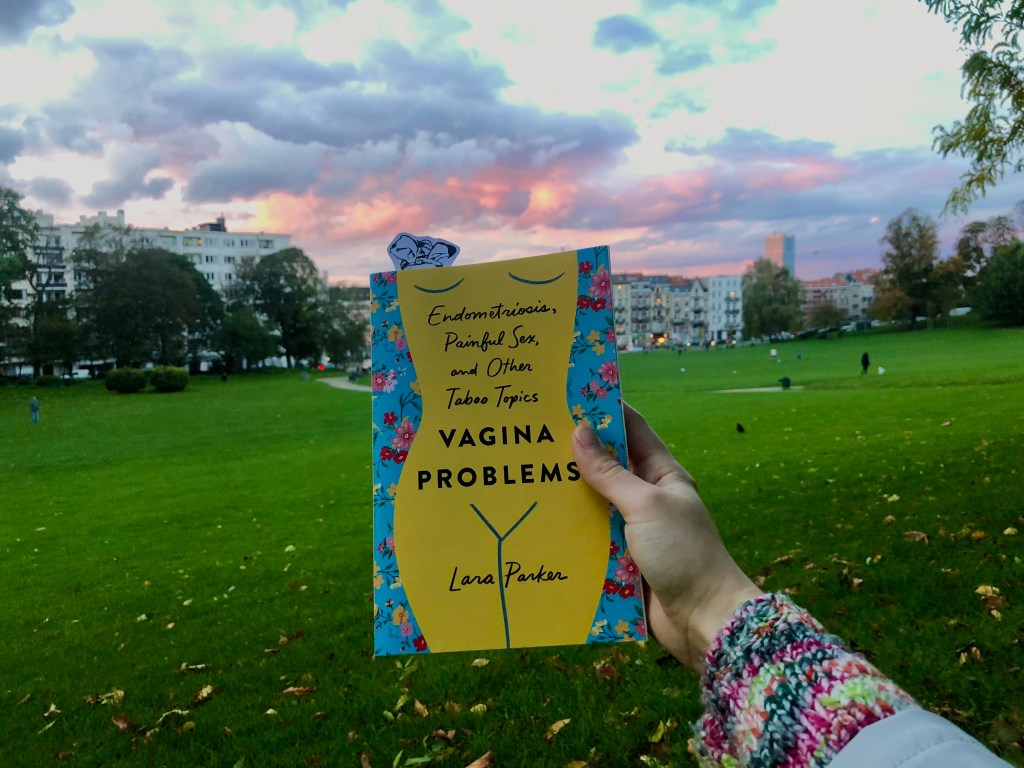
  • Reading Vagina Problems by Lara Parker

    Reading Vagina Problems by Lara Parker

    I love non-fiction – so much so that this blog is probably poorly named. Yet the book I’m going to write about in this blog was pretty difficult to read. It had nothing to do with the writing and a lot to do with the fact that it crossed the line from reading non-fiction to broaden my worldview to reading about my own reality. So while this is a blog about reading Lara Parker’s Vagina Problems: Endometriosis, painful sex and other taboo topics, it is not a review – the subject matter is far too close to home for me to be able to give an ounce of objectivity. 

    Vagina Problems was difficult to read because it made me think about things that I spent the best part of the last year trying not to think about. I’m not sure if it’s the Mirena coil or a perk of COVID-19 restrictions, but my symptoms have become increasingly unpredictable leading to multiple weeks of relative relief that I affectionately call ‘hormone holidays’. These weeks are by no means pain free but the pain is manageable, I can hike and concentrate and think about something other than pain. During these weeks, I again start to wonder if I no longer need to seek treatment for endometriosis, maybe it wasn’t ever that bad in the first place, maybe further intervention isn’t necessary. But Vagina Problems reminded me how much I continue to adapt my life around my own vagina problems. And how while it’s hard to remember pain after the fact, the moment it returns, it is totally life-disrupting. Every time I learn about an external factor that worsens my pain, like sex, running and now stress, I’ve been in the habit of removing that thing from my life. Unfortunately, removing stress isn’t an option and I’m sick of stripping away the good triggers. While I have come to terms with the fact that there probably isn’t a long-term solution to be found at present, it is still worth pursuing one, especially while I have the energy during these ‘holidays’. 

    “Hearing that voice inside my head that says, ‘You probably wouldn’t be in pain if you didn’t eat that cookie,’ and telling it to shut the fuck up. Because the truth is, I’d still be in pain. But I’d be in pain without experiencing the pleasure of eating a cookie. And that’s not the kind of life I want to have.”

    Lara Parker, Vagina Problems – p. 40

    Sometimes when I talk about the last year in Brussels, I frame the story as though endometriosis, vaginismus and pelvic floor dysfunction were the last of my worries, with Brexit, chickenpox and a sodding pandemic trumping the chronic problems. But as I anticipate moving house and watch a new housemate as she discovers the city, I realise that my pain is embedded in my experience of Brussels, my work and my house. “This is where I work,” I said as the metro pulled into the platform, “and that’s where I fainted a year ago… and that’s where I vomited once I came round.” Asked why I fainted, I shrugged and said “pain”. Every time I use my work toilets, I’m reminded of how many times I’ve been sick in them, how it’s one of the first places I experienced rectal bleeding, how often I found blood in that small room and was never entirely sure where it was coming from or why. And then there’s the house. That’s where I sat every Friday evening when I came home from work ill, just in time for the weekend. We used to laugh at it, that I was always unwell the moment the weekend started. It took a lockdown for me to piece together that my body starts to send me red flags to rest on Thursdays and that when I ignore them, something breaks the moment I relax. If this has been the good year for my symptoms, then maybe my gauge for goodness is a bit out of kilter. 

    “I start downplaying what’s going on, or backtracking on what I was trying to reveal … I feel the need to make others comfortable with a situation that I’m definitely not comfortable with.”

    Lara Parker, Vagina Problems – p. 131

    Also etched on this house are my failed attempts at dating again for the first time since my first laparoscopy several years ago. You can take Parker’s chapter on dating with endometriosis (titled ‘Hi, my vagina hurts, wanna date?’) and just staple it to my forehead so that people can read my thoughts. Perhaps it’s because we’re both white and date men, but it seems as though I’ve been on a very similar journey to Parker regarding pain, sex and communication. Like me, Parker’s pain during sex is not just limited to penetration or insertion, “just getting aroused can cause a shooting pain from my pelvic area throughout my entire body… it’s not exactly an aphrodisiac,” and like Parker, I’ve spent years fretting over when is a good time to break that news to a potential partner. I recently came to the same sucky conclusion as her: “I don’t think there’s ever going to feel like the right time because it will always feel like boiling-hot water burning your tongue after you spit it out”. And when that communication breaks down, or just doesn’t happen, sometimes it backfires and the other person comes across very, very badly. I’ve tried explaining this to friends and never found the words, but now I have Parker’s:

     “Maybe he was scared! Maybe I wasn’t communicating what the fuck was happening and not providing an opening for a conversation about it. He was confused, I am sure. And for that, I give him 12 percent of my sympathy. Because guess what? As confused as he might have been, so was I. And I was the one dealing with the actual fucking pain.”

    Lara Parker, Vagina Problems – p. 119

    When I think about my future in terms of treatment and any potential coupledom, I’m surprised to find them interlinked, after fighting against doctors’ assumptions of such a link for years. But they’re not linked in the way people always assumed. Let’s say I see this top doctor in Belgium and she is as skilled as the world says she is and she greatly improves my symptoms to the point that I can once again have an active and social personal life and have or even enjoy penetrative sex again? What if I entered a relationship after that point and my partner didn’t know what it took to get there – what if there even came a point where it was taken for granted because they didn’t know what a huge deal it was for me? Then on the other side, what if I see this doctor, and like the others that came before her, she can’t do anything for me? It’s hard to imagine having a functional relationship with someone who didn’t witness that process and know first hand that I didn’t chose the result. Although maybe that attitude is rooted in living in a world where women are rarely believed on testimony alone. 

    I am certain that these aren’t good reasons to start a relationship, and they’re definitely not reasons to have more surgery, yet one intense weekend reading Vagina Problems had me actively using a dating app and on a waiting list for a new gynaecologist after months of dithering on both. I’m still not sure if either of those things are good but somewhere in there, there’s hope. 

    You can follow Lara Parker on Instagram and buy her book here. At the moment she’s raising awareness about U.S. endometriosis experts who have donated to Trump’s campaign. I join her in saying that they cannot advocate for people with endometriosis when they are supporting racist and sexist policymaking. Doing so is to work directly against the patients they claim to care for. I encourage my U.S. readers (that’s 37% of you!) to cast your vote if you haven’t already and to know that a vote for Trump is a vote against pretty much everything good in this world, including access to safe healthcare. Elsewhere, the all party parliamentary group (APPG) report on Endometriosis has just been published – read it here

  • Different, not better: trying (and failing) to ignore my body

    Different, not better: trying (and failing) to ignore my body

    I have spent 12 months trying to ignore my body. My body has spent 12 months demonstrating how and why that is an impossible endeavour. This week it has been a year since I last published a blog and a year since I last (intentionally) sought medical intervention for endometriosis – happy birthday to my Mirena coil. 

    It’s been a big year, for me personally and for the world, and there’s been plenty to write about but for some reason I couldn’t bring myself to share any of it. I find it hard to express what stopped me but a read of Olivia Sudjic’s Exposure might enlighten you if you’re curious. The simplest explanation is that I didn’t want to. There’s also the fact that I have always tried to keep these blogs relatively positive in their outlook, and much of what I’ve been doing over the last year is coming to terms with the chronic element of endometriosis, a task that involves a significant distortion of optimism as you know it. Again, if you’re curious about how I began to think about that in a more positive light, I highly recommend reading Alison Kafer’s theorisation of crip time. 

    I’m sure as I slowly revive the blog I’ll fill you in on some of the things that have happened but here are the highlights: I graduated from my MSc in Gender and Sexuality, I moved to Brussels, Belgium where I’m still living and working a meaningful job that, refreshingly, doesn’t involve thinking about bodies all day. In many ways these three headlines are all connected to each other and to my attempt at ignoring my body. My MSc was, in the end, incredibly rewarding but it left me with a bit of a hangover. I spent last summer recovering from diagnostic surgery and a traumatic IUD insertion while writing a dissertation on the cultural backlash against hormonal contraception. The dissertation ended up being much more than that – really it was a manifesto for a hormonal feminism. Having been told not to intellectualise my health by an old therapist I did the exact opposite and while I would do the same again, I finally saw what the warning was about: I could no longer think about anything else. 

    So when I was offered a job in Belgium I grabbed the opportunity and saw it as a chance to find out what else I could think about. In many ways the plan was a success. Especially at the beginning, when I was hopeful that if I gave this new treatment a chance to work then maybe I might be able to forget about having endometriosis for a while. So I just ignored the old pains and the awful new ones that had arrived since I got the IUD. I ignored the fact that I hadn’t stopped bleeding for four months. I passed out from pain out on the metro and tried to ignore that too. I took a lot of painkillers and just kept waiting for the IUD to start working. I ignored the very obvious fact that ever since the coil insertion I had redeveloped vaginismus in a much more frightening way than before. I stopped tracking my bleeding or pain, and put every bad day behind me, trying not to notice how debilitating they were or how frequently they were coming. I would work all day and then return home exhausted to eat then sleep, sometimes taking a few moments to marvel at how my flatmates could work, exercise and have social lives. I tried dating again, and when I quickly realised that doing so would make me think about my body, pain and the fact that nothing had really changed, I promptly stopped. 

    Then in January 2020 I came down with the chickenpox at 24 years-old. As it took hold, I told myself it was all in my head, that everything I was feeling was imaginary. It was only when the blisters arrived that I began to believe my body and started to see how much impact the diagnostic process had on my mental health. There is nothing like an acute illness to make you dwell on a chronic one. It was horrible. Every medical intervention I’ve had has gradually chipped away any sense of sexiness I once had, and let me tell you, nothing will finish it off like chickenpox taking over your face and vulva. I wrote some very dark essays where I vowed to start listening to my body’s warning signs and then the files corrupted and I lost the motivation they captured along with the essays. I went for a mammoth hike and felt my body in a good way for the first time in months. It felt good to feel good and I tried to chase that feeling. 

    I finally stopped bleeding for the first time since the coil went in, only for blood to start emerging from new, scarier places. I ignored it. I noticed that I started bleeding after I ran for a bus or carried something heavy. So I stopped doing those things. Seeking good feelings and avoiding the bad ones seemed like a solid way to ignore my body in a slightly healthier way. And then a pandemic started.

    I talked myself out of my COVID symptoms, which were later confirmed by a positive antibody test. I used lockdown to redraft the novella I wrote in 2018 and while the process involved thinking about physical pain, it was easier than thinking about what I was going to do with the pain I felt now or that might get worse at any moment. My pain started to come back more frequently, in ways I could no longer ignore. My flatmates repeatedly implored me to call in sick to work. I again reverted to the logic of waiting until there was a ‘real’ reason, ignoring the fact that not resting immediately would probably cause that ‘real’ reason to arrive. When I bled I no longer reached for a menstrual cup. I finally acknowledged that the coil insertion was the last straw for my vagina: it had truly closed for business.  

    As lockdown began to ease in Belgium I went to see my GP. I had no intention of mentioning endometriosis, I just wanted a blood test and a repeat prescription. But she started to ask questions and I, reluctantly, answered them. ‘You can have surgery for endometriosis, you know?’, she said. I smiled politely and said I knew. After further probing I decided to give her the overview of what I had tried and where I was. She asked me what was next, did I want to seek treatment in Belgium? I didn’t want to seek treatment at all, doing so had only made things different, not better. She tells me I don’t have to suffer, that she knows Belgium’s sole endometriosis specialist personally, that I have options. I start to believe her. I’m not yet sure where that sits with my acceptance of crip time, but optimism is contagious and it was the driving force of this blog. It’s good to have a little back. It’s good to be back. 

    This summer I am taking part in Endometriosis UK’s #WalkForEndo. I will be doing eight 7.5km walks in solidarity with those still on the path to diagnosis, which takes 7.5 years on average in the UK. You can support my fundraising by sponsoring me here. Research suggests that racial biases in medicine, where endometriosis is often considered a white woman’s disease, lead to even longer delays in treatment and diagnosis for Black women. There is a wealth of literature that logs the wrongful presumption that Black women’s tolerance for pain is higher than others. It takes all of us to address these inequalities in healthcare and beyond and I urge all readers to confront them.