
“How do you review a contraceptive?” was a question I asked myself when Natural Cycles kindly sent me a six month trial of its certified* contraceptive app. I sure as hell wasn’t going to risk pregnancy for the sake of a blog, even if I had been having any sex in the first place. So the following review does nothing to attest as to whether the Natural Cycles app actually prevents pregnancy, but it does test the accuracy of the app against my own fertility awareness, that of other apps I use, namely Clue, and how it compares to hormonal contraceptives like the pill. I have now (sadly) restarted the pill, but the last five months of my hormone-free journey have been made so much more interesting thanks to Natural Cycles, it was the perfect way to say goodbye to my (literal) natural cycles.

It’s nothing like the pill…
… in that it’s non-hormonal, non-invasive and has no side affects. For those who don’t know, the app works by taking your Basal Body Temperature (BBT), which you measure yourself, to detect the rise in temperature that occurs around and after ovulation to estimate your fertile window. Whereas most contraceptives involve taking precaution 24/7 or with every sexual encounter, by knowing when your fertile, ideally you can gauge the (much longer) period of time when you’re infertile and have lots of barrier and/or pill-free sex during that time. With that in mind, the app gives you ‘green days’ (infertile, go bare-back if you wish!) and ‘red days’ (fertile, wrap it up). Since you don’t have to ingest anything or have anything injected or implanted into you, there are no side-affects, which is very attractive to lots of people with uteruses for obvious reasons.
Contrary to what a member of my family presumed, you take your temperature by sticking the thermometer in your mouth, NOT your vagina!
But it’s more like the pill than you would think…
… because it relies on you doing something at roughly the same time every day. What’s worse, it relies on you doing it first thing in the morning before you’ve done anything else at all, including but no limited to, getting up. If you happen to take the pill as you get out of bed, but one day forget until after you’ve brushed your teeth – it’s no biggy, but if you brush your teeth and only then remember to measure your temperature, then you have immediately compromised the reliability of the app and therefore your contraception. For someone like me – the very opposite of a morning person – this has been a challenge. I usually need an alarm on the other side of the room to get me out of bed, and while I’ve had alerts reminding me to take my temperature before my alarm goes off, it took a while to get consistent with measuring in the morning. In this sense Natural Cycles is a bit like the pill, skip a pill and risk fertility, skip a measurement and risk a green day when it ought to be red.
Do I have a drinking problem or is there an evolutionary flaw with the app?
There are a few circumstances when your temperature is considered unreliable. Getting out of bed before you measure being one of them. Basically, anything that messes with your BBT is no longer really your BBT and might wrongly detect ovulation – the app calls this a deviating temperature (naughty). Other triggers for a deviating temperature include having a lay-in (or any disruption to your usual sleeping pattern), being unwell or having a hangover. Now boozy nights have become much less frequent for me since I graduated, so I wasn’t worried about hangovers being a major hindrance to my experience with the app until it became clear that the only bloody time I was hungover was around ovulation.


The first couple of times I thought it was a fluke, but then it started happening every cycle – something about being fertile makes me DRINK. There are several explanations for this, but one that sticks out for me is that one of the behavioural changes that we experience around ovulation is that we go out and socialise – biologically, this is to find a mate, but socially in the twenty-first century, this often involves having an alcoholic beverage or thirteen. This is in no way Natural Cycles’ fault, honestly it could just be a coincidence with my own bad habits, but it disrupted four out of five fertile windows I had while trying the app. For this reason I personally wouldn’t recommend the app as a contraceptive to single people enjoying regular drunk stranger sex.

Throw an ovulation test in the mix – I dare you
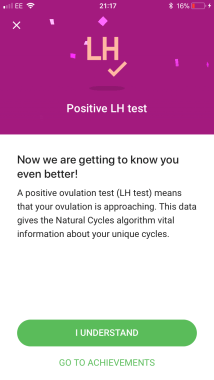
So once it was decided I was going back on the pill, albeit reluctantly, I wanted to really see what Natural Cycles could do in my final cycle using the app. When you input your temperature it gives you the option to add a positive or negative LH (Luteinising Hormone) test, a positive result means the hormone is surging and you’re about to ovulate. So with this in mind I started a five-test pack on the date recommended by both Natural Cycles and Clue. Five days passed and I only had negative results, as far as Clue was aware I was out of my fertile window and steaming towards PMS. Natural Cycles meanwhile was pulling the old “the ovulation symbol has disappeared for a while until we detect it” which is reassuring. So I bought another pack and continued for another five days… still nothing. This really made me panic, I’m going back on the pill to stop me ovulating – “WHAT IF I DON’T OVULATE AT ALL IN THE FIRST PLACE?” I thought, thinking I’d accidentally discovered my real problem. Another three tests later and I got a positive result on the twenty-third day of my cycle (I have no idea if that is normal and or healthy) BUT ANYWAY, low-and-behold my temperature did what Natural Cycles expected it to do after that and my pain moved in tandem with it – I think it successfully detected my ovulation – wahoo!
There were so few green days it almost wasn’t worth the fuss
Maybe it was because the app was still getting to know me or maybe it was because my ovaries are evidently dysfunctional, but red days have been the majority, making me think that if I were having sex, it would be a whole lot easier (and cheaper given the price one would normally pay for the app) to just use condoms all the time? I wouldn’t have to worry about getting out of bed too quickly, an issue that has never ever been an issue in my life before, nor having a hangover or a cold.
Uhm… my birth control isn’t a video game & other concerns
I’m all about making Femtech fun. There’s a pelvic floor exercise device and app that involves moving a butterfly by literally clenching your vagina – I think that’s brilliant (and hilarious), but if I’m trying not to get pregnant, that’s no joke and I don’t treat it as such. So the fact the app has “achievements” for users to unlock, i.e. it’s currently hounding me to become a “Pro Cycler” – I’ve only got three stars so far – isn’t very motivating to me. I get that they’re trying to encourage users to input as much data accurately and as often as possible, but for me it felt a bit like trivialising what is otherwise a very scientific app.
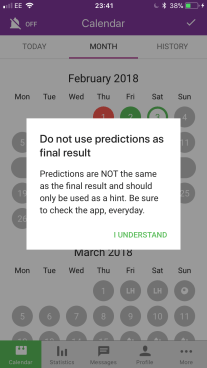
In the same vein of thought, I’m a little uncomfortable with how the app is advertised. “Wake up. Measure. Get Up” the slogan goes and upon setting up everything is said in such a positive, sales-pitchy way that the very serious warnings risk passing you by – like the fact if you have a reproductive issue like PCOS for example, it’s likely the app could interpret your data incorrectly – and anything that risks pregnancy is dangerous. There have also been concerns mentioned in the press and also at a number of Femtech events I’ve attended that the figures regarding the success of the app aren’t entirely reliable, you can read the company’s reaction to some of these issues in its press release here.
One other minor annoyance. Are we not done with blue periods and bizarre, unrealistic representations of women? Let’s just get one thing clear, at no point during my Natural Cycles experience did I wake up and measure looking like those featured on the app’s website. Can you possibly tell which one of these photos is the official Natural Cycles branding???


A step in the right direction
I’ve learnt a lot about my body and Femtech in the last few months using Natural Cycles. The hormone-free aspect of the app is incredibly appealing to me, but the fact remains that it relies on me too much, and I am not nearly reliable enough for it to work for me as a means of birth control. However, the app is, without a doubt, progress.
What would I like to see from Natural Cycles in the future if I were to use it again?
- No achievements to unlock or stars to gain, just pregnancies to achieve and avoid!
- An alert that wakes me up before the actual alarm set on my phone to remind me to take my temperature.
- A better interface for inputting data – it’s a bit too numerical and off-putting. (The graphics on Clue are much more welcoming, but Natural Cycles’ temperature graphs are waaaay easier to read than Clue’s.)*
- No BS about the risks. Say it how it is please!
*Same data as presented on Clue and Natural Cycles. While Clue is not a contraceptive app, I find it really hard to interpret its temperature graph, a problem I didn’t have with Natural Cycles.


 fictitiouslyhilary.com