The last couple of months have seen me finally achieve some sense of stability with pain management and general wellbeing. I’m able to exercise again, I’ve completed a round of psychosexual counselling and I’ve started a new chapter by beginning my masters in gender and sexuality studies at the LSE. But what do these changes mean for the #Periodically blogs? I’m not sure yet.
My challenges are by no means over, some of them I haven’t even considered addressing yet. But after having shared so much, I’ve been enjoying sharing a little less lately. Now I know what I’m like, I’ll write and post a blog saying I’m stepping back from #Periodically and a week later my oversharing side will kick back in, that’s what happened the last time I considered reigning things in.
Healthwise, I’m still facing new issues every month, but I’m finding it hard to tell whether things are connected or not or whether they’re just signs of life. And while I’m in considerably less pain, my acne is refusing to calm down and my body feels a bit like it’s beginning to override the pill (I have a horrible feeling about my next cycle, I hope I’m wrong!) I’ve reached the end of my journey with the urology department (I think) and it seems that despite my hunch, I’m all OK in that sense. Currently, I’m not in a frame of mind where I’m looking to open up another can of worms by investigating something else. This is a huge deal for me because it must mean that I’m doing something remarkable — I’m coping!
Despite being asked on the regs, I have no idea when I’m going to ‘get back out there’ romantically and sexually, but what I do know is that I have a lot to say about painful sex, vaginismus, female sexual dysfunction and sexuality in general, plus the effects all of these things have on your mental health and personal relationships. But I’m not quite ready to share them yet.
This is the bit of the story that I feel is missing from #Periodically at the moment, and it doesn’t really fit into the category #Periodically, does it? So I’m toying with the idea that when I’m ready (don’t hold your breath), these conversations will come under a new banner, or maybe in an entirely different format altogether.
So to repeat my earlier question, what’s next for #Periodically? I definitely want to cover a few more events and I would love to review a few more period products, but logistically I’m not menstruating regularly enough for that to work right now. (LOL, period logistics eh?!) I’ve been testing out the new release of Clue Plus and have some thoughts on that, so that’s to come, but most of all, I would really love to hear from #Periodically readers. You lovingly email and message me the nicest words of support, and now, if it’s not too much to ask, I would love to hear what blogs you’d like to read and what topics you’d like to see me cover. What’s more, if you want to write a guest blog for #Periodically, I am all ears! A) I want to broaden the experiences #Periodically covers and B) I have considerably less time for the blog at the moment, LSE is trying to suck all spare minutes out of my life…
BASICALLY, I’d like to hear from you, so if you have any blog ideas or a guest blog pitch for me, please get in touch, by Twitter, Instagram or email.
I had a different blog planned for this week but after a rather special evening on Friday I’ve had a change of heart. Today I want to talk about something I’ve only touched upon before – Vaginismus.
In #Periodically 18 – “Can I examine you?” – I spoke about how my gynaecologist had informed me that as well as the unidentified shit storm working its way through my womb that I had now also developed a “superficial problem” – vaginismus. But that’s the first and last time I mentioned it. Since then, I’ve turned the blog’s focus towards the hormonal adventure I’m going on in an attempt to resolve the internal issues. Given that #Periodically is a blog where I very graphically talk about the inner workings of my reproductive system, why did I stop talking about vaginismus? It was a diagnosis I was neither expecting nor knew much about, but when I started #Periodically I wrote, “I don’t want to write about it after the fact, because after the fact might not be for a long time. I want to write about it while it is happening.” The same is true for vaginismus, so let’s do that. Today I want to talk about vaginismus, what it is and how an evening with a group of extraordinary women at the Vaginismus Network completely transformed my feelings towards it.
Vaginismus is the uncontrollable clenching of muscles in and around the vagina upon penetration. It can be compared to shutting your eye if someone tries to stick something in it. It’s a reflex, a physical reaction and not one that you have any direct control over. Most of the time it results in penetration, whether that’s a finger, a cotton bud, a speculum or a penis, being impossible and/or incredibly painful.
The pelvic examination where my gynaecologist noticed I had vaginismus was painful and uncomfortable, more so than normal. When he said that I had vaginismus I was surprised because I don’t think it’s something I’ve regularly experienced during sex. I can think of one, maybe two occasions where I now think “oh, is that what was happening there?” It’s probably also relevant to note than this was nine months after I stopped having sex, for a variety of reasons, including the fact my deep dyspareunia (sex that hurts deep inside) was too much to handle, physically and otherwise.
This means I developed vaginismus after having had normal and healthy (sort of) penetrative sex in the past. On Friday, I learnt that there’s a word for this too – “secondary vaginismus”. Many who suffer from vaginismus have never been able to endure let alone enjoy penetration, going overdue for pap smears and not being able to use tampons – this is primary vaginismus.
My gynae gave me the news and said I would need therapy, physio and maybe anti-depressants. In reality he only referred me for therapy, which I started last week after a four month wait. I’m still not having sex but I have had the displeasure of noticing vaginismus on my own for the first time. Why? Menstrual cups! Just when I thought I had mastered them, something bloody well changed. There I was, cup in hand and sort of in vagina. As I tried to get it in place I experienced that horrendous, breathtaking pain for the first time since I last had an internal ultrasound or sex. I immediately removed the cup, steadied myself and caught my breath. When I tried again, lo-and-behold my vagina was closed for business. Rock solid and painful, nothing was getting in there. So it was nickers down, on the loo with a menstrual cup in one hand that I had my first personal encounter with vaginismus.
Like I said, I have only just started counselling, so I’m at the beginning of a weird “journey” to discover why my body is doing this and how I can stop it, but I personally think that what I’m displaying is “harm avoidance behaviour”. My vagina is closing to prevent further pain inside – it’s quite clever really. There are of course other reasons it could be happening, from the whiplash I’ve experienced from surgery to ultrasounds (all of which have involved something entering my poor vagina) to something I haven’t even realised yet. It does add a further complication to my situation though. As my GP(s) and I concentrate on finding a solution to the internal pain worsened by penetrative sex, I now have to deal with the very real possibility that if and when I next try to have sex, it might not be able to happen. Man, that’s piling a lot of pressure on any future relationships I may have!
I am lucky in so many ways. My vaginismus is secondary, meaning I know that sex can be a positive experience and that my vagina is, or at least once was, capable of opening. My vaginismus being secondary also means that I have a definitive time span in which to search for what changed to trigger my vaginismus. My vaginismus is apparently sporadic, or it only happens when there’s serious internal pain, meaning that most of the time I can use menstrual cups – tampons pose something of a different challenge, however. It’s likely that my vaginismus will be triggered by sex, but since I’m not currently dating or having sex it’s not a problem I have to deal with at the moment. I have time.
On Friday I attended the Vaginismus Network’s first meet up in London. I didn’t know what to expect when I walked into the Sh! Women’s Erotic Emporium, but what I found was a room full to the brim with brilliant women who happened to have vaginismus. For most people there, including me, it was their first time meeting others with vaginismus. What was really empowering about the event was that as united we were with the spasming of our vaginas, everyone was completely unique in their experience, not only of the condition but of life, work and relationships. Vaginismus can affect anyone with a vagina, it holds no prejudices. For some it’s easy to pin point what causes vaginismus, for others it’s easy to speculate (like me) and for a few there’s literally no obvious reason why it’s happening, which can make recovery all the more tedious and complicated. Founders Lisa and Kat have created something incredible. As you know, I attend my fair share of female health related events and talks, but this was different. It was like being at the start of a revolution. Some of the ideas being spitballed at the event could be game-changing. It’s certainly spurred me on with that “secret” project I’ve been working on lately.
— The Vaginismus Network (@TheVagNetwork) April 14, 2018
In my very limited experience with vaginismus, the impression I’ve so far got from discussions about it (with people who have no experience of the condition or even having a vagina) is that it’s a case of women needing to relax, to lighten up or to be less uptight. Holy moly it felt good to bitch about those judgements with people who really got it. And the truth is, now that a few of us know that we’re not alone in our thoughts on vaginismus, we know that we have to go out and talk about it – otherwise no one is ever going to understand, let alone start researching the damn thing. Friday night saw a barrier come down, so while our vaginas might not want to open, now at least we can open our mouths to talk about vaginismus.
My experience is new and manageable for the time being, but for many of the people I met on Friday, this is not the case. I am so grateful to have found a group like the Vaginismus Network so early on, imagine what could change if the same was true for everyone? A huge thank you to Lisa, Kat, the inspirational and hilarious psychosexual therapist Sarah Berry and the Sh! Women’s Erotic Emporium for creating such a safe, supportive and fun environment – you’ve already made a difference bigger than you know. Keep an eye on the Vaginismus Network – it’s one to watch for sure.
“How do you review a contraceptive?” was a question I asked myself when Natural Cycles kindly sent me a six month trial of its certified* contraceptive app. I sure as hell wasn’t going to risk pregnancy for the sake of a blog, even if I had been having any sex in the first place. So the following review does nothing to attest as to whether the Natural Cycles app actually prevents pregnancy, but it does test the accuracy of the app against my own fertility awareness, that of other apps I use, namely Clue, and how it compares to hormonal contraceptives like the pill. I have now (sadly) restarted the pill, but the last five months of my hormone-free journey have been made so much more interesting thanks to Natural Cycles, it was the perfect way to say goodbye to my (literal) natural cycles.
It’s nothing like the pill…
… in that it’s non-hormonal, non-invasive and has no side affects. For those who don’t know, the app works by taking your Basal Body Temperature (BBT), which you measure yourself, to detect the rise in temperature that occurs around and after ovulation to estimate your fertile window. Whereas most contraceptives involve taking precaution 24/7 or with every sexual encounter, by knowing when your fertile, ideally you can gauge the (much longer) period of time when you’re infertile and have lots of barrier and/or pill-free sex during that time. With that in mind, the app gives you ‘green days’ (infertile, go bare-back if you wish!) and ‘red days’ (fertile, wrap it up). Since you don’t have to ingest anything or have anything injected or implanted into you, there are no side-affects, which is very attractive to lots of people with uteruses for obvious reasons.
Contrary to what a member of my family presumed, you take your temperature by sticking the thermometer in your mouth, NOT your vagina!
But it’s more like the pill than you would think…
… because it relies on you doing something at roughly the same time every day. What’s worse, it relies on you doing it first thing in the morning before you’ve done anything else at all, including but no limited to, getting up. If you happen to take the pill as you get out of bed, but one day forget until after you’ve brushed your teeth – it’s no biggy, but if you brush your teeth and only then remember to measure your temperature, then you have immediately compromised the reliability of the app and therefore your contraception. For someone like me – the very opposite of a morning person – this has been a challenge. I usually need an alarm on the other side of the room to get me out of bed, and while I’ve had alerts reminding me to take my temperature before my alarm goes off, it took a while to get consistent with measuring in the morning. In this sense Natural Cycles is a bit like the pill, skip a pill and risk fertility, skip a measurement and risk a green day when it ought to be red.
Do I have a drinking problem or is there an evolutionary flaw with the app?
There are a few circumstances when your temperature is considered unreliable. Getting out of bed before you measure being one of them. Basically, anything that messes with your BBT is no longer really your BBT and might wrongly detect ovulation – the app calls this a deviating temperature (naughty). Other triggers for a deviating temperature include having a lay-in (or any disruption to your usual sleeping pattern), being unwell or having a hangover. Now boozy nights have become much less frequent for me since I graduated, so I wasn’t worried about hangovers being a major hindrance to my experience with the app until it became clear that the only bloody time I was hungover was around ovulation.
My hangovers (the green dots) as tracked in Clue
The first couple of times I thought it was a fluke, but then it started happening every cycle – something about being fertile makes me DRINK. There are several explanations for this, but one that sticks out for me is that one of the behavioural changes that we experience around ovulation is that we go out and socialise – biologically, this is to find a mate, but socially in the twenty-first century, this often involves having an alcoholic beverage or thirteen. This is in no way Natural Cycles’ fault, honestly it could just be a coincidence with my own bad habits, but it disrupted four out of five fertile windows I had while trying the app. For this reason I personally wouldn’t recommend the app as a contraceptive to single people enjoying regular drunk stranger sex.
Sure, it’s a fun game to play when you’re not having sex, but a risky one if you are
Throw an ovulation test in the mix – I dare you
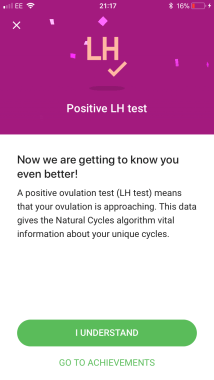
So once it was decided I was going back on the pill, albeit reluctantly, I wanted to really see what Natural Cycles could do in my final cycle using the app. When you input your temperature it gives you the option to add a positive or negative LH (Luteinising Hormone) test, a positive result means the hormone is surging and you’re about to ovulate. So with this in mind I started a five-test pack on the date recommended by both Natural Cycles and Clue. Five days passed and I only had negative results, as far as Clue was aware I was out of my fertile window and steaming towards PMS. Natural Cycles meanwhile was pulling the old “the ovulation symbol has disappeared for a while until we detect it” which is reassuring. So I bought another pack and continued for another five days… still nothing. This really made me panic, I’m going back on the pill to stop me ovulating – “WHAT IF I DON’T OVULATE AT ALL IN THE FIRST PLACE?” I thought, thinking I’d accidentally discovered my real problem. Another three tests later and I got a positive result on the twenty-third day of my cycle (I have no idea if that is normal and or healthy) BUT ANYWAY, low-and-behold my temperature did what Natural Cycles expected it to do after that and my pain moved in tandem with it – I think it successfully detected my ovulation – wahoo!
There were so few green days it almost wasn’t worth the fuss
Maybe it was because the app was still getting to know me or maybe it was because my ovaries are evidently dysfunctional, but red days have been the majority, making me think that if I were having sex, it would be a whole lot easier (and cheaper given the price one would normally pay for the app) to just use condoms all the time? I wouldn’t have to worry about getting out of bed too quickly, an issue that has never ever been an issue in my life before, nor having a hangover or a cold.
Uhm… my birth control isn’t a video game & other concerns
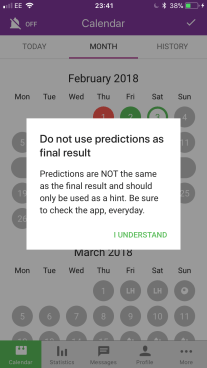
I’m all about making Femtech fun. There’s a pelvic floor exercise device and app that involves moving a butterfly by literally clenching your vagina – I think that’s brilliant (and hilarious), but if I’m trying not to get pregnant, that’s no joke and I don’t treat it as such. So the fact the app has “achievements” for users to unlock, i.e. it’s currently hounding me to become a “Pro Cycler” – I’ve only got three stars so far – isn’t very motivating to me. I get that they’re trying to encourage users to input as much data accurately and as often as possible, but for me it felt a bit like trivialising what is otherwise a very scientific app.
In the same vein of thought, I’m a little uncomfortable with how the app is advertised. “Wake up. Measure. Get Up” the slogan goes and upon setting up everything is said in such a positive, sales-pitchy way that the very serious warnings risk passing you by – like the fact if you have a reproductive issue like PCOS for example, it’s likely the app could interpret your data incorrectly – and anything that risks pregnancy is dangerous. There have also been concerns mentioned in the press and also at a number of Femtech events I’ve attended that the figures regarding the success of the app aren’t entirely reliable, you can read the company’s reaction to some of these issues in its press release here.
One other minor annoyance. Are we not done with blue periods and bizarre, unrealistic representations of women? Let’s just get one thing clear, at no point during my Natural Cycles experience did I wake up and measure looking like those featured on the app’s website. Can you possibly tell which one of these photos is the official Natural Cycles branding???
Case and point…
A step in the right direction
I’ve learnt a lot about my body and Femtech in the last few months using Natural Cycles. The hormone-free aspect of the app is incredibly appealing to me, but the fact remains that it relies on me too much, and I am not nearly reliable enough for it to work for me as a means of birth control. However, the app is, without a doubt, progress.
What would I like to see from Natural Cycles in the future if I were to use it again?
No achievements to unlock or stars to gain, just pregnancies to achieve and avoid!
An alert that wakes me up before the actual alarm set on my phone to remind me to take my temperature.
A better interface for inputting data – it’s a bit too numerical and off-putting. (The graphics on Clue are much more welcoming, but Natural Cycles’ temperature graphs are waaaay easier to read than Clue’s.)*
No BS about the risks. Say it how it is please!
*Same data as presented on Clue and Natural Cycles. While Clue is not a contraceptive app, I find it really hard to interpret its temperature graph, a problem I didn’t have with Natural Cycles.




 fictitiouslyhilary.com