Tag: #SaveOurNHS

  • Going digital: pelvic physio & biofeedback | Pleasure Moans #4

    Going digital: pelvic physio & biofeedback | Pleasure Moans #4

    Thank you so much for all the love following my last Pleasure Moans blog and the guest post I wrote for Hysterical Women about finally being diagnosed with endometriosis. If you haven’t read it yet, check it out here

    When I first started writing about investigating my gynae health I wrote, ‘I don’t want to write about it after the fact, because after the fact might not be for a long time.’ Well, it’s a good job I took that attitude because since I got the endometriosis diagnosis in April I’ve been absolutely useless at writing about it, or at least sharing what I have written about it. This is particularly stupid because after so much nonsense I finally seem to be getting somewhere. A positive blog, at last!
    I’m in the middle of (another) Gilmore Girls binge so bare with the GG gifs.

    Two big things have happened since I shared the news of what was then a tentative diagnosis. Firstly, I had the post-op where my gynaecologist put to bed any fears that it still wasn’t really an answer by explaining that I have stage 1 endometriosis, freckled in tiny dots mostly on one side of my uterus/recto-uterine pouch. I even saw pictures (which I won’t share, but don’t worry there’s plenty of oversharing coming up). He continued to relieve my doubt by explaining how low stage endometriosis is sometimes (but obviously not always) more painful or as painful as high grade endometriosis because of where it sits: on the nerve layer. To try and stop it getting worse I am getting a Mirena coil (IUS) fitted at some point this summer – I have a lot of thoughts on this which I’ll share another time in a #Periodically blog.

    The second thing is that I’ve started pelvic physiotherapy. My symptoms of painful sex are explainable by the fact that endometriosis was found in my recto-uterine pouch but a few doctors I’ve seen have suggested that there also appears to be some pelvic floor dysfunction kicking about, hence why I was referred to a women’s health physio. Without a shadow of a doubt, this has been the most positive, interesting, logical and, dare I say it, empowering, part of my medical path so far and a reminder of why the NHS is so bloody brilliant.

    My first appointment was almost an hour long and for good reason. My physio took 50 minutes getting to know me, my medical history and my experience of pain, before a 10 minute pelvic examination. What this meant was that during the verbal consultation we hashed out a hypothesis: that pain, likely caused by endometriosis, had caused the muscles around the top of my vagina to go into spasm creating yet more pain and what feels like a bottleneck in my vagina, explaining why my primary issue is deep pain rather than ‘superficial’ pain. The pelvic examination, which involved gripping my physio’s finger with my fanny (no way to make that sound any less weird), confirmed her suspicions and then some. It seems that the upper part of my pelvic floor is not just in spasm upon penetration, but all the damn time.

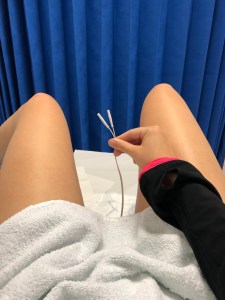
    Turns out, this isn’t an all too common occurrence and so my treatment plan is a bit experimental at the moment but the point is: there is a plan! The plan is biofeedback. It sounds cool because it is. It involves putting a small probe (yep) in my vagina, which is wired up to a monitor that allows me to see and hear my muscle activity. In pelvic physio it’s mostly used to strengthen muscles to improve bladder and bowl function but in my case I’m using it to try and learn how to relax the muscles involved.
    img_8827
    Nothing says ‘relax your vagina’ better than the horror of wires coming out of it…

    It’s a weird thing, because it doesn’t actually do anything to you but it enables you to understand how your muscles are working and what control you have over them in a way that is otherwise impossible. It’s really easy to understand too. Once it was in (I insert and remove it myself to save some awkwardness) my physio asked me to clench/pull up/engage my vagina and the number (microvolts) went up. The issue was that my number didn’t descend low enough when I relaxed. I’ve been doing to this for a couple of sessions now and while I can make the number jump down low, I can’t get it to stay there – so that’s what we’re working on. I’ve posted a video of the unit in action on my Instagram story/highlights if anyone’s interested in seeing how it communicates with you.


    There’s a range of verbal cues used to help someone relax their pelvic floor that of course don’t seem to do anything for me, so it’s a case of trying a bit of everything to find something that works. And for once, I’m actually really hopeful that I will.

    You’d think I’d be used to oversharing by now but believe it or not taboos run deep and I’m still conditioned in ways that made me hesitate about posting this blog, let alone illustrating it. But in my experience personal accounts of deep dyspareunia are few and far between, especially treating/easing that pain, and so it feels important share this story, including pictures of my cyber fanny, just in case it’s of any hope or help to someone else.

    If you’ve tried biofeedback or pelvic physio, for painful sex or something else, and have tips and tricks about how I can get the most out of it please get in touch – I also finally made a Facebook page for the blog so give that a like if you’re feeling friendly! In the mean time, I’m going to keep trying to interpret my vagina’s microvolts… 


  • “While you’re unconscious…” | Pleasure Moans #2

    “While you’re unconscious…” | Pleasure Moans #2

    There I was, sitting in the waiting room of my community hospital trying to read Papillion. I say trying because I was very distracted. It was my last week of term, I was, as I made clear in my last post, absolutely pooped. But more distracting than any of the assignments, deadlines and very real desire to finish Papillion was my concern for what was going to happen when I saw the gynaecologist.

    As discussed in the last blog, the impending appointment pushed me to take action for the first time in a few months. But until the night before I hadn’t actually given the appointment itself much thought. True to form, once I did I completely freaked myself out. Doing all the period, pain and penetration maths in my head I had come to the conclusion that my gynaecologist was going to want to do another diagnostic laparoscopy – keyhole surgery to look for endometriosis.

    Image result for algebra meme gif
    Me doing the period, pain and penetration maths

    How had I come to this conclusion? Because that’s the only other thing my local NHS has to offer, other than antidepressants, which I tried but weren’t for me. But also because since I started with this new gynae he hadn’t been convinced by the laparoscopy I had in Swansea back in 2017, but from what I could understand, the only reason for doubt was that he hadn’t performed it himself.

    Anyway, I was right. But not for the reasons I’d anticipated. He suggested antidepressants again, which I declined. So then he suggested something I didn’t even know was a thing. He wanted to examine me under anesthesia, since it’s hard to really get a good look at my innards with so much pain kicking about. And then… well, then this conversation happened:

    Dr: So when I do the examination under anaesthesia, I can stretch the vagina and see if that helps.
    Me: Sorry, stretch my what?
    Dr: Vagina
    Me: With what?
    Dr: What do you mean?
    Me: What would stretch my vagina with? 
    Dr: My hands.
    Me: ..
    Me: And what’s that… procedure… called? 
    Dr: Oh it doesn’t have a name. It’s just part of ‘examination under anaesthesia.’ 
    Me:
    Dr: And while you’re unconscious we might as well do another laparoscopy just to have a look around. 

    The more I think about this conversation the funnier/more ridiculous it seems. I was flabbergasted but this is the coolest and most collected I’ve ever been in an appointment like this, I asked loads of follow up questions, aired my doubts and concerns and he heard them all out and answered them as best he could. Many of my concerns were, are even, small little things, but when I look at the bigger picture holistically, these things add up. For example, the irony is not lost on me that in the process of trying to have pain free sex I’ve made myself feel incredibly unsexy – a resurgence of acne, surgical wounds that scarred weirdly, taking a drug that in the past has reduced my libido but in the present has given me erratic mood swings that I have to actively intervene to control. All pretty minor things, but when I consider what the point of all this is, which hasn’t been reached, I have to ask myself what price I’m willing to pay to get answers. My belly button’s starting to look normal again, do I really want to start from the beginning again?

    The other thing, that’s slightly bigger, is that having diagnostic surgery and not getting a diagnosis is a very surreal and difficult thing to process. Surgery and the recovery from it are painful – which is just so frustrating when it hasn’t done anything to help the underlying pain. I’ve tried and failed several times on the #Periodically blogs, but it’s a really difficult thing to articulate. You cause yourself additional pain and duress only to be told ‘there’s nothing wrong.’ That’s not a feeling I enjoy remembering and I don’t particularly want to experience it again.

    If I’m going to have another laparoscopy, I need a better reason that already being unconscious.

    But, this is the NHS in 2019 so if I say no and then find a better reason then in all likelihood it would take me a year to get to this point again. So I’m on the waiting list, mulling it over, very aware and reassured that I can withdraw my name from the waiting list at any point.

    I’ve sought counsel from just about everyone on this. Friends, family, my GP, support groups, random strangers on the Internet, academics and a brill gynaecologist I have the good fortune of knowing (thank you!) And all of their concerns echoed mine – there’s got to be a better reason to do another laparoscopy. I should also add, there were lots of raised eyebrows about the idea of having my vagina stretched. Worryingly, I can’t find any information about this having been done to anyone else, and given I apparently have a certain psychosexual vulnerability, it sounds like a stretching might do more harm than good.

    So I’m in the process of trying to get a second opinion from a London gynaecologist, which, while possible, is proving to be more complicated than me and my GP first thought. London hospitals are more likely to do more detailed/thorough scans (MRIs & ultrasounds by gyanes rather than radiologists) to check if there are any signs of endometriosis before surgical intervention. Unfortunately the wires have been crossed in my referral letter and I’ve been referred to a vulvology specialist, which is not what I want at all, but my doctor’s surgery have submitted the referral despite my protests and have said I have to talk to my GP if I want to alter it, which is fine, except my GP is booked up for the next month, meaning the referral I don’t want is likely to be processed in that time. It’s just a massive waste of time and money for everyone which is the last thing I want to do. As always, the admin side of this is really hard work and puts irritating little voices in your head that ask ‘is this stress really worth it?’ The jury’s still out. 

    I did not think we would be back at the ‘e‘ word, and I’m nervous about going down that path again. But November’s news that a special NHS report had found that there was ‘a demonstrable lack of understanding’ of endometriosis among Welsh health care providers (I had my first lap in Wales) has made me wonder whether double checking is a good idea after all.

    I change my mind every day about what I would do if my gynae’s office called me and told me I could have the laparoscopy tomorrow. Today I would say no, but ask me when I’m in more pain and I might say yes.

    Since I might be going back down the endometriosis route, you might be wondering why I decided to move this story over into Pleasure Moans and away from Periodically. I’ve been thinking a lot, academically and personally, about the interrelation and separation of sexual and reproductive health lately. This ‘situation’ is obviously both. But it’s also not. I am very aware that to get help faster I only have to rephrase what I’m saying to my doctors about my sexual health to make it about my reproductive health. My aims are to be able to have and enjoy sex again and to be in less pain day-to-day. In my current reality, this has very little to do with reproduction. For others, it’s a totally different situation with the same symptoms and goals. Plus, it may be that this is easier to say now that I’ve settled some of my menstrual issues. It’s complicated stuff, but the way we talk about it makes a huge difference to patient experience, and so this is how I’m choosing to tell this part of my story from now and for now.

    Thank you for all the encouragement about making this change. It’s been on my mind for a while and I’m feeling good about it! 


  • The pill & my face #Periodically 31

    The pill & my face #Periodically 31

    Here’s a blog I didn’t want to write but that’s been itching to get out for a couple of months. It’s about a problem I didn’t realise the extent of until the worst had passed, so keep in mind that this story has a slightly happier ending than most of my blogs!

    A Skin Thing

    I have never had particularly ‘good’ skin — that is to say since puberty I have always had some acne. But it was completely synced to my menstrual cycle and, while annoying, it was totally manageable. The only time it got a little out of hand was around exam periods, which was always perfect considering exams are nearly always rounded off with a prom or a summer ball. But that was as bad as it got. When I was on the pill in the past I noticed changes but never anything drastic, other than that it was much better when I finally came off all hormonal birth control in 2015, by which point I was 20 and thought maybe I was just beginning to grow out of it.

    When I went back on the combined pill in February of this year I was prepared for a little skin turbulence. I knew that while things were settling it was likely to get worse, but I also knew that the general rule preached by my doctors and countless anecdotal stories was that my acne was likely to improve on the pill. At the time, it felt like the only silver lining of selling my pill-free self to the hormone gods.

    What I didn’t expect was that when things did eventually settle on the pill that my face would be taken hostage by what my doctors were by now calling “adult acne.” Oh good, not only am I spotty but I’m also out of the designated spotty age bracket!

    skin3

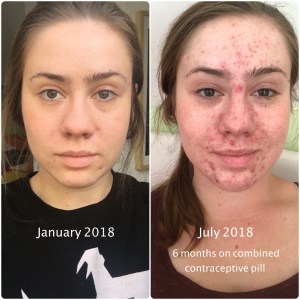
    The irony is that I took the “before” shot thinking “my skin is going to get so much better!” A classic case of you don’t know what you’ve got ’til it’s gone… 

    My GP immediately said, “that’s unusual, it usually gets better,” and my gynae said, “that shouldn’t happen.” We literally watched my face get worse and worse the longer I took the pill — it was like an accumulative allergic reaction. This was the only visual sign I had of my “improving” health, which didn’t make things feel all that improved — shocker! “If it’s not supposed to do this then surely it’s a sign that there is some kind of hormonal imbalance in my body?” I asked my doctors. They both agreed but said there was no point investigating it because “we know so little about hormones that even if an endocrinologist did spot an anomaly we wouldn’t know what to do with that data.” Which, while completely true, didn’t make me feel much better.

    Remember how a few months ago I said, “it’s a bummer but acne is something I am well-used to dealing with, and I’ll take it over pain any day“? I don’t necessarily take that back, but when your pain hardly improves and your acne just descends into total chaos it’s hard to take it on the chin (very literally). To add insult to injury, the blistering hot summer we just had meant that 30 million freckles also descended on my face (regardless of how much SPF I put on). I just felt and looked like a bit of a mess. No wonder I started taking Bookstagram so seriously, I was hardly likely to be posting summer selfies. In fact, I now realise that I was cutting my face out of Bookstagrams to hide the acne, case and point:


    (Remember kids, Instagram is a web of lies!)

    Funnily enough, this did not help my mood, which was already being tormented by raging mood swings and rampant PMS. I’m pretty good at hiding acne with makeup but it was so painful that I didn’t want to touch it. I like to think of myself as pretty skin-positive (I love everything Em Ford does for the movement!) but I really avoided leaving the house or wearing makeup unless I absolutely had to. Dyspareunia and vaginismus aren’t exactly conditions that make one feel particularly sexy, throw some angry acne into the mix and it understandable results in a slight crisis of confidence.

    However, I’m not beating myself up about that too much. I did eventually think, “stuff it, I don’t have to look at my face when I’m out, that’s the rest of the world’s problem.” But it’s not great when you do finally leave the house, spots-and-all, and are then bombarded with well-meaning people telling you to “drink more water” or “try this horrifically expensive product.” And when you dare say that you chug water by the gallon or that you can’t afford this particular product then somehow it becomes your own fault — you’re not trying hard enough and therefore you want your skin to be bad… Um, sod off?

    There’s no doubt in my mind that there are dietary changes and some products that genuinely help some kinds of acne. Hell, I’ve tried lots of them, but given how quickly and aggressively this came on it felt so obvious to me, and my doctors, that it was hormonal. Personally, changes to my diet have never made a difference to my skin, but I think acne is nearly always a case-by-case, individual issue and unsolicited advice about it, for me at least, is always unwanted.

    A little bit of this and a little bit of that…

    As promised this story has a happy-ish ending. My GP and gynae both suggested that the pill was more likely to reduce my pain if I skipped periods. This meant I would take two or three pill packets back-to-back without a withdrawal bleed. When I eventually gave it a try my mood improved in a matter of days and everything else followed. I had no idea it would make such a big difference but it really did. Around this time I also started using prescribed Adapalene gel and taking Evening Primrose Oil. Whether it’s one of these treatments or a combination of all three, the last two+ months have seen a drastic improvement in my acne, mood and (fanfare please) pain! (Typically, three days after I penned this blog things got a little worse again, but overall things are definitely better!)

    skin7

    What now?

    It’s getting better as the scarring goes down and the further away I am from my last withdrawal bleed the better my skin is, but considering going on the pill was a last-resort solution for my pain, this skin journey doesn’t exactly feel like a triumph. The last few months have mostly been about treating problems that the pill caused. As mentioned, I have finally noticed an improvement in my pelvic pain but I would be lying if I said I don’t worry about what happens to that progress if and when I have sex or come off the pill. Long-term readers won’t be surprised to hear that staying on the pill for the rest of my ‘reproductive life’ isn’t my plan of choice.

    Why didn’t I want to write this blog? Because I didn’t want to start moaning about something else. So many of my friends have struggled with their skin for years, dealing with Roaccutane and its complications. Eight months of bad skin hardly feels worth complaining about in that respect. But I had no idea that the pill could have this effect — so that’s something I’m keen to share and leaving it out of these blogs felt a little dishonest.

    Love the skin you’re in, unless it bloody well hurts, in which case: seek medical intervention… Thanks for reading!