Tag: Research

  • History in Context: From hating history to, well what exactly?

    History in Context: From hating history to, well what exactly?

    I despised history lessons when I was at school. For the most part, it was limited to British history and I was more interested in the rest of the world. For the other part, I took the attitude ‘why are we focussing on the past?’ or, as the SSX Tricky character would yell, ‘the past is gone, now is all there is!’ Of course every right minded person, usually my dad, would fire back with ‘you have to learn about the past to stop us from making the same mistakes’. From where I was sitting, however, humankind kept making even worse mistakes than those I learnt about in history class, so it couldn’t be that effective. Tired of this age-old philosophical argument, I instead just decided to adopt the easier excuse; that I thought history was boring (of course that only pissed off people (my dad) tenfold).

    The moment I didn’t have to study history I stopped, or at least, I thought I had. In fact I found I got sort of a thrill out of how irritated saying I ‘hated’ history made people. While I was done with history, history it seemed, was not done with me.

    I remember the moment, in A Level English where my teacher Miss O’Neil, started talking about how the character of Serena Joy in Margaret Atwood’s The Handmaid’s Tale was based on a real woman, Phyllis Schlafly, from the age of Thatcher and Reagan. ‘It’s context like this that will really push your grade up in your coursework’. I remember thinking, ‘cool, what is this mysterious context business?’ like it was a new found entity. I plodded my way through A Level revelling in the moments where I got to bring in context or even ‘cultural context’ to explain why a novel was written a certain way, or the parallels that could be drawn between the book and the ‘real world’.

    Then I got to university and something truly horrible happened. In our first and only compulsory module (that didn’t go well for me for other reasons) Monsters and Transformations, the slide show in the introductory lecture paired the words ‘history’ and ‘context’ together. Historical context? What is that supposed to mean? As the module progressed I began to become more and more suspicious that historical context might actually be the same damn thing as context. You can imagine my horror, in learning that one of my favourite parts about my chosen subject was actually rooted, in its entirety, in my least favourite subject.

    Eventually I accepted it. In fact, I started to really enjoy it. I even opted in for French modules our lecturers called ‘cultural modules,’ that I now realise were often European and French history classes. When my sister finally agreed to read Harry Potter last year she said it was under the condition I read something with history in it, and gave me Captain Corelli’s Mandolin. Did I still think history was boring? Did I really never read historical novels, I asked?

    I loved The Handmaid’s Tale and that was packed full of historical context, as was Nineteen Eighty-Four which I studied alongside it. The same was true with The Scarlett Letter and King Lear. Even biblical books like Impossible Saints drew me in (questionable re: history, though) and hell, my dissertation was packed full of context of the 1960s and 70s, if that counts as historical yet. OK so maybe I like historical novels, but not ones about war? Nope that wasn’t it. Milan Kundera’s The Unbearable Lightness of Being led me to read Anna Karenina, which set me on a path to War and Peace and The Kossacks. To my horror, I’d become a Tolstoy fan, which meant that war clearly wasn’t the problem. In these French cultural modules we studied art, literature and film in context, meaning we would explore cultural artefacts from one specific period or place, and I loved it. When Les Misérables was made into a film, I loved that even more and read A Tale of Two Cities (even though I would quickly learn that it was about a different French Revolution).

    Last month I finally read Captain Corelli’s Mandolin, and surprise to no one, I really enjoyed it (except the ending, don’t get me started). The entire time I was reading though it I was thinking, am I over my hatred of history? Last month I went to the Imperial War museum, it was certainly heavy in content but boring it was not. I’ve been to Anne Frank’s house, I wasn’t bored, insensitive or uninterested. If I went back to school now to study history, would I still be distraught with boredom?

    Honestly? Yes. Sitting down and learning about history is not how my brain processes the past. I need history in context. Learning about the past for past’s sake doesn’t fire me up, I need human stories to realise it. The worst parts of history don’t hit home until you understand the impact they had on someone’s life. Take Captain Corelli for example, before I read it I had no idea of Italy, Greece or the Ionian Islands’ involvement in World War II. The novel only gives you four or five perspectives and of course there are so many more, but really understanding how transformative one event can be on one person’s life, gives you a crazy amount of perspective when you zoom out and think about how many different lives were effected by the same event. Even the best events from history, like the sexual revolution, they’re no good without the personal stories. When I’m reading a novel with a real context, I find myself googling and reading simultaneously, and for some years now, that’s how I’ve learnt to enjoy learning about history.

    Last week I had the extraordinary opportunity to hear Margaret Atwood speak at New Scientist Live. Known for her science and speculative fiction, often set in dystopian futures, I always associated her work with the future. She talked about how she couldn’t have predicted how relevant her novels would have become, given the election of Trump and its effects of reproductive rights and the environment. Talking about how his election ‘framed’ the Hulu adaptation of The Handmaid’s Tale, Atwood said how if Hillary Clinton had been elected the show would have been the same but it would have been viewed differently. “Even if you’re writing a historical novel, you’re still writing about now,” she said. This was after I’d written this blog but I had to come back and add that quote in. I think it would be equally true to say “even if you’re reading a historical novel, you’re still reading about now”.

    That’s what I’ve learnt from historical novels. History is relevant and interesting and not boring because it’s always, however subtly, applicable to the current world. So if you ever hear a kid saying they don’t like history, I strongly recommend giving them a good book. Because any good book tells a story about a place, a people and a time and historical context is just part of that. (Hey that’s sounds like Christian in Moulin Rouge, another example of history sneaking into my world without me knowing).

    IMG_7229
    Thank you Margaret Atwood, for putting this blog in context
  • Recovery & do I Regret Having the Laparoscopy? #Periodically 12

    Recovery & do I Regret Having the Laparoscopy? #Periodically 12

    I am now over three weeks post-laparoscopy. I’ve started working, from home happily, and I could be doing a lot worse. But for the sake of record, I thought I better write about how everything’s healing up.

    Badly, is the answer.

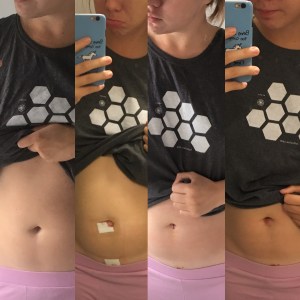
    In my blog about the surgery itself I included this picture of my stomach’s ‘transformation’.

    FullSizeRender

    Unfortunately, I think shared my before and after photos a little prematurely. Ten days after the surgery my belly button, for want of a less disgusting word, exploded. Quite literally. But it was a bank holiday weekend and we were on the way to a party, so I slapped on a plaster and carried on. Towards the end of the party my belly button was so incredibly itchy, and as I changed the plaster I discovered the explosion had continued. Hoping it would go away I stuck another plaster on and continued with my life.

    IMG_6856
    I’ll spare you the close up, the live show made my sister gag, #sexy, but here’s how much worse it is from two days post-op.

    The Tuesday after the bank holiday I decided it was looking too suspicious and so I went to see a nurse at my new/old GP. She poked it a bit and said it wasn’t infected, covered it with an iodine gauze and said don’t shower or take the plaster off until I see you on Friday.

    Friday rolls around slowly with a lot of itching, moaning and stinging. When the nurse and the doctor remove the plaster, hoping to see a nice, dried up wound, they instead find three blisters where the lower half of the wound had been. ‘Huh, I’ve never seen that before’ is yet another thing I had never hoped to hear about my body.

    Still not convinced that this new mass growing out of me, like something from Alien, was infected, the doctor umed and ahed before saying ‘it’s the weekend – give her some antibiotics’. So the weekend went by with me being pumped full of penicillin, taking awkward half body showers, all while the delightful wound continued to blister and get redder and angrier.

    Another Tuesday later I’m back at the doctors being inspected and prodded. Still not thinking its infected, the doctor concluded it must be some sort of ‘skin reaction’ and so then I was prescribed Fucidin H (an antibiotic + steroid combo) to rub on this, the world’s most disgusting wound. During this appointment the doctor asked about my pain and pushed on my abdomen. Since my files haven’t correctly transferred from Swansea, trying to explain ‘yes it hurts but it often hurts anyway’ was a little longwinded.

    As I write this I’ve returned from the doctors again where this time two doctors had a gander. It looks like I have hyperkeratosis, meaning that the skin is out overgrowing itself. The result is that I might have a bit more of a scar than expected.

    SO THE PHYSICAL RECOVERY IS GOING GREAT. Anything too strenuous still hurts, jumping and such, and long walks conjure up some stomach pain on top of the preexisting pelvic pain so that’s nice. Meanwhile the other wound is acting quite proper and is healing up nicely. An actual nice surprise was that my cycle hasn’t been effected by the surgery at all. My period came rather promptly and behaved fairly normally.

    Given the increasingly bizarre situation of my belly button my mum said to me the other day ‘I wish you’d never had this laparoscopy’. I’ve been mulling that sentence over for a few days now. Do I regret having the surgery? After all, it didn’t find the cause of my pain and it has temporarily deformed and possibly permanently scared my abdomen.

    I can’t bring myself to regret having the surgery. Firstly, it was never really a choice. I was handed from doctor to doctor and they said ‘hey next step is surgery’ and I said ‘hey OK’. It was never an active decision, it was medical practice and advice. Every single one of my symptoms points, or pointed, towards my reproductive health. Checking my uterus out surgically when an ultrasound had displayed nothing, was the next logical step. In fact at that point in time, it was the only step. Now that we know my reproductive health is in tip top condition, we can re-giggle my symptoms and look at my body in a ‘well we know it’s not that so could it be…’ kind of way. The final reason is that to wish I’d never had the surgery achieves literally nothing. I’ve had it, it happened, we know what we know. I wish I knew more, but I don’t BUT I will. Of course it’s frustrating, but powering on is the only fruitful attitude to have.

    Besides, no one ever really saw my belly button anyway – I’ve never been one for crop tops.

  • An attempt at not forgetting 17 years of French

    An attempt at not forgetting 17 years of French

    It has been three months since I finished my degree! What! While I’ve always been good at keeping up with the literature side of my degree, the French side can be a little harder to slot into everyday life (without moving to France that is, believe me – I’m trying). I was reading at least one French novel a month up until June, but since then things have been a bit crazy and my English To Be Read pile has been much larger than my French TBRs.

    It hit me today, scrolling through Twitter. There was a Tweet by French President Emmanuel Macron that I read and processed and then I continued to scroll. Wait, I just read and understood a tweet in another language. I never want to forget how cool that is. To learn a language is to open up a whole other world of people you can communicate with. It has also been a huge amount of hard work to get my French to where it is today, but ‘today’ is also the first time in seventeen years that I haven’t been studying French academically.

    I remember going to a Franglish Language exchange in Lyon and meeting a middle aged man who told me he was there because he had a degree in English, a language he hadn’t spoken since he was studying it. He was now applying for a job where he needed English and he suddenly realised he had forgotten almost everything he knew about the language.

    I do not want to find myself in his shoes in twenty years time. In fact I outright refuse. So here’s what I propose to do to stop myself forgetting French:

    Read, read, read

    One French novel a month. It’s only recently I stopped doing this but it’s time to revive the habit. It is not nearly as laborious as it once was, in fact it’s a pleasure. One that I take for granted. I have a few French reading goals to, but they’re all pretty long winded so they might take a while:

    • Les Misérables (Parts 1 – 4)
    • Some Proust
    • Harry Potter en français 

    News, news, l’actus

    I’m going to take a revision exercise and try and make it a daily, if not weekly, habit. Translating the headlines of French news websites into English and English headlines into French – and of course reading the French articles. Asides from the language benefits you get from this, reading a different perspective on English news is always a bonus. Particularly when I connect much more with European coverage of Brexit than British coverage.

    On y va!

    I need to get to France. As much as is realistically possible. This one is a little harder because of money, but I just need to scrape up some pennies and go on a weekend break. The best way to improve my French is (shock) to speak French with French people. In fact I’m just going to set myself the goal of returning to Lyon for this year’s Fête des Lumières, since it was partially cancelled when I was living there. OK that was easy… now for finding some money…