Tag: reproductive health

  • Vindication, endometriosis & some Douglas bloke | Pleasure Moans #3

    Vindication, endometriosis & some Douglas bloke | Pleasure Moans #3

    In my last blog I detailed my hesitation and resistance to my gynaecologist’s suggestion that I have a second diagnostic laparoscopy (keyhole surgery) to look for endometriosis. It feels weird then, almost two months later, to be writing that this week I had that surgery.

    My hesitations varied from not wanting to repeat another painful and probably pointless surgery like the one I had in August 2017, to wanting an endometriosis specialist to be the one to go in for a second look, rather than a general gynaecologist. Once I received a date for the operation I was more certain than ever that I was going to be withdrawing my name from the waiting list, but I had an upcoming appointment with a different doctor that I had set as the deadline for my final decision.

    This other appointment was a bit of a cock-up – I was supposed to have been referred to a specialist gynaecology clinic in London but wires were crossed and somehow I ended up with a referral to a sexual health clinic in London that specialises in sexual pain. The problem was, the only female sexual pain the clinic deals with was superficial pain, relating to pain that occurs externally or on entry, like vaginismus and vulvodynia. While I have had some run-ins with superficial pain, my most persistent symptom over the last few years has been deep dyspareunia – that’s deep, internal pain during vaginal penetration.

    When I got to the appointment I was, as expected, greeted with, ‘why have you been sent here? We don’t deal with deep pain, that’s gynaecology.’ But I was kind of hoping I might be referred to that hospital’s gynaecology department because it’s one of the best. He decided to examine me anyway, and I realised this was going to be something of a new experience when he said, ‘oh we use stirrups a little differently here…’ One bizarre examination later and he agreed with me that superficial pain was not a primary issue but that it was present. He also said I appear to have some pelvic floor dysfunction which doesn’t surprise me at all. Physio is something I’ve been increasingly curious about over recent months.

    When it became clear that he wasn’t going to refer me to the hospital’s gynae unit, I just decided to ask, ‘do you think I should have a second laparoscopy?’ He took a sharp inhale and said something along the lines of, ‘I’m sure you get this a lot and are pretty fed up of it, but it sounds like endometriosis to me.’ He was right, I have been getting that a lot, increasingly so. He suggested some urological and gastrointestinal causes too, but then he went on to explain endometriosis to me in a way no one else ever had before. He said, ‘some women will be struggling with infertility, have absolutely no pain and a laparoscopy will find endometriosis in abundance. Other people will have serious, chronic pain and yet when endometriosis is found it will be a really small, localised amount, probably on or very near a nerve.’

    This, pardon the pun, really struck a nerve. My symptoms have improved so much since going on the pill that it seemed to me that if I did have endometriosis after all then there couldn’t be very much of it. So I started to focus in on the one symptom that hadn’t changed – deep dyspareunia. I asked around, did a lot of research (I’m particularly grateful for the resources on the Nancy’s Nook Endometriosis Education Facebook page) and discovered that deep dyspareunia is often associated with rectovaginal endometriosis and endometriosis found in the Pouch of Douglas (POD).

    Image result for rectouterine pouch

    ‘POD’ struck a chord. Why did I know those letters? I started sifting through my (now finally organised) records of appointments, examinations and scans and discovered that on one of my more troubling scans, where a persistent hemorrhagic cyst (commonly associated with endometriosis) was found, a very small, uneventful comment was written: ‘some free fluid seen in POD.’ The POD, evidently named after some Douglas bloke, is also known as the ‘rectouterine pouch’ or the ‘posterior pouch.’ It’s the seemingly useless ‘cul de sac’ between the uterus and the rectum. Intelligent design, eat your heart out. The more I read about endometriosis-related dyspareunia the more it all seemed to marry up with my symptoms (retroverted uterus, constipation after sex, deep dyspareunia).

    It was this discovery, as well as my first debilitating period in a year, that pushed me to say I would have the surgery in April after all. I was pretty steady in this decision, up until a week before where I promptly freaked out. My initial fear was that I going to die and it was all going to be my fault, but most of all, I was crippled by the fear of going through the entire process again to be told there was nothing wrong but to continue to be told that my symptoms sound like endometriosis. It’s an incredibly frustrating cycle. Once I talked myself off of that ledge I was determined to be as prepared as I possibly could be for the surgery. Looking at it now, I think I did a pretty good job.

    I had a full sheet of questions and concerns that I wanted to run by my gynaecologist before I let him operate on me, all of which he respectfully and sincerely answered. A few included:

    1. Please don’t stretch my vagina, as you suggested you might – OK
    2. Since deep dyspareunia is my most persistent symptom can you please check my POD and look out for rectovaginal endometriosis – it’s unlikely but sure, I would have looked anyway
    3. Will you open up my old scars or create new ones? A bit of both, personally I prefer going in from the left, so that would mean a new scar
    4. If you find endometriosis how will you treat it? Burn it
    5. Is excision surgery not an option? I hear that it’s better. If it’s significant then I would excise it, yes.

    Ecetera, etcetera.

    Reassured by his answers and our rapport, I was readied for surgery and sat reading Chamber of Secrets until they came and got me.

    Inhale.

    A couple of hours later, exactly 20 months after my first disheartening surgery, my gynaecologist swaggered into recovery (where I was crying and swearing because my drugged-up self had come to the conclusion they hadn’t found anything) to tell me, ‘I found endometriosis in your Pouch of Douglas, it’s not in your head!’

    Exhale.
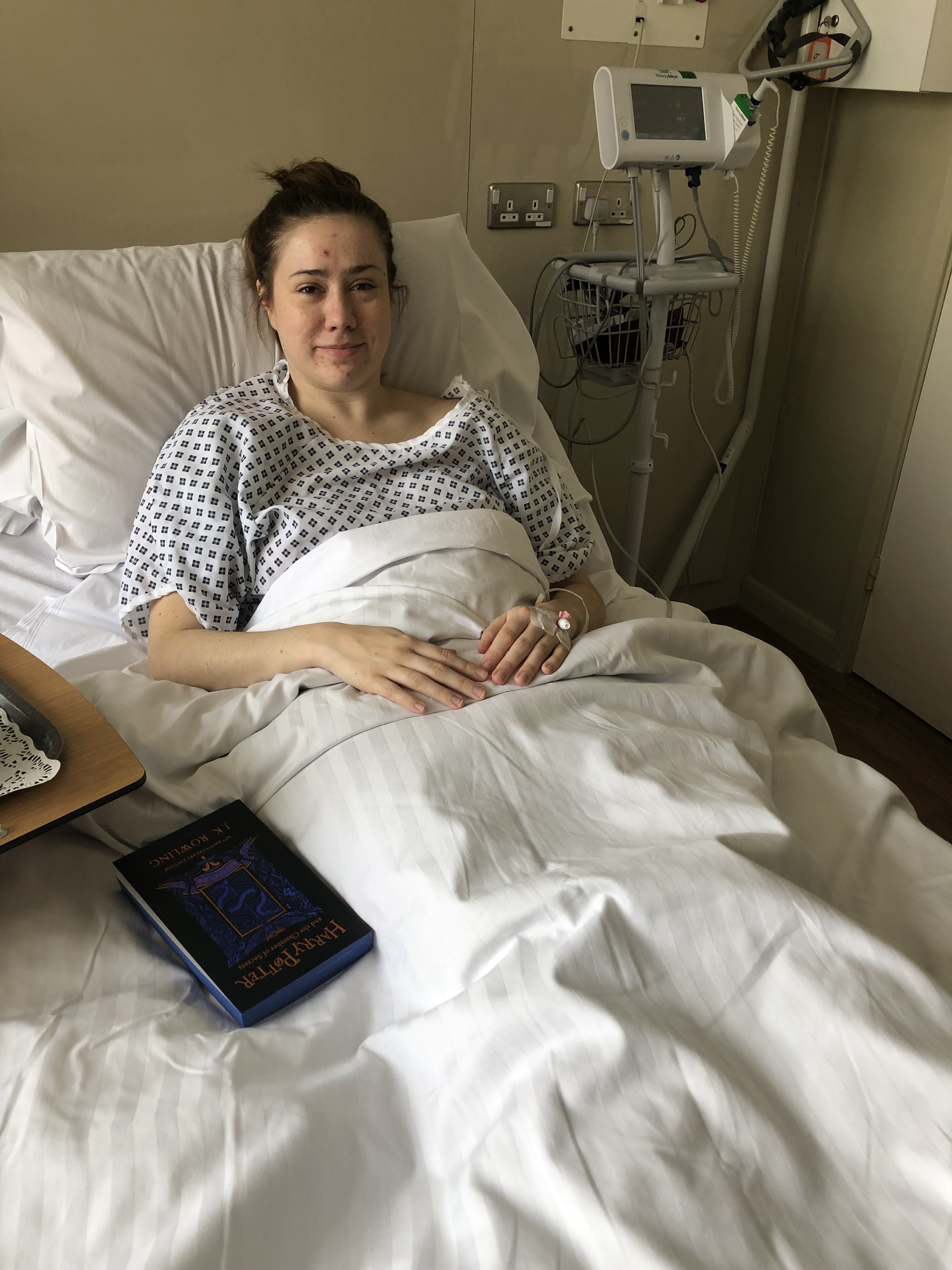
    IMG_7403
    Sore, surprised and a little smug

    It’s only been a few days and I’m still processing. It was a really tiny amount of endometriosis, but as I’ve been reminded time and time again, the severity of endometriosis does not correlate to pain. Giving myself endometriosis imposter syndrome at this point will help nothing.

    I can’t help but wonder what role my own advocacy and research played in finally get an, albeit tentative, answer. Would he have double-checked my POD if I hadn’t specifically done the research and asked him to? Would painful sex ever have been the symptom my doctors focussed on if I hadn’t forced them to? A widely touted statistic about endometriosis is that on average it takes 7.5 years to get a diagnosis, but that’s actually contested between 7 and 12 years. I’ve got here, where I’m not sure I have a diagnosis exactly but where I have had endometriosis discovered and treated, in three and a half years. But reaching this point has been a hell of a lot of hard work, physically and emotionally. I’ve been misdiagnosed with vaginismus, spent months attending psychosexual counselling, been placed on a pill that’s wreaked havoc with my skin and mood, taken anti-depressants for pain management, stopped running, stopped having sex, stopped socialising like a normal twenty-whatever-year-old. I’ve gained a lot too, knowledge, friends, writing gigs, a novel, job opportunities, a post-grad pathway I didn’t expect, a blog – but I am constantly curious about what the last three years might have looked like if my pain had been believed earlier, taken seriously sooner and treated promptly – by myself and by others.

    It’s not yet clear whether this is the beginning or the end of this particular experience. I have a million questions for my post-op appointment and I won’t know if the surgery has actually improved anything for months. But to have had the hysteria label lifted is hugely gratifying. Honestly, I feel vindicated because in my head the pain was never in my head. If that makes any sense at all.

    IMG_2795
    Of course, summer arrived the day after my op so I’ll be sporting some DVT stocking tan lines this year!
  • The pill & my face #Periodically 31

    The pill & my face #Periodically 31

    Here’s a blog I didn’t want to write but that’s been itching to get out for a couple of months. It’s about a problem I didn’t realise the extent of until the worst had passed, so keep in mind that this story has a slightly happier ending than most of my blogs!

    A Skin Thing

    I have never had particularly ‘good’ skin — that is to say since puberty I have always had some acne. But it was completely synced to my menstrual cycle and, while annoying, it was totally manageable. The only time it got a little out of hand was around exam periods, which was always perfect considering exams are nearly always rounded off with a prom or a summer ball. But that was as bad as it got. When I was on the pill in the past I noticed changes but never anything drastic, other than that it was much better when I finally came off all hormonal birth control in 2015, by which point I was 20 and thought maybe I was just beginning to grow out of it.

    When I went back on the combined pill in February of this year I was prepared for a little skin turbulence. I knew that while things were settling it was likely to get worse, but I also knew that the general rule preached by my doctors and countless anecdotal stories was that my acne was likely to improve on the pill. At the time, it felt like the only silver lining of selling my pill-free self to the hormone gods.

    What I didn’t expect was that when things did eventually settle on the pill that my face would be taken hostage by what my doctors were by now calling “adult acne.” Oh good, not only am I spotty but I’m also out of the designated spotty age bracket!

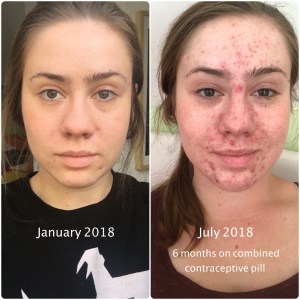
    skin3

    The irony is that I took the “before” shot thinking “my skin is going to get so much better!” A classic case of you don’t know what you’ve got ’til it’s gone… 

    My GP immediately said, “that’s unusual, it usually gets better,” and my gynae said, “that shouldn’t happen.” We literally watched my face get worse and worse the longer I took the pill — it was like an accumulative allergic reaction. This was the only visual sign I had of my “improving” health, which didn’t make things feel all that improved — shocker! “If it’s not supposed to do this then surely it’s a sign that there is some kind of hormonal imbalance in my body?” I asked my doctors. They both agreed but said there was no point investigating it because “we know so little about hormones that even if an endocrinologist did spot an anomaly we wouldn’t know what to do with that data.” Which, while completely true, didn’t make me feel much better.

    Remember how a few months ago I said, “it’s a bummer but acne is something I am well-used to dealing with, and I’ll take it over pain any day“? I don’t necessarily take that back, but when your pain hardly improves and your acne just descends into total chaos it’s hard to take it on the chin (very literally). To add insult to injury, the blistering hot summer we just had meant that 30 million freckles also descended on my face (regardless of how much SPF I put on). I just felt and looked like a bit of a mess. No wonder I started taking Bookstagram so seriously, I was hardly likely to be posting summer selfies. In fact, I now realise that I was cutting my face out of Bookstagrams to hide the acne, case and point:


    (Remember kids, Instagram is a web of lies!)

    Funnily enough, this did not help my mood, which was already being tormented by raging mood swings and rampant PMS. I’m pretty good at hiding acne with makeup but it was so painful that I didn’t want to touch it. I like to think of myself as pretty skin-positive (I love everything Em Ford does for the movement!) but I really avoided leaving the house or wearing makeup unless I absolutely had to. Dyspareunia and vaginismus aren’t exactly conditions that make one feel particularly sexy, throw some angry acne into the mix and it understandable results in a slight crisis of confidence.

    However, I’m not beating myself up about that too much. I did eventually think, “stuff it, I don’t have to look at my face when I’m out, that’s the rest of the world’s problem.” But it’s not great when you do finally leave the house, spots-and-all, and are then bombarded with well-meaning people telling you to “drink more water” or “try this horrifically expensive product.” And when you dare say that you chug water by the gallon or that you can’t afford this particular product then somehow it becomes your own fault — you’re not trying hard enough and therefore you want your skin to be bad… Um, sod off?

    There’s no doubt in my mind that there are dietary changes and some products that genuinely help some kinds of acne. Hell, I’ve tried lots of them, but given how quickly and aggressively this came on it felt so obvious to me, and my doctors, that it was hormonal. Personally, changes to my diet have never made a difference to my skin, but I think acne is nearly always a case-by-case, individual issue and unsolicited advice about it, for me at least, is always unwanted.

    A little bit of this and a little bit of that…

    As promised this story has a happy-ish ending. My GP and gynae both suggested that the pill was more likely to reduce my pain if I skipped periods. This meant I would take two or three pill packets back-to-back without a withdrawal bleed. When I eventually gave it a try my mood improved in a matter of days and everything else followed. I had no idea it would make such a big difference but it really did. Around this time I also started using prescribed Adapalene gel and taking Evening Primrose Oil. Whether it’s one of these treatments or a combination of all three, the last two+ months have seen a drastic improvement in my acne, mood and (fanfare please) pain! (Typically, three days after I penned this blog things got a little worse again, but overall things are definitely better!)

    skin7

    What now?

    It’s getting better as the scarring goes down and the further away I am from my last withdrawal bleed the better my skin is, but considering going on the pill was a last-resort solution for my pain, this skin journey doesn’t exactly feel like a triumph. The last few months have mostly been about treating problems that the pill caused. As mentioned, I have finally noticed an improvement in my pelvic pain but I would be lying if I said I don’t worry about what happens to that progress if and when I have sex or come off the pill. Long-term readers won’t be surprised to hear that staying on the pill for the rest of my ‘reproductive life’ isn’t my plan of choice.

    Why didn’t I want to write this blog? Because I didn’t want to start moaning about something else. So many of my friends have struggled with their skin for years, dealing with Roaccutane and its complications. Eight months of bad skin hardly feels worth complaining about in that respect. But I had no idea that the pill could have this effect — so that’s something I’m keen to share and leaving it out of these blogs felt a little dishonest.

    Love the skin you’re in, unless it bloody well hurts, in which case: seek medical intervention… Thanks for reading! 

  • Review: It’s Only Blood – Anna Dahlqvist #Periodically 25

    Review: It’s Only Blood – Anna Dahlqvist #Periodically 25

    Last week I attended the launch of gender, sexuality and human rights journalist Anna Dahlqvist’s book It’s Only Blood: Shattering the Taboo of Menstruation. The conversations on the night, between Dahlqvist, the founder of Bloody Good Period Gabby Edlin and the audience were interesting enough, but the book itself stands out as an enlightened piece of writing about the profound impact that period taboos, period poverty and poor menstrual hygiene have on menstruators’ lives.

    The book was originally published in Swedish and has been translated into English by literary translator Alice E. Olsson. Olsson was at the launch and discussed the fun (and struggle) of translating some of the menstrual colloquialisms.

    https://www.instagram.com/p/BjJ2uqLFo_-/?taken-by=baraliteblod

    It’s Only Blood is not a list of historical period myths, instead it’s a contemporary assessment of how reinforced menstrual shame continues to cause harm on a monumental scale. “Even though shame and silence are experiences shared by menstruators all over the world, the consequences become far more serious when an additional dimension is introduced: poverty,” Dahlqvist writes.

    The testimonies, many from school girls and activists from Uganda, Kenya, Bangladesh, India, America and Sweden, are combined with Dahlqvist’s research of UN legislation to highlight the fact that inaction when it comes to menstrual hygiene, education and resources means that many human rights are being violated, and yet, there’s a distinct lack of retaliation by politicians. The book is also coloured with Dahlqvist’s personal anecdotes and descriptions, which makes this serious book palatable – it’s rare to get a non-fiction book that you can’t put down.

    “Power over the period is a necessity, a precondition for participation in public life,” Dahlqvist writes, in reference to the serious social and educational issues poor menstrual hygiene can bring about. When school girls don’t have access to running water or locking doors, their options are rather bleak. If they bleed in public they’ll experience immense shame (the weight of which is only heavier when menstrual myths maintain that seeing or touching menstrual blood is bad luck), returning home to secretly clean and change a cloth at lunchtime, avoiding school entirely or hoping, at risk of infection, that one cloth or pad can survive a whole school day. Unsurprisingly, this has a profound and direct impact on their education. The book also explores how, contrary to popular opinion, these problems don’t go away as menstruators leave school.

    One particularly interesting part of It’s Only Blood is the connection Dahlqvist draws attention to between infections, like UTIs and Bacterial Vaginosis, which can be caused by poor menstrual hygiene, with HIV and HPV (leading to Cervical Cancer). Society, including period product providers, encourages menstruators to aspire to be clean and fresh while simultaneously not letting anyone around them know that they are bleeding. With all this shame and secrecy, it’s no surprise then that students in Malawi dry their menstrual protection under their mattresses or that in Bangladesh, one women hides her cloths in the roof, rather than drying them in sterilising sunlight. It’s a public health issue, why aren’t we treating it as such?

    Not only is Dahlqvist’s book intersectional in the stories that it tells, it also covers the intersections of menstrual hygiene with poverty, politics, commercial business and cultural and social stigmas. If you’re already active in combatting period poverty It’s Only Blood will spur you on and if you’re new to the discussion, the book will motivate you to join the ranks. Activists’ stories of feats large and small show how desperately change is needed, but also how in some cases, how little it takes to dramatically improve things.

    It’s Only Blood perfectly showcases how menstrual shame causes problems for everyone and why shattering the taboos will undoubtedly improve individuals’ lives and society in broader terms.

    Buy It’s Only Blood from Wordery by clicking here.