Tag: Mental Health Awareness

  • Review: It’s Only Blood – Anna Dahlqvist #Periodically 25

    Review: It’s Only Blood – Anna Dahlqvist #Periodically 25

    Last week I attended the launch of gender, sexuality and human rights journalist Anna Dahlqvist’s book It’s Only Blood: Shattering the Taboo of Menstruation. The conversations on the night, between Dahlqvist, the founder of Bloody Good Period Gabby Edlin and the audience were interesting enough, but the book itself stands out as an enlightened piece of writing about the profound impact that period taboos, period poverty and poor menstrual hygiene have on menstruators’ lives.

    The book was originally published in Swedish and has been translated into English by literary translator Alice E. Olsson. Olsson was at the launch and discussed the fun (and struggle) of translating some of the menstrual colloquialisms.

    https://www.instagram.com/p/BjJ2uqLFo_-/?taken-by=baraliteblod

    It’s Only Blood is not a list of historical period myths, instead it’s a contemporary assessment of how reinforced menstrual shame continues to cause harm on a monumental scale. “Even though shame and silence are experiences shared by menstruators all over the world, the consequences become far more serious when an additional dimension is introduced: poverty,” Dahlqvist writes.

    The testimonies, many from school girls and activists from Uganda, Kenya, Bangladesh, India, America and Sweden, are combined with Dahlqvist’s research of UN legislation to highlight the fact that inaction when it comes to menstrual hygiene, education and resources means that many human rights are being violated, and yet, there’s a distinct lack of retaliation by politicians. The book is also coloured with Dahlqvist’s personal anecdotes and descriptions, which makes this serious book palatable – it’s rare to get a non-fiction book that you can’t put down.

    “Power over the period is a necessity, a precondition for participation in public life,” Dahlqvist writes, in reference to the serious social and educational issues poor menstrual hygiene can bring about. When school girls don’t have access to running water or locking doors, their options are rather bleak. If they bleed in public they’ll experience immense shame (the weight of which is only heavier when menstrual myths maintain that seeing or touching menstrual blood is bad luck), returning home to secretly clean and change a cloth at lunchtime, avoiding school entirely or hoping, at risk of infection, that one cloth or pad can survive a whole school day. Unsurprisingly, this has a profound and direct impact on their education. The book also explores how, contrary to popular opinion, these problems don’t go away as menstruators leave school.

    One particularly interesting part of It’s Only Blood is the connection Dahlqvist draws attention to between infections, like UTIs and Bacterial Vaginosis, which can be caused by poor menstrual hygiene, with HIV and HPV (leading to Cervical Cancer). Society, including period product providers, encourages menstruators to aspire to be clean and fresh while simultaneously not letting anyone around them know that they are bleeding. With all this shame and secrecy, it’s no surprise then that students in Malawi dry their menstrual protection under their mattresses or that in Bangladesh, one women hides her cloths in the roof, rather than drying them in sterilising sunlight. It’s a public health issue, why aren’t we treating it as such?

    Not only is Dahlqvist’s book intersectional in the stories that it tells, it also covers the intersections of menstrual hygiene with poverty, politics, commercial business and cultural and social stigmas. If you’re already active in combatting period poverty It’s Only Blood will spur you on and if you’re new to the discussion, the book will motivate you to join the ranks. Activists’ stories of feats large and small show how desperately change is needed, but also how in some cases, how little it takes to dramatically improve things.

    It’s Only Blood perfectly showcases how menstrual shame causes problems for everyone and why shattering the taboos will undoubtedly improve individuals’ lives and society in broader terms.

    Buy It’s Only Blood from Wordery by clicking here.

  • “Can I examine you?” #Periodically 18

    “Can I examine you?” #Periodically 18

    Covering all bases here, Happy 2018 #Periodically readers! We left off with me on Mefanamic Acid and iron tablets to help with period pain and heavy bleeding, for more details on that read: #Periodically 17. Today however, I have news, good and bad, a diagnosis and a potential solution, but it’s all rather bitter sweet.

    TW/Disclaimer: I briefly touch upon mental health in this blog and as serious as I consider discussions on mental health to be, I do approach the subject with a little bit of humour. Making light of something isn’t always mockery, sometimes it’s a brilliant coping mechanism and an even better way to banish demons – even those of the vaginal kind. 

    I was going to delve right in and give you the gossip from my gynae appointment last week, but having flicked through my December diary entries, I realise there’s a whole load of crap that needs to come before that, feel free to skip ahead. Warning, moaning ahead.

    Just over a month ago we had some snow here in Essex. It only lasted a day but for about four seconds of this particular snow day, I pulled my twenty-seven year old sister two metres across the garden in a sled. The next morning I woke with an excruciating backache. Back pain is something I’ve dealt with for years, especially when on my period, but this was something else. Assuming it was because of the spontaneous sled pulling, I dosed up on ibuprofen and took it easy. A lot of the pain was intensified to my lower back and got particularly bad at night when I was sitting or lying down, at which point it was accompanied by some delightful shooting, tugging and tearing pains across my pelvic area, front and back.

    After ten days of my moaning being even more annoying for my family than normal, I went to the doctors to check this wasn’t a womb-related pain. The delightful new doctor I had the pleasure of seeing basically laughed at me for expecting the pain to go away so quickly, and when I explained the fact that “hey, I’m in a lot of pain most of the time anyway and this is a bit much and I think I’m going to lose my mind” he did a nice, patronising head tilt and said, “so how long have you had this tummy ache?” Have you ever wanted to flick someone in the face, Rachel and Monica style?giphy (4)

    The pain was quickly accompanied by some intense nausea, which I now believe was caused by the iron tablets. I had some really disturbing nights’ sleep for a while in December, so I stopped taking them for a couple of days and immediately felt better. Since I’ve been back on them it’s been OK, so I think it was just an acclimatisation thing. When the doctor couldn’t do anything for my back my mum insisted I got a sports massage, my first since the good ol’ marathon days. I don’t actually think this helped at all, but it turns out the masseur happened to have endometriosis, PCOS and a one year-old, so it served as an enlightening therapy session, if only emotional. The backache went away while I was on my period curiously enough, it’s back now, but honestly I think I’ve gotten used to it. I am wondering if perhaps it has been caused by the fact I probably carry myself awkwardly because of the pelvic pain and it’s therefore referred elsewhere, but the fact it hasn’t healed like a normal muscle injury does leave me wondering if it is just the next phase of Project Pelvic Pain.

    So I started 2018 with my two favourite things; a period and a visit to the gynaecologist – yahoo, lucky me! Going into the appointment I had two things in mind: a) I hope its a female gynae and b) I think I’m going to come out with a prescription for the pill. Well the gynae was a man so that was an excellent start. I’ve never been bothered about having a male doctor for “intimate” situations, it’s more that in Swansea Dr M asked me what was wrong and then interrupted me every time I spoke – all that resulted in was fruitless surgery and a dodgy belly button. I wanted things to be different this time. Unfortunately, things started the same way. He asked me what my symptoms were and the moment I opened my mouth he just started talking over me and before I knew it he was saying, “so we need to get some hormones in you” and I just said “NO.” Happily, he shut up and listened while I explained that this was no longer just a situation of bad period pain. I told him that the pain and the repercussions of it were creeping in my life in serious and unwelcome ways and he finally said the words I’ve always wanted to hear: “can I examine you?” For avid #Periodically readers, you’ll know this is a momentous moment. Read: Why didn’t the gynae look at my vagina? to see why.

    This was horribly awkward because I was on my period but also because the chaperone, who is there to make me feel comfortable, got waaaay too close while I was changing. But it turns out, the exam was uncomfortable for another reason.

    Reclothed and a little lubey, I sat back down at his desk and he immediately said “OK you have a superficial problem too, it’s not just your internal system”. I didn’t even care what it was at this point, I just wanted to cry about the fact that all it took was a 30 second exam for someone to finally be like “oh yeah, there’s a problem”. He went on to explain that some of my pain, specifically my dyspareunia (pain during sex) is being caused by the uncontrolled clenching of my vagina upon penetration. Yep, I just wrote that #sharingiscaring. This has a name, vaginismus, sexy right? So he starts listing the treatments for vaginismus; “definitely counselling, probably physio and possibly anti-depressants”. I should have been fairly concerned at this point, but instead, my mind immediately went to Charlotte in Sex and the City… 

    I’m not surprised, given the difficulty of pelvic examinations in the past, but I am not exactly comforted by this diagnosis as my dyspareunia is described as deep dyspareunia, meaning the pain I experience is more internal than my vagina, it is “deep”. To me it feels a bit like a chicken or the egg situation. Did I always have vaginismus, or did I get vaginismus because my vagina is like “wow don’t go in there, it’s a mess”. My instinct is the latter, but I guess we’ll find out in therapy! My gynae’s referred solutions have to be arranged by my GP and so it’s probably going to take a while, but this feels like progress, albeit it disheartening, worrying and a little sad.

    The other result of the gynae appointment was that I now have, as predicted, a pill prescription. I expressed all my concerns, and other doctors’ concerns regarding DVT and breast cancer, but the gynae was confident that going on the pill will not only help with my symptoms, but that it has the potential to cure them. We also had a discussion about what pill I am *happy* to go on. It could of course be that if I come off the pill in two years everything will come back, and it could also being that going on the pill will do sod all to help me, but at this point it’s worth a shot. I won’t be starting the pill for a few weeks, so I’ll write a blog soon about my thoughts and feelings about going back on – as you can imagine, there are a lot.

    Sorry this was a long one, but me and my depressed vagina needed some processing time before writing this. There’ll be more, but in the mean time I’m going to go and learn a little more about vaginismus, how I feel about going back on the pill and maybe I’ll even re-read Naomi Wolf’s chapter about the Vagina-Brain connection – I feel like I’m going to need it more than ever.

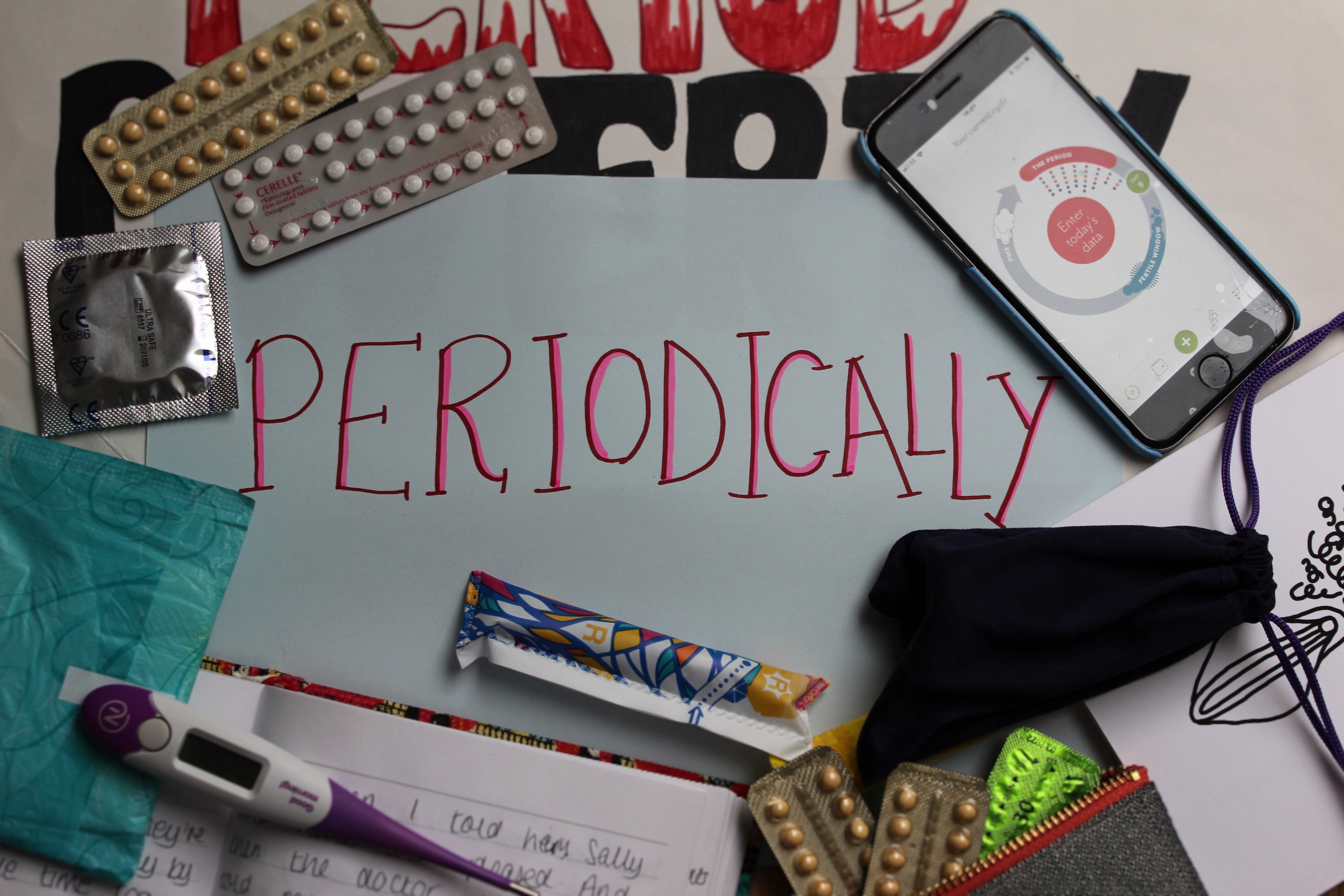
    How are we feeling about the new #Periodically picture? Yay, nay?

    periodically3

  • Review: Tigerish Waters – Sophie Reilly

    Review: Tigerish Waters – Sophie Reilly

    Launching this week is a stirring book written from the front line of a bright young woman’s battle with her mental health. Tigerish Waters is the selected writings of Glasgow-born Sophie Reilly, edited by her brother Samuel Reilly after Sophie took her life last year. This striking combination of poetry, prose and fiction is both an upsetting marker of a waste of talent and a celebration of a short but thoughtful life.

    Knowing the context around Tigerish Waters you might not expect the book to be so funny, but Sophie’s voice and style is a lot of really wonderful things, and comic is one of them. Having suffered with a plethora of mental illnesses including Anorexia Nervosa, Bipolar Affective Disorder and Emotionally Unstable Personality Disorder, her writing speaks of unfathomable pain and hardship as well as total euphoria. By articulating her relationship with her mental health through drama, poetry, short stories and diary entries, Tigerish Waters offers insight into a gritty reality of extreme highs and the lowest of lows.

    The dark, ironic and humorous style leaves you wanting more from this talented young writer, but then you remember the context of the book’s publication and it all begins to feel desperately sad. Throughout, Sophie talks about the future, specifically about when she’s written a play or a memoir or a novel. “Nobody who attempts or commits suicide wants to die” she writes, and we think of how a book was always supposed to be part of Sophie’s future, but the reality is not how anyone, least of all Sophie, would have wanted it to come about. And yet, the publication of Tigerish Waters does come with barrels of hope. All profits made by the book are being donated to the Scottish Association for Mental Health (SAMH). The book passes comment on the “non-existence” of Dundee’s mental health services and the counter-productive support Sophie felt she received. Tigerish Waters has the power to serve as a real wake up call to a revolution that needs to happen with the treatment of mental illness in Scotland and beyond.

    For me personally, I was deeply effected by the normality of Sophie’s life. At first glance it is all very relatable. In her diary entries she talks about Gavin and Stacey, Harry Potter, Orange is the New Black, even her crush on the show’s star. She expresses her concerns about the overbearing presence of social media on girls’ self-esteem and she hesitates over whether or not she really needs a smartphone. She was a normal young woman with a promising future (she had been accepted to study Theology and Literature at St Andrews). If one ever needs a reminder of how mental health issues can and do impact everyone and anyone, Tigerish Waters is a prime example. In one diary entry Sophie calls us to take pride in our mental health issues. Taking inspiration from some of the triumphs of the Gay Pride movement Sophie titles the essay “Mental Health Pride”. It is a confident approach to mental illness that could have a really positive effect in my opinion, and I hope that message will be another positive thing to come from Sophie’s life.

    “If one ever needs a reminder of how mental health issues can and do impact everyone and anyone, Tigerish Waters is a prime example.”

    For me, the two most poignant parts of the book were the short play “Before the Snuff of the Lights” and the poem “Birth & Growth.” While both play an important part in telling Sophie’s story, they are also standout for their quality and creativity. (Update: I just heard a performance of “Before the Snuff of Lights” at the book’s London launch, which only affirmed my opinion that it is really extraordinary and mindful piece of writing.)

    It is easy to get swept up in the circumstances of Tigerish Waters’ publication, when perhaps the emphasis should be on the phenomenal talent the lies in the sentences and verses of Sophie’s writing. Anyone who has ever lived and wondered why will find something in this book that makes them say “I thought it was just me.” From that, I hope they will be motivated to demand help, receive it and share their unique voice with the world.

    Tigerish Waters, the selected writings of Sophie Reilly, edited by Samuel Reilly, is available on Amazon for £6.99. Published by Mad Weir Books, all profits from the book will be donated the Scottish Association for Mental Health.