Tag: Literature

  • My 5 Favourite Potter en Français Translations – PART 4

    My 5 Favourite Potter en Français Translations – PART 4

    As you probably know by now, I recently read the Potter books one through seven for the first time in years and it’s been a ride — even more so than normal because this time I’ve done it in French. I’ve loved sharing my favourite translations on Fictitiously Hilary and I’m sad to say that this is the last blog I’ll be adding to the collection. Catch up with the others by clicking here:

    Part One     Part Two     Part Three

    Here are my final favourite French Harry Potter translations, taken from across the seven books.

    Image result for quidditch gif

    Le Quidditch

    The title of everyone’s favourite wizarding sport remains the same in French, but the same can’t be said for the rest of the game’s elements. The players’ roles are directly translated as chasers become “poursuiveurs,” beaters become “batteurs” and the seeker becomes “l’attrapeur.” I can’t for the life of me figure out the logic behind the Quaffle translation, which becomes “Souafle” – I guess both words are kind of onomatopoeic in their respective languages? Bludgers become “Cognards,” which comes from the French verb cogner, meaning to bang, knock or strike — figures. The Golden Snitch, rather magically, becomes “le Vif d’or” – or meaning gold, while vif is an adjective that can mean anything from vivacious, keen, sharp, quick, strong or bright – I’d say the Snitch is all those things…

    Transplanage & Désartibulement 

    Apparating and splinching become more relevant in the final two Potter books and I was interested to see how they’d be translated. Translator Jean-François Ménard goes for are “transplanage” (noun) and “transplaner” (verb) for apparating, and “désartibulement” for splinching. Transplanage presumably makes sense in terms of the word “transplant” but I really can’t put my finger on the translation of splinching. It obviously doesn’t mean too much in English, which doesn’t help me understand the translation. It’s really bugging me, so any French readers, please let me know if/why it makes sense!

    Image result for hedwig gifs

    “Un hibou huhula…”

    In part two, I talked about how much fun I think it is to discover onomatopoeias in other languages, and in Deathly Hallows (or les reliques de la mort in French) I found another corker. As Harry and Hermione are recovering in the Forest of Dean, Harry hears an owl, except in French, it’s “un hibou hulula.” “Hululer,” I then confirmed is the French for to hoot, but since you pronounce it “hoo-hoo-ler” (but with the almost non-existent French ‘h’) you literally have to make the “hoo-hoo” sound owls make. Magic! Much better than our old “twit-twoo!”

    Image result for mudblood gif

    Sang-de-Bourbe & Moldus

    Onto a slightly more unpleasant translation now, one that became more and more present in the final books — Mudblood. In French, this derogatory slang for a Muggle-born wizard becomes “Sang-de-Bourbe” — which reads more as “Sludgeblood,” but it certainly does the job. Come to think of it, I never talked about the translation of Muggles, I think it’s slightly nastier in French, it’s “Moldus.” My English mind immediately goes to mouldy, but in French “molle” means soft, weak or floppy, so it’s nicer than it sounds, just.

    Le plus grand bien 

    The deep philosophical “greater good” issues in Harry Potter have always been ruined for me because I immediately think of Hot Fuzz, but I was interested to see how it would be translated. Turns out, very, very literally! I thought French grammar might overcomplicate it, but it is simply translated to “le plus grand bien” —  word-for-word that’s “the more big good” – that’ll do it!

    Related image

    Thank you so much for reading these blogs! They’re not exactly examples of hard-hitting journalism but they’ve been so much fun to write. And that’s on top of the fact that reading the books in French has been incredibly rewarding and a great way to keep my French up since graduation. I hope you’ve enjoyed reading them as much as I’ve loved writing them.

    Merci beaucoup, onto the next French/magic/literary adventure! 

    Image result for harry ron hermione gif

  • My Favourite Potter en Français Translations PART 3

    My Favourite Potter en Français Translations PART 3

    Coucou! I’m back with another round of Potter translations. Regardless of whether anyone reads them (which some people actually do!) I love writing these blogs so don’t expect them to relent just yet. I’ve now read Order of the Phoenix (ordre du phoenix) and Half-Blood Prince (prince du sang-mêlé), and I am holding off on Deathly Hallows because I DON’T WANT IT TO END. Where I’m at with the series now means that many of the characters and ideas have already been introduced, so the translations featured today are less likely to be exclusive to books five and six.

    Delores, Doloris, Endoloris

    Back when I was reading Goblet of Fire and Mad Eye Moody (Maugrey Fol Œil) introduced the unforgivable curses (les sortilèges Impardonnables) I was struck by the translation of one in particular because I thought it might clash with an upcoming character’s name. “Le sortilège Doloris” is the name given to the cruciatus curse. It makes sense because “douleur” is the French for pain and suffering. Just as the cruciatus curse becomes “crucio” when used, the doloris spell is cast with “endoloris”. When Delores Jane Umbridge arrived in Order of the Phoenix, I wondered whether there was going to be a nod to the similar words or a change to her name. It turns out the name Delores means sorrow anyway, but in the French books Umbridge’s name literally becomes Cruciatus Umbridge. What’s more, her surname is changed. Umbridge is changed to Ombrage, which can translate to anything from “shady” to “offence,” “resentment” to “make s.o feel small.” Delores Umbridge becomes Delores Ombrage, or Cruciatus Shady Belittler, an extra excruciating name for an especially despicable character – I love it!

    BUSE & ASPIC

    I’ve reached the point in the books where academia is becoming more important because of the arrival of wizard GCSEs and A Levels, known in the books as O.W.Ls (Ordinary Wizarding Levels) and N.E.W.Ts (Nastily Exhausting Wizarding Tests). Like with S.P.E.W in my last blog, the translations into French needs to make some kind of sense in terms of being about difficult exams, but they also need to spell out the names of animals frequently mentioned in the wizarding world. The Jean-François Ménard translations call them B.U.S.E and A.S.P.I.C. B.U.S.E stands for Brevet Universel de Sorcellerie Élémentaire (a good magical twist on a French GCSE) but the word “buse” itself is a buzzard or a hawk. Parfait! A.S.P.I.C. stands for Accumulation de Sorcellerie Particulièrement Intensive et Contraignante which is a bit far fetched if you ask me, I’m not sure about the word “accumulation,” BUT it works because “aspic” is a type of viper. Magic!

    L’élu

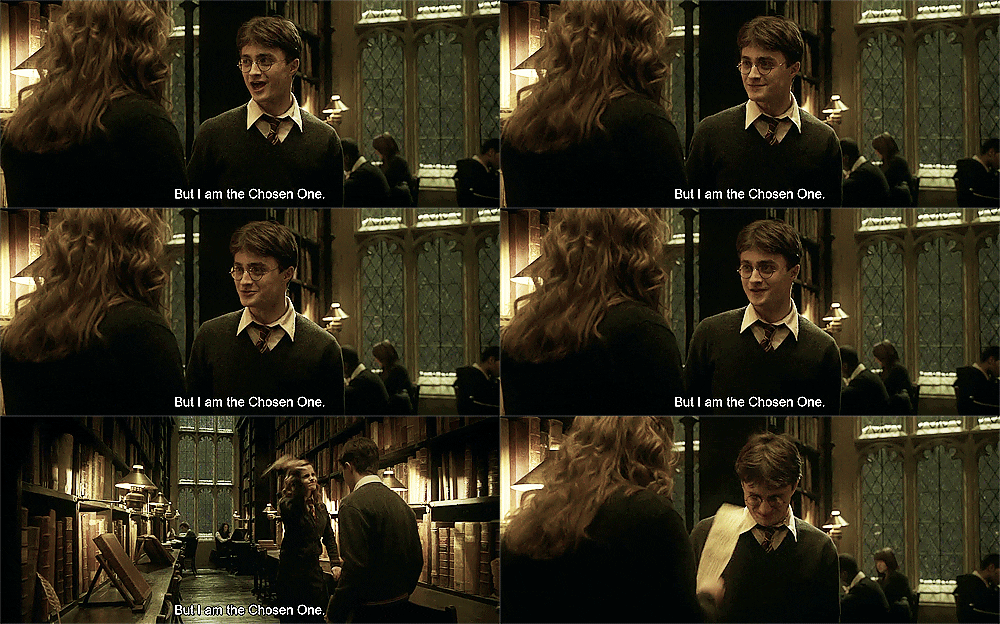
    Now despite the massive waste that is Dumbledore’s Army’s trip to the Department of Mysteries, we still learn from Dumbledore just bloody well telling Harry the prophecy afterwards (I’m not bitter about it at all), that Harry is in fact The Chosen One. When I started reading Half-Blood Prince in French I kept seeing these four little letter gathering near Harry’s name and I didn’t clock what it meant until I stopped reading and thought, “l’élu? The eleceted? Oooooooh!” It’s such a simple translation that uses the verb “to elect” in a way I’ve never seen outside of politics but it makes more sense than any way I can imagine directly translating “the chosen one”.

    Je suis Voldemort 

    I can’t believe I forgot to mention this when I wrote about Chamber of Secrets because it is just so bizarre. We all know the moment, in the film and book, when creepy teenage Voldemort reveals that his given name was Tom Riddle. He does this by creating an anagram out of his full name “Tom Marvalo Riddle” to spell “I am Lord Voldemort”. Riddle can’t drop an English “I am” into his speech in the French books, so his name had to be altered to find room for a “je suis.” His surname Riddle is also a hint at the fact his name is a riddle in itself so that’s something worth trying to convey in French too.

    And oh my god, how Ménard does it still makes me cry with laughter every time it comes up. I can’t help but wonder whether Rowling had to sign off on it… Imagine you’re reading what is a really intense scene when suddenly Voldemort drops the bombshell that his middle name is ELVIS. His surname becomes Jedusor, which I think is a play on the French phrase for “pun” – “jeu de mots” (game of words), where “words” is replaced with “sort” meaning “spell” – so jedusor might mean “game of spells” – a pun in itself – I could be wrong there though. But anyway, back to the fact HIS MIDDLE NAME IS ELVIS. It does work as an anagram – “Tom Elvis Jedusor” spells out “je suis Voldemort” – but for me the tension was all gone because I was too busy laughing at the fact the Dark Lord’s middle name is Elvis.

    You-Know-Who

    In the same vein of thought, there is another aspect to Voldemort’s name that I’ve failed to mention. If you’ve ever studied French, one of the first things you’re taught is that there are two ways to say “you”. There’s the familiar “tu,” for friends, family, younger people and such, and there’s the more formal “vous” for elders, your superiors etc or a plural group. Remarkably, or perhaps unremarkably, this rule still applies when it comes to saying “You-Know-Who” in French. For example, when Harry first learns about Voldemort from Hagrid, Hagrid says “Tu-Sais-Qui” but when Harry replies he says “Vous-Savez-Qui” – demonstrating the linguistic power balance between Hagrid and Harry, adult and child. The more complicated “He-Who-Must-Not-Be-Named” becomes the mouthful “Celui-Dont-On-Ne-Doit-Pas-Prononcer-Le-Nom” (the one whom we must not say the name of).

    As we’ve established by now, I find these translations fascinating and I hope you do too! If you’ve enjoyed part three be sure to check out parts one and two, and please share them with any Francophiles or Potterphiles you think might be interested. 

    In other news, you might have noticed that a little badge has appeared on the site – Feedspot have ranked Fictitiously Hilary 36 in its Top 50 Freelance Writing Blogs. Thank you all for reading, sharing and making exciting things like this possible, big love! 

  • A Note on Writer’s & Reader’s Block

    A Note on Writer’s & Reader’s Block

    Inspiration has been a hard match to strike this week. Actually, that’s not entirely true. I’m working on a slightly different (and secret!) project at the moment and I’m pumped for that, but when it comes to reading and writing, my usual motivations have simmered. So true to form, I thought I’d write about it (does that mean I’m over it already?!) Writer’s block is something I know all too well and I find mixing projects up helps a lot, but reader’s block is not something I’ve experienced before.

    When it comes to reading I knew my 2018 reading goal of 65 books was going to be tough. So to try and counter disappointment at the end of the year, I thought that if I go super hard in the first couple of months of 2018 then I can take it easy for the rest of the year. I’ve succeeded with this plan, I’m writing this on February 23 and I’m on my 14th book of the year. But this ‘success’ has come at a price. I’m finding it a little hard to concentrate on what I’m reading. Last weekend I found myself not loving Ali Smith’s How to be Both, which surprised me because I loved Girl Meets Boy. I was worried that I would have liked it more if my mind was less on the deadline of how many books can I squeeze into February and more on the content, characters and writing of the book. I think I succeeded in rectifying the problem though: I followed How to be Both with Roald Dahl’s Matilda. I haven’t read it in years but a children’s book demands a little less brain power and offers a lot of entertainment. It shifted my brain back into the reading for pleasure zone. I’m now purposely making slow progress through Naomi Wolf’s The Beauty Myth. However many books I read in March, I hope I stop competing with myself and just enjoy the brilliant books waiting for me on my TBR pile.

    As far as writer’s block goes it’s been a mixed bag. Creatively, things are good – things are happening. I’ve been getting my novels out there to agents and feeling positive about what I’m submitting. I’m even working on a play, as promised. In fact, I’m even more inspired about it after having seen Fran Bushe’s one-woman show Ad Libido at Vault Festival last night, where I had this exact magical Gilmore moment:

    giphy (9)

    The problem this week has been with non-fiction and journalism. This poses a slight problem given that it’s my source of income. Last week an article I wrote about pubic hair was published on Repro Justice, you can read it here. I loved writing it and have thoroughly enjoyed the conversations I’ve had because of it, but ideas for the next article and/or blog are playing hard to get. That being said, if there are any blogs you’d like to see from me or reviews you’d like to read, please let me know!

    Get in touch if your brain’s switched off in inconvenient places this week, then I won’t be alone in my frustration, and if you are facing a wall too, I can confirm that there is always a way around it, even if you have to tear it down with your bare hands. Anyway, I’m confident that my normal levels of reading, writing and loving both will be back soon. And don’t worry, if it doesn’t come back soon I’ll be sure to blame it on the pill.