Tag: Health

  • Brexit and my body

    Brexit and my body

    Like many, life has been a complete stress fest for reasons mostly out of my control in the last few months so I thought the enforced downtime of my Christmas quarantine would be a good chance to write a blog or two. Problem is, I’ve just been sitting in my parents’ loft working and then listening to Brexit unravel, again. This perhaps explains where the following blog came from.

    When is a good time to emigrate? The answer probably isn’t weeks into a painful treatment for endometriosis, a month before the UK is scheduled to leave the EU just as the world is about to enter a pandemic. You can guess what I did. In my defence, I couldn’t have known about the pandemic. 

    I mentioned a few blogs back that I moved to Belgium for a job. What I didn’t mention was that when I interviewed for the job I had one hot water bottle tied around my waist, another shoved in between my legs and during the meeting I squeezed my stressball in half. I was in a hell of a lot of pain and I was interviewing in the full knowledge that it was perfectly possible, likely even, that if I got the job then my body would not be able to hack a 40 hour work week, especially with such a big change of scenery. I tried it anyway, to varying degrees of success. There are weeks when I feel like I should never have doubted myself or my body, and then there are weeks when I regret not raising a white flag. I am still not very good at listening to my body when it tells me it’s struggling, except and always in hindsight. 

    There are plenty of things that haven’t helped me manage endometriosis over the last 18 months, my own foolishness and the pandemic included, but would you like to know one thing that has consistently complicated things? The British Government and its insistence on dicking about with Brexit. 

    When I first moved to Brussels I was an intern, which unfortunately leaves you in a unique kind of limbo in Belgium. When I say limbo, I mean there are very few grounds on which you can access health insurance like the rest of the working population. I learnt this, unfortunately, when I passed out a few weeks into my Brussels adventure. I was able to access great healthcare, but it was out of pocket. Now the out of pocket prices aren’t astronomical (relative to countries like the U.S, not as much to the free-at-the-point-of-use NHS) but even on a decent intern’s salary and with my body’s record, I knew paying out of pocket wasn’t sustainable. 

    Shortly before I moved, I renewed my European Health Insurance Card (EHIC). I did it almost as a joke, but when another Brexit day came and went without anything happening, I decided to see if my status as an EU citizen had any last minute perks. It did, my EHIC gave me health insurance as if I were a regular employee in Belgium, not because I was an intern, not because of the NHS, just because I was an EU citizen. Problem was, I had no idea at what point Brexit would turn off the coverage. The insurers in Belgium said they didn’t know yet, so I wrote to my (conservative, Boris-championning) MP in the UK, whose response was unsurprisingly useless.

    When your body has become an incredibly uncertain place to live and suddenly your healthcare is reliant on a precarious political situation, you begin to become quite scared of your body in new, very unnerving ways. This anxiety over if and when my health insurance might stop made my doomed mission of avoiding medical intervention that much easier because I relied on the fact that my health insurance was limited in ways I couldn’t fully know. Regardless, my European health insurance got me through the chickenpox and other unexpected gifts from 2020. Yet every time a doctor referred me for an outpatient treatment or investigation, a new gynaecologist or a colonoscopy, they recommended I wait until either the Brexit negotiations were clearer or until I had a job with health insurance.

    Fortunately, my employment situation became more secure and my health insurance should now be unaffected by the end of the Brexit transition period, though I can’t say the same for my right to live or work in Belgium. I am so lucky but I can’t help think of the Brits who will move to Brussels for internships, which are already out of reach to many since they have a reputation for being poorly paid, and how they are going to do so without any health insurance options, especially if there is no deal. At one point when I was trying to sort this whole mess out someone advised me, “just don’t get sick”, a deeply disturbing attitude that I regretfully expect a lot of interns to adopt in the coming months. What’s more, through my work I have had the chance to see the innovations that come from European funding, especially related to health. My skin crawls at the idea that British researchers and innovators won’t have access to these opportunities anymore. 

    So when my MP wrote to me in October 2019 that “the PM has secured a new deal which will allow us to avoid a No Deal Brexit and leave the EU with a deal … If you need any specific support relating to your condition, please do let me know,” not only was he apparently lying about the avoidance of a No Deal Brexit but he was ignorant of the fact that the specific support relating to my condition that I needed was for my government to create an environment where I could make the best decisions for my health based on my body’s needs, without factoring in Brexit negotiations. All I needed was the basic commitment from my government not to use human lives as political pawns. 

    My situation was nothing compared to the precarity Boris Johnson’s government consistently plunge lives into every day but I hope it’s yet another reminder that negotiating policy has real-life consequences before the (likely bad) policy is even made. Everyone keeps talking about the uncertain times we’re living through because of the coronavirus pandemic, which is undeniably true, but let’s not forget that through the Brexit negotiations, the British government has continually chosen to create more uncertainty, for reasons I can only attribute to delusions of grandeur. 

    I know a lot of people have news fatigue at the moment but we can’t let a bad Brexit slip through because of this, I recommend you give Femi Oluwole a follow for some hard truths. I’ll be writing to my MP again but maybe yours will be more helpful than mine?

  • Different, not better: trying (and failing) to ignore my body

    Different, not better: trying (and failing) to ignore my body

    I have spent 12 months trying to ignore my body. My body has spent 12 months demonstrating how and why that is an impossible endeavour. This week it has been a year since I last published a blog and a year since I last (intentionally) sought medical intervention for endometriosis – happy birthday to my Mirena coil. 

    It’s been a big year, for me personally and for the world, and there’s been plenty to write about but for some reason I couldn’t bring myself to share any of it. I find it hard to express what stopped me but a read of Olivia Sudjic’s Exposure might enlighten you if you’re curious. The simplest explanation is that I didn’t want to. There’s also the fact that I have always tried to keep these blogs relatively positive in their outlook, and much of what I’ve been doing over the last year is coming to terms with the chronic element of endometriosis, a task that involves a significant distortion of optimism as you know it. Again, if you’re curious about how I began to think about that in a more positive light, I highly recommend reading Alison Kafer’s theorisation of crip time. 

    I’m sure as I slowly revive the blog I’ll fill you in on some of the things that have happened but here are the highlights: I graduated from my MSc in Gender and Sexuality, I moved to Brussels, Belgium where I’m still living and working a meaningful job that, refreshingly, doesn’t involve thinking about bodies all day. In many ways these three headlines are all connected to each other and to my attempt at ignoring my body. My MSc was, in the end, incredibly rewarding but it left me with a bit of a hangover. I spent last summer recovering from diagnostic surgery and a traumatic IUD insertion while writing a dissertation on the cultural backlash against hormonal contraception. The dissertation ended up being much more than that – really it was a manifesto for a hormonal feminism. Having been told not to intellectualise my health by an old therapist I did the exact opposite and while I would do the same again, I finally saw what the warning was about: I could no longer think about anything else. 

    So when I was offered a job in Belgium I grabbed the opportunity and saw it as a chance to find out what else I could think about. In many ways the plan was a success. Especially at the beginning, when I was hopeful that if I gave this new treatment a chance to work then maybe I might be able to forget about having endometriosis for a while. So I just ignored the old pains and the awful new ones that had arrived since I got the IUD. I ignored the fact that I hadn’t stopped bleeding for four months. I passed out from pain out on the metro and tried to ignore that too. I took a lot of painkillers and just kept waiting for the IUD to start working. I ignored the very obvious fact that ever since the coil insertion I had redeveloped vaginismus in a much more frightening way than before. I stopped tracking my bleeding or pain, and put every bad day behind me, trying not to notice how debilitating they were or how frequently they were coming. I would work all day and then return home exhausted to eat then sleep, sometimes taking a few moments to marvel at how my flatmates could work, exercise and have social lives. I tried dating again, and when I quickly realised that doing so would make me think about my body, pain and the fact that nothing had really changed, I promptly stopped. 

    Then in January 2020 I came down with the chickenpox at 24 years-old. As it took hold, I told myself it was all in my head, that everything I was feeling was imaginary. It was only when the blisters arrived that I began to believe my body and started to see how much impact the diagnostic process had on my mental health. There is nothing like an acute illness to make you dwell on a chronic one. It was horrible. Every medical intervention I’ve had has gradually chipped away any sense of sexiness I once had, and let me tell you, nothing will finish it off like chickenpox taking over your face and vulva. I wrote some very dark essays where I vowed to start listening to my body’s warning signs and then the files corrupted and I lost the motivation they captured along with the essays. I went for a mammoth hike and felt my body in a good way for the first time in months. It felt good to feel good and I tried to chase that feeling. 

    I finally stopped bleeding for the first time since the coil went in, only for blood to start emerging from new, scarier places. I ignored it. I noticed that I started bleeding after I ran for a bus or carried something heavy. So I stopped doing those things. Seeking good feelings and avoiding the bad ones seemed like a solid way to ignore my body in a slightly healthier way. And then a pandemic started.

    I talked myself out of my COVID symptoms, which were later confirmed by a positive antibody test. I used lockdown to redraft the novella I wrote in 2018 and while the process involved thinking about physical pain, it was easier than thinking about what I was going to do with the pain I felt now or that might get worse at any moment. My pain started to come back more frequently, in ways I could no longer ignore. My flatmates repeatedly implored me to call in sick to work. I again reverted to the logic of waiting until there was a ‘real’ reason, ignoring the fact that not resting immediately would probably cause that ‘real’ reason to arrive. When I bled I no longer reached for a menstrual cup. I finally acknowledged that the coil insertion was the last straw for my vagina: it had truly closed for business.  

    As lockdown began to ease in Belgium I went to see my GP. I had no intention of mentioning endometriosis, I just wanted a blood test and a repeat prescription. But she started to ask questions and I, reluctantly, answered them. ‘You can have surgery for endometriosis, you know?’, she said. I smiled politely and said I knew. After further probing I decided to give her the overview of what I had tried and where I was. She asked me what was next, did I want to seek treatment in Belgium? I didn’t want to seek treatment at all, doing so had only made things different, not better. She tells me I don’t have to suffer, that she knows Belgium’s sole endometriosis specialist personally, that I have options. I start to believe her. I’m not yet sure where that sits with my acceptance of crip time, but optimism is contagious and it was the driving force of this blog. It’s good to have a little back. It’s good to be back. 

    This summer I am taking part in Endometriosis UK’s #WalkForEndo. I will be doing eight 7.5km walks in solidarity with those still on the path to diagnosis, which takes 7.5 years on average in the UK. You can support my fundraising by sponsoring me here. Research suggests that racial biases in medicine, where endometriosis is often considered a white woman’s disease, lead to even longer delays in treatment and diagnosis for Black women. There is a wealth of literature that logs the wrongful presumption that Black women’s tolerance for pain is higher than others. It takes all of us to address these inequalities in healthcare and beyond and I urge all readers to confront them.

  • Clue Plus Review #Periodically 33

    Clue Plus Review #Periodically 33

    One of WordPress’ slightly creepier features allows me to see that a whole bunch of people have been coming to my blog looking for reviews of Clue Plus – the paid-for version of a popular menstrual tracking app. I reviewed it when it was called ‘premium’ and still super expensive, but now that the new and improved version has been rolled out I thought I would update you all on how I found two months using it.

    As mentioned, Clue has made its paid-for version much cheaper. In the UK it now only costs £0.83 a month if you buy a year at a time (£9.96), or £0.99 month-by-month, just a casual £33.03 cheaper than the original version – SO much more affordable. So what about the features, are they more interesting?

    Yes and no. I’ll get to the main feature, forecasts, in a minute but first I want to talk about what else is new. IMG_2986

    Sorry I couldn’t resist that picture placement… Other than the cheaper price and forecasts the only added feature on the paid-for version is that it now notifies you when your period or other menstrual symptoms are ‘out of normal range.’ This is pretty neat and it might help people take their problematic menstrual symptoms seriously, but it doesn’t (yet) consider other data you’ve inputted. For example, I got the alert below, but it didn’t take the fact I’d recently changed hormonal contraception into account and so a 22 day period threw my average off. But, I should add, this might be my fault for not taking advantage of the ‘exclude this cycle’ feature – which exists in the free version and is such a great idea.

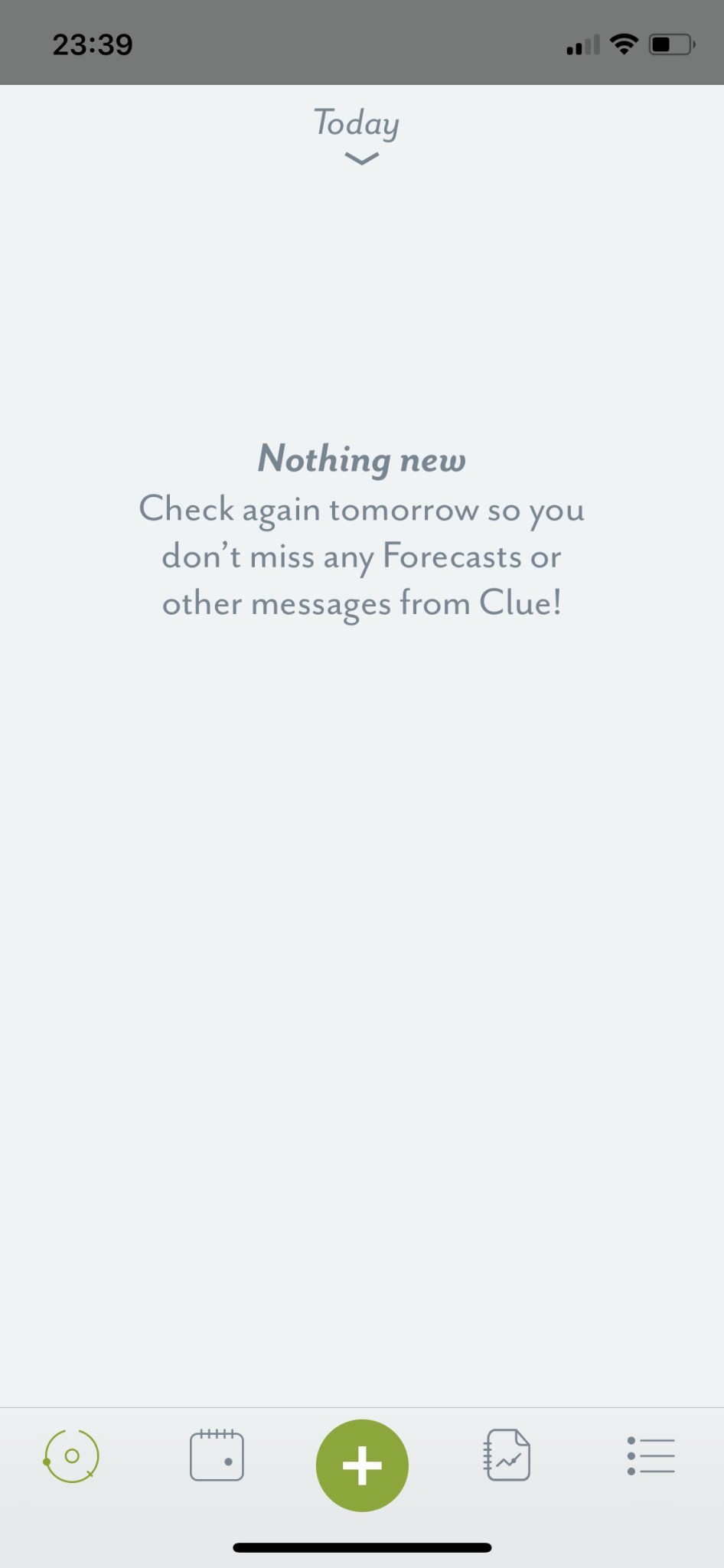
    The main feature of Clue Plus is ‘forecasts.’ When Plus was first released it said ‘know the future’ on its call-to-action button, which completely undermined the meaning of the word ‘forecast’ (estimate) but that was soon gone. Unlike when I first trialled forecasts under Clue Premium I actually got forecasts this time – progress! Unfortunately,  notifications appeared sporadically and often in the evening, so I wasn’t sure if it was talking about today or tomorrow. They all come with one of several generic messages, meaning that if you get multiple forecasts one day things are likely to be repetitive, which ruins the great personalised feel Clue used to have. The cool thing about the forecasts feature is that it asks ‘did this happen today?’ and if you answer yes or no it will log it so you don’t have to.

    As for the accuracy of the forecasts… I’m not convinced but I think other forces are at play (in my body, not at Clue), and it makes me wonder: is there any point in tracking your cycle when you’re on hormonal contraception? When I was off the pill it was really interesting and almost fun to track my cycle because I could see how my mood, motivation, exercise habits, libido and acne all varied across it and how certain things, like staying up all night or having a cold, impacted my cycle. It was also vital in helping me spot trends that led me to seek medical help. But on the pill, there’s far less variation or ‘excitement’ and I find myself using and needing Clue less and less. I do use its pill reminder feature but annoyingly it’s been glitchy lately.

    There is one thing I’d love to see from Clue, that I *might* be willing to pay for, and that’s the ability to analyse two categories at the same time. I think this could really help people identify what’s causing pain or other symptoms. 

    So while Clue Plus is definitely an improvement on its last iteration, I’m not sure there’s much in it for someone on hormonal contraception like myself. I didn’t renew my membership but for now, at least, I still use the free version.

    Let me know if there are any other period or Femtech products you’d like to see me try and I’ll see what I can do! Check out my review of Natural Cycles here.