Tag: Female Health

  • Going digital: pelvic physio & biofeedback | Pleasure Moans #4

    Going digital: pelvic physio & biofeedback | Pleasure Moans #4

    Thank you so much for all the love following my last Pleasure Moans blog and the guest post I wrote for Hysterical Women about finally being diagnosed with endometriosis. If you haven’t read it yet, check it out here

    When I first started writing about investigating my gynae health I wrote, ‘I don’t want to write about it after the fact, because after the fact might not be for a long time.’ Well, it’s a good job I took that attitude because since I got the endometriosis diagnosis in April I’ve been absolutely useless at writing about it, or at least sharing what I have written about it. This is particularly stupid because after so much nonsense I finally seem to be getting somewhere. A positive blog, at last!
    I’m in the middle of (another) Gilmore Girls binge so bare with the GG gifs.

    Two big things have happened since I shared the news of what was then a tentative diagnosis. Firstly, I had the post-op where my gynaecologist put to bed any fears that it still wasn’t really an answer by explaining that I have stage 1 endometriosis, freckled in tiny dots mostly on one side of my uterus/recto-uterine pouch. I even saw pictures (which I won’t share, but don’t worry there’s plenty of oversharing coming up). He continued to relieve my doubt by explaining how low stage endometriosis is sometimes (but obviously not always) more painful or as painful as high grade endometriosis because of where it sits: on the nerve layer. To try and stop it getting worse I am getting a Mirena coil (IUS) fitted at some point this summer – I have a lot of thoughts on this which I’ll share another time in a #Periodically blog.

    The second thing is that I’ve started pelvic physiotherapy. My symptoms of painful sex are explainable by the fact that endometriosis was found in my recto-uterine pouch but a few doctors I’ve seen have suggested that there also appears to be some pelvic floor dysfunction kicking about, hence why I was referred to a women’s health physio. Without a shadow of a doubt, this has been the most positive, interesting, logical and, dare I say it, empowering, part of my medical path so far and a reminder of why the NHS is so bloody brilliant.

    My first appointment was almost an hour long and for good reason. My physio took 50 minutes getting to know me, my medical history and my experience of pain, before a 10 minute pelvic examination. What this meant was that during the verbal consultation we hashed out a hypothesis: that pain, likely caused by endometriosis, had caused the muscles around the top of my vagina to go into spasm creating yet more pain and what feels like a bottleneck in my vagina, explaining why my primary issue is deep pain rather than ‘superficial’ pain. The pelvic examination, which involved gripping my physio’s finger with my fanny (no way to make that sound any less weird), confirmed her suspicions and then some. It seems that the upper part of my pelvic floor is not just in spasm upon penetration, but all the damn time.

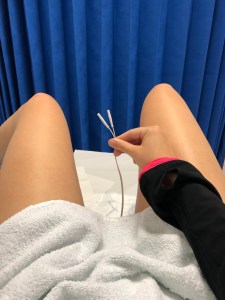
    Turns out, this isn’t an all too common occurrence and so my treatment plan is a bit experimental at the moment but the point is: there is a plan! The plan is biofeedback. It sounds cool because it is. It involves putting a small probe (yep) in my vagina, which is wired up to a monitor that allows me to see and hear my muscle activity. In pelvic physio it’s mostly used to strengthen muscles to improve bladder and bowl function but in my case I’m using it to try and learn how to relax the muscles involved.
    img_8827
    Nothing says ‘relax your vagina’ better than the horror of wires coming out of it…

    It’s a weird thing, because it doesn’t actually do anything to you but it enables you to understand how your muscles are working and what control you have over them in a way that is otherwise impossible. It’s really easy to understand too. Once it was in (I insert and remove it myself to save some awkwardness) my physio asked me to clench/pull up/engage my vagina and the number (microvolts) went up. The issue was that my number didn’t descend low enough when I relaxed. I’ve been doing to this for a couple of sessions now and while I can make the number jump down low, I can’t get it to stay there – so that’s what we’re working on. I’ve posted a video of the unit in action on my Instagram story/highlights if anyone’s interested in seeing how it communicates with you.


    There’s a range of verbal cues used to help someone relax their pelvic floor that of course don’t seem to do anything for me, so it’s a case of trying a bit of everything to find something that works. And for once, I’m actually really hopeful that I will.

    You’d think I’d be used to oversharing by now but believe it or not taboos run deep and I’m still conditioned in ways that made me hesitate about posting this blog, let alone illustrating it. But in my experience personal accounts of deep dyspareunia are few and far between, especially treating/easing that pain, and so it feels important share this story, including pictures of my cyber fanny, just in case it’s of any hope or help to someone else.

    If you’ve tried biofeedback or pelvic physio, for painful sex or something else, and have tips and tricks about how I can get the most out of it please get in touch – I also finally made a Facebook page for the blog so give that a like if you’re feeling friendly! In the mean time, I’m going to keep trying to interpret my vagina’s microvolts… 


  • Clue Plus Review #Periodically 33

    Clue Plus Review #Periodically 33

    One of WordPress’ slightly creepier features allows me to see that a whole bunch of people have been coming to my blog looking for reviews of Clue Plus – the paid-for version of a popular menstrual tracking app. I reviewed it when it was called ‘premium’ and still super expensive, but now that the new and improved version has been rolled out I thought I would update you all on how I found two months using it.

    As mentioned, Clue has made its paid-for version much cheaper. In the UK it now only costs £0.83 a month if you buy a year at a time (£9.96), or £0.99 month-by-month, just a casual £33.03 cheaper than the original version – SO much more affordable. So what about the features, are they more interesting?

    Yes and no. I’ll get to the main feature, forecasts, in a minute but first I want to talk about what else is new. IMG_2986

    Sorry I couldn’t resist that picture placement… Other than the cheaper price and forecasts the only added feature on the paid-for version is that it now notifies you when your period or other menstrual symptoms are ‘out of normal range.’ This is pretty neat and it might help people take their problematic menstrual symptoms seriously, but it doesn’t (yet) consider other data you’ve inputted. For example, I got the alert below, but it didn’t take the fact I’d recently changed hormonal contraception into account and so a 22 day period threw my average off. But, I should add, this might be my fault for not taking advantage of the ‘exclude this cycle’ feature – which exists in the free version and is such a great idea.

    The main feature of Clue Plus is ‘forecasts.’ When Plus was first released it said ‘know the future’ on its call-to-action button, which completely undermined the meaning of the word ‘forecast’ (estimate) but that was soon gone. Unlike when I first trialled forecasts under Clue Premium I actually got forecasts this time – progress! Unfortunately,  notifications appeared sporadically and often in the evening, so I wasn’t sure if it was talking about today or tomorrow. They all come with one of several generic messages, meaning that if you get multiple forecasts one day things are likely to be repetitive, which ruins the great personalised feel Clue used to have. The cool thing about the forecasts feature is that it asks ‘did this happen today?’ and if you answer yes or no it will log it so you don’t have to.

    As for the accuracy of the forecasts… I’m not convinced but I think other forces are at play (in my body, not at Clue), and it makes me wonder: is there any point in tracking your cycle when you’re on hormonal contraception? When I was off the pill it was really interesting and almost fun to track my cycle because I could see how my mood, motivation, exercise habits, libido and acne all varied across it and how certain things, like staying up all night or having a cold, impacted my cycle. It was also vital in helping me spot trends that led me to seek medical help. But on the pill, there’s far less variation or ‘excitement’ and I find myself using and needing Clue less and less. I do use its pill reminder feature but annoyingly it’s been glitchy lately.

    There is one thing I’d love to see from Clue, that I *might* be willing to pay for, and that’s the ability to analyse two categories at the same time. I think this could really help people identify what’s causing pain or other symptoms. 

    So while Clue Plus is definitely an improvement on its last iteration, I’m not sure there’s much in it for someone on hormonal contraception like myself. I didn’t renew my membership but for now, at least, I still use the free version.

    Let me know if there are any other period or Femtech products you’d like to see me try and I’ll see what I can do! Check out my review of Natural Cycles here. 

  • Review: My Thoughts Exactly – Lily Allen

    Review: My Thoughts Exactly – Lily Allen

    I’ve always been a huge fan of Lily Allen’s music and I love an autobiography, so when I heard that she was writing one I was very excited. My Thoughts Exactly is an addictive read that doesn’t disappoint. I’ve always considered Allen to be a bit of a lyrical genius, but now she’s proved herself as a talented writer beyond the realm of music.

    As much as I wanted to savour My Thoughts Exactly, I whizzed through it because it’s so engaging and moving. Allen reveals her darkest moments, fesses up to her failings and raises awareness about a whole bunch of important issues.

    The book chronicles her life so far but not in a strictly chronological order. Always a controversial figure, the tabloid press has often had it in for Allen, so there are some events that you expect to read about, some that show just how wrong some of Allen’s critics appear to have been and others that you don’t see coming. Unsurprisingly, given the title, the stories are very much from her perspective, she doesn’t try to give other sides of the story because she can only give her version of events. From the off, she’s very open and honest about what you’re about to read.

    It’s not a particularly happy book, but I wasn’t expecting it to be. Tackling drug abuse, stalking, infidelity, assault, stillbirth, divorce and mental health, it’s a rough ride. Allen writes it all so vividly and honestly that you’ll often be angry at various people and things, including, but not limited to, Allen’s parents, the music industry, the police, the press and Lily Allen herself. She apologies for the racism in the satirical music video for Hard Out Here and says it was a result of her not paying attention to what was going on around her. Given her very intense personal life that seems entirely possible, but also, it isn’t really good enough, is it? She does, however, talk about how once she stopped being defensive about it she then became interested in intersectional feminism. Allen seems determined to learn from her mistakes but doesn’t deny them ever having happened.

    My Thoughts Exactly documents a lot of chaos. In fact, it’s not unlike the late, great Carrie Fisher’s autobiographies, it’s certainly written as well as them only with considerably less humour. It gets really dark at times, and you find yourself wincing through several chapters, but happily, it has a hopeful ending.

    Allen also departs from the big events to talk about some topics in broader terms, female sexuality is one of them — which of course caught my attention (#sexualityinculture)!  She discusses her struggle with orgasm and the lessons she had to learn to take her own pleasure seriously — it turns out that the song It’s Not Fair wasn’t written about one partner in particular but all sexual encounters in general. Even more relevant to this blog, she touches upon how trauma impacted her menstrual cycle and contraception. #Nevernotrelevant

    For fans of her music, it’s a must-read. One of my favourite things about Allen’s music is that it’s not all romantic love songs, she writes about the press and politics, siblings and parenthood, loss and feminism. All the backstories you’ve imagined from the lyrics and dodgy press coverage are set aside as you learn the real stories behind the songs. It doesn’t make them less relatable, instead, it allows her music to mean even more.