Tag: Endometriosis

  • Going digital: pelvic physio & biofeedback | Pleasure Moans #4

    Going digital: pelvic physio & biofeedback | Pleasure Moans #4

    Thank you so much for all the love following my last Pleasure Moans blog and the guest post I wrote for Hysterical Women about finally being diagnosed with endometriosis. If you haven’t read it yet, check it out here

    When I first started writing about investigating my gynae health I wrote, ‘I don’t want to write about it after the fact, because after the fact might not be for a long time.’ Well, it’s a good job I took that attitude because since I got the endometriosis diagnosis in April I’ve been absolutely useless at writing about it, or at least sharing what I have written about it. This is particularly stupid because after so much nonsense I finally seem to be getting somewhere. A positive blog, at last!

    I’m in the middle of (another) Gilmore Girls binge so bare with the GG gifs.

    Two big things have happened since I shared the news of what was then a tentative diagnosis. Firstly, I had the post-op where my gynaecologist put to bed any fears that it still wasn’t really an answer by explaining that I have stage 1 endometriosis, freckled in tiny dots mostly on one side of my uterus/recto-uterine pouch. I even saw pictures (which I won’t share, but don’t worry there’s plenty of oversharing coming up). He continued to relieve my doubt by explaining how low stage endometriosis is sometimes (but obviously not always) more painful or as painful as high grade endometriosis because of where it sits: on the nerve layer. To try and stop it getting worse I am getting a Mirena coil (IUS) fitted at some point this summer – I have a lot of thoughts on this which I’ll share another time in a #Periodically blog.

    The second thing is that I’ve started pelvic physiotherapy. My symptoms of painful sex are explainable by the fact that endometriosis was found in my recto-uterine pouch but a few doctors I’ve seen have suggested that there also appears to be some pelvic floor dysfunction kicking about, hence why I was referred to a women’s health physio. Without a shadow of a doubt, this has been the most positive, interesting, logical and, dare I say it, empowering, part of my medical path so far and a reminder of why the NHS is so bloody brilliant.

    My first appointment was almost an hour long and for good reason. My physio took 50 minutes getting to know me, my medical history and my experience of pain, before a 10 minute pelvic examination. What this meant was that during the verbal consultation we hashed out a hypothesis: that pain, likely caused by endometriosis, had caused the muscles around the top of my vagina to go into spasm creating yet more pain and what feels like a bottleneck in my vagina, explaining why my primary issue is deep pain rather than ‘superficial’ pain. The pelvic examination, which involved gripping my physio’s finger with my fanny (no way to make that sound any less weird), confirmed her suspicions and then some. It seems that the upper part of my pelvic floor is not just in spasm upon penetration, but all the damn time.

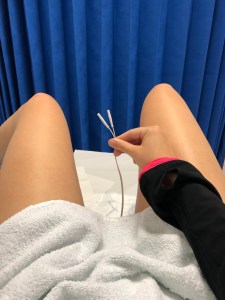
    Turns out, this isn’t an all too common occurrence and so my treatment plan is a bit experimental at the moment but the point is: there is a plan! The plan is biofeedback. It sounds cool because it is. It involves putting a small probe (yep) in my vagina, which is wired up to a monitor that allows me to see and hear my muscle activity. In pelvic physio it’s mostly used to strengthen muscles to improve bladder and bowl function but in my case I’m using it to try and learn how to relax the muscles involved.
    img_8827
    Nothing says ‘relax your vagina’ better than the horror of wires coming out of it…

    It’s a weird thing, because it doesn’t actually do anything to you but it enables you to understand how your muscles are working and what control you have over them in a way that is otherwise impossible. It’s really easy to understand too. Once it was in (I insert and remove it myself to save some awkwardness) my physio asked me to clench/pull up/engage my vagina and the number (microvolts) went up. The issue was that my number didn’t descend low enough when I relaxed. I’ve been doing to this for a couple of sessions now and while I can make the number jump down low, I can’t get it to stay there – so that’s what we’re working on. I’ve posted a video of the unit in action on my Instagram story/highlights if anyone’s interested in seeing how it communicates with you.


    There’s a range of verbal cues used to help someone relax their pelvic floor that of course don’t seem to do anything for me, so it’s a case of trying a bit of everything to find something that works. And for once, I’m actually really hopeful that I will.

    You’d think I’d be used to oversharing by now but believe it or not taboos run deep and I’m still conditioned in ways that made me hesitate about posting this blog, let alone illustrating it. But in my experience personal accounts of deep dyspareunia are few and far between, especially treating/easing that pain, and so it feels important share this story, including pictures of my cyber fanny, just in case it’s of any hope or help to someone else.

    If you’ve tried biofeedback or pelvic physio, for painful sex or something else, and have tips and tricks about how I can get the most out of it please get in touch – I also finally made a Facebook page for the blog so give that a like if you’re feeling friendly! In the mean time, I’m going to keep trying to interpret my vagina’s microvolts… 


  • Vindication, endometriosis & some Douglas bloke | Pleasure Moans #3

    Vindication, endometriosis & some Douglas bloke | Pleasure Moans #3

    In my last blog I detailed my hesitation and resistance to my gynaecologist’s suggestion that I have a second diagnostic laparoscopy (keyhole surgery) to look for endometriosis. It feels weird then, almost two months later, to be writing that this week I had that surgery.

    My hesitations varied from not wanting to repeat another painful and probably pointless surgery like the one I had in August 2017, to wanting an endometriosis specialist to be the one to go in for a second look, rather than a general gynaecologist. Once I received a date for the operation I was more certain than ever that I was going to be withdrawing my name from the waiting list, but I had an upcoming appointment with a different doctor that I had set as the deadline for my final decision.

    This other appointment was a bit of a cock-up – I was supposed to have been referred to a specialist gynaecology clinic in London but wires were crossed and somehow I ended up with a referral to a sexual health clinic in London that specialises in sexual pain. The problem was, the only female sexual pain the clinic deals with was superficial pain, relating to pain that occurs externally or on entry, like vaginismus and vulvodynia. While I have had some run-ins with superficial pain, my most persistent symptom over the last few years has been deep dyspareunia – that’s deep, internal pain during vaginal penetration.

    When I got to the appointment I was, as expected, greeted with, ‘why have you been sent here? We don’t deal with deep pain, that’s gynaecology.’ But I was kind of hoping I might be referred to that hospital’s gynaecology department because it’s one of the best. He decided to examine me anyway, and I realised this was going to be something of a new experience when he said, ‘oh we use stirrups a little differently here…’ One bizarre examination later and he agreed with me that superficial pain was not a primary issue but that it was present. He also said I appear to have some pelvic floor dysfunction which doesn’t surprise me at all. Physio is something I’ve been increasingly curious about over recent months.

    When it became clear that he wasn’t going to refer me to the hospital’s gynae unit, I just decided to ask, ‘do you think I should have a second laparoscopy?’ He took a sharp inhale and said something along the lines of, ‘I’m sure you get this a lot and are pretty fed up of it, but it sounds like endometriosis to me.’ He was right, I have been getting that a lot, increasingly so. He suggested some urological and gastrointestinal causes too, but then he went on to explain endometriosis to me in a way no one else ever had before. He said, ‘some women will be struggling with infertility, have absolutely no pain and a laparoscopy will find endometriosis in abundance. Other people will have serious, chronic pain and yet when endometriosis is found it will be a really small, localised amount, probably on or very near a nerve.’

    This, pardon the pun, really struck a nerve. My symptoms have improved so much since going on the pill that it seemed to me that if I did have endometriosis after all then there couldn’t be very much of it. So I started to focus in on the one symptom that hadn’t changed – deep dyspareunia. I asked around, did a lot of research (I’m particularly grateful for the resources on the Nancy’s Nook Endometriosis Education Facebook page) and discovered that deep dyspareunia is often associated with rectovaginal endometriosis and endometriosis found in the Pouch of Douglas (POD).

    Image result for rectouterine pouch

    ‘POD’ struck a chord. Why did I know those letters? I started sifting through my (now finally organised) records of appointments, examinations and scans and discovered that on one of my more troubling scans, where a persistent hemorrhagic cyst (commonly associated with endometriosis) was found, a very small, uneventful comment was written: ‘some free fluid seen in POD.’ The POD, evidently named after some Douglas bloke, is also known as the ‘rectouterine pouch’ or the ‘posterior pouch.’ It’s the seemingly useless ‘cul de sac’ between the uterus and the rectum. Intelligent design, eat your heart out. The more I read about endometriosis-related dyspareunia the more it all seemed to marry up with my symptoms (retroverted uterus, constipation after sex, deep dyspareunia).

    It was this discovery, as well as my first debilitating period in a year, that pushed me to say I would have the surgery in April after all. I was pretty steady in this decision, up until a week before where I promptly freaked out. My initial fear was that I going to die and it was all going to be my fault, but most of all, I was crippled by the fear of going through the entire process again to be told there was nothing wrong but to continue to be told that my symptoms sound like endometriosis. It’s an incredibly frustrating cycle. Once I talked myself off of that ledge I was determined to be as prepared as I possibly could be for the surgery. Looking at it now, I think I did a pretty good job.

    I had a full sheet of questions and concerns that I wanted to run by my gynaecologist before I let him operate on me, all of which he respectfully and sincerely answered. A few included:

    1. Please don’t stretch my vagina, as you suggested you might – OK
    2. Since deep dyspareunia is my most persistent symptom can you please check my POD and look out for rectovaginal endometriosis – it’s unlikely but sure, I would have looked anyway
    3. Will you open up my old scars or create new ones? A bit of both, personally I prefer going in from the left, so that would mean a new scar
    4. If you find endometriosis how will you treat it? Burn it
    5. Is excision surgery not an option? I hear that it’s better. If it’s significant then I would excise it, yes.

    Ecetera, etcetera.

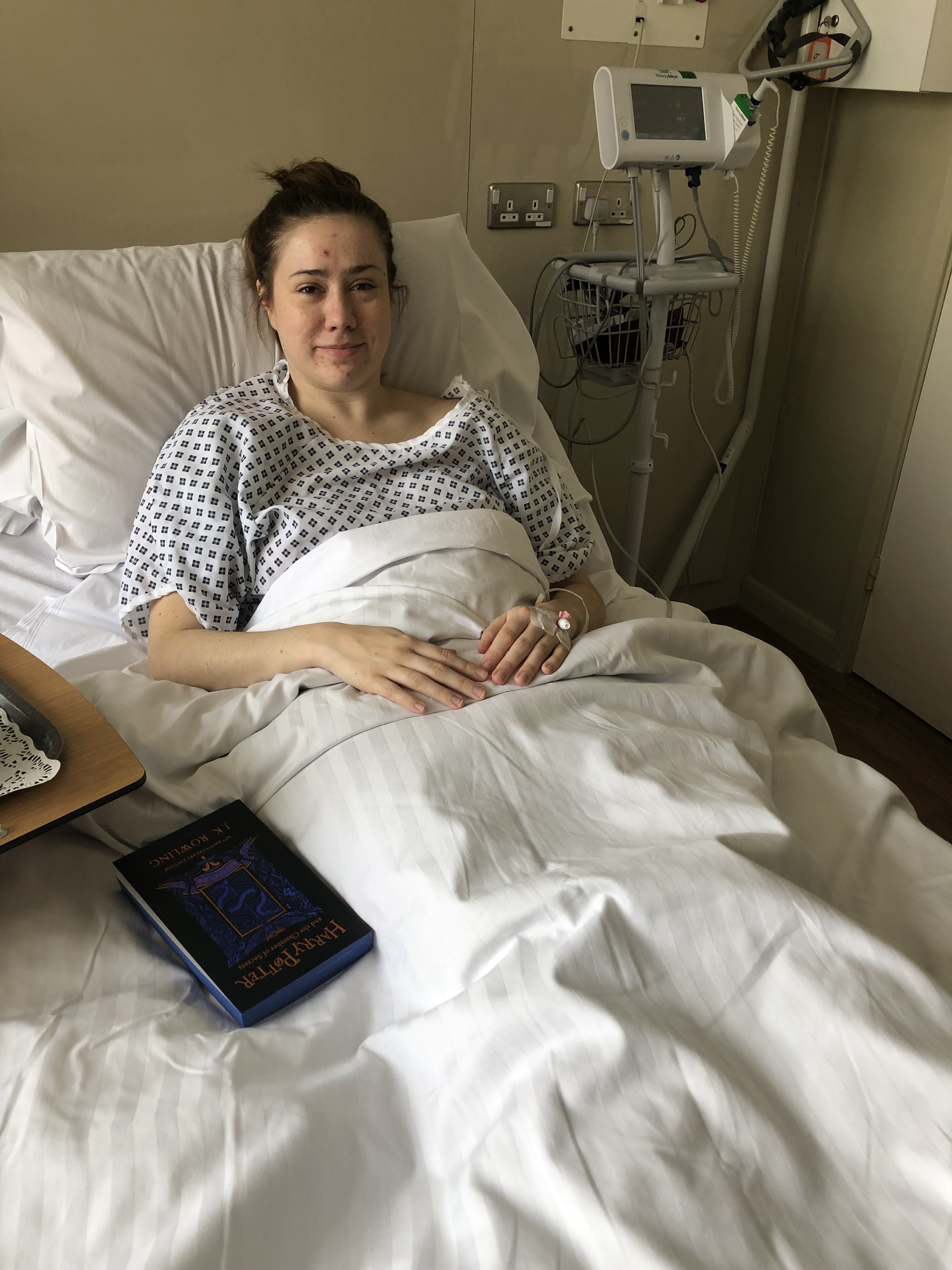
    Reassured by his answers and our rapport, I was readied for surgery and sat reading Chamber of Secrets until they came and got me.

    Inhale.

    A couple of hours later, exactly 20 months after my first disheartening surgery, my gynaecologist swaggered into recovery (where I was crying and swearing because my drugged-up self had come to the conclusion they hadn’t found anything) to tell me, ‘I found endometriosis in your Pouch of Douglas, it’s not in your head!’

    Exhale.

    IMG_7403
    Sore, surprised and a little smug

    It’s only been a few days and I’m still processing. It was a really tiny amount of endometriosis, but as I’ve been reminded time and time again, the severity of endometriosis does not correlate to pain. Giving myself endometriosis imposter syndrome at this point will help nothing.

    I can’t help but wonder what role my own advocacy and research played in finally get an, albeit tentative, answer. Would he have double-checked my POD if I hadn’t specifically done the research and asked him to? Would painful sex ever have been the symptom my doctors focussed on if I hadn’t forced them to? A widely touted statistic about endometriosis is that on average it takes 7.5 years to get a diagnosis, but that’s actually contested between 7 and 12 years. I’ve got here, where I’m not sure I have a diagnosis exactly but where I have had endometriosis discovered and treated, in three and a half years. But reaching this point has been a hell of a lot of hard work, physically and emotionally. I’ve been misdiagnosed with vaginismus, spent months attending psychosexual counselling, been placed on a pill that’s wreaked havoc with my skin and mood, taken anti-depressants for pain management, stopped running, stopped having sex, stopped socialising like a normal twenty-whatever-year-old. I’ve gained a lot too, knowledge, friends, writing gigs, a novel, job opportunities, a post-grad pathway I didn’t expect, a blog – but I am constantly curious about what the last three years might have looked like if my pain had been believed earlier, taken seriously sooner and treated promptly – by myself and by others.

    It’s not yet clear whether this is the beginning or the end of this particular experience. I have a million questions for my post-op appointment and I won’t know if the surgery has actually improved anything for months. But to have had the hysteria label lifted is hugely gratifying. Honestly, I feel vindicated because in my head the pain was never in my head. If that makes any sense at all.

    IMG_2795
    Of course, summer arrived the day after my op so I’ll be sporting some DVT stocking tan lines this year!
  • Gynaecological Whiplash #Periodically 15

    Gynaecological Whiplash #Periodically 15

    I feel like I should start this blog with a “Previously on #Periodically…” but it might just be easier to read Periodically 10, 11 and 12 if you’re new. If you (understandably) can’t be bothered, here’s the gist: in August I had laparoscopic surgery to look for endometriosis, they found nothing but a regular (functional/ovulation) cyst on my right ovary and said there was “no gynaecological cause of pain”. While my belly button took some recovery meanders, I readied myself for my first doctors appointment since moving back to Essex and to look beyond gynaecology (towards bowels and bladder) to find a cause for my pelvic pain. Since then I’ve processed the news and the language issues I was worrying about in Articulating Pain – saying “dementors” instead of pelvic pain has stuck pretty firmly in my vocabulary.

    I must confess, trying to find the words to articulate how confused I am at the moment is proving difficult. Every time I process one fact, something contradicts it and I’m in a new hole of confusion and disillusion. So bear with me. 

    October started with September’s late period and a whole load of nauseating, black-out pain. And it really surprised me. I was surprised because by linguistically and medically disassociating my pain from my menstrual cycle, I think I thought the gynaecological symptoms would disassociate themselves too. Foolish, of course, but that period was a bit of a wake up call.

    Before my first GP appointment I had my symptom spiel ready, I’d checked that my discharge letter from Swansea had transferred and I was ready to start the process once again. Dr C, my new GP, listened to my symptoms, felt my abdomen, read the “no gynaecological cause of pain” letter, then turned to me and said “I am not convinced”. Excuse me? “I am not convinced that it is not gynaecological. You don’t experience painful periods or painful sex unless there is a gynaecological problem”. He ordered an ultrasound and some blood tests and said he would refer me to a gynaecologist.

    I was pissed off. I’d been jokingly forecasting that the doctor was going to refer me to a gyane in this appointment for weeks but I had been joking. I was mad, and my general attitude was “it has taken me 12 months to get to where I am now (which is nowhere) and now we’re going to start all over again from the same place”. Basically, I sulked for a fortnight. Until…

    This week, I headed to the ultrasound with my mum, confused as to why they hadn’t told me to drink a litre of water like last time. The reason I didn’t need any water was because it happened to be an internal ultrasound. Now they had my attention – I’d be moaning for months that it seemed strange to me that I’d never had one of these. While Dr T, who carried out the ultrasound, and the chaperone described the device as a “wet tampon”, I would describe it as a very solid USB dildo that’s plugged into a computer being watched by two doctors and your mum. To my surprise, it hurt almost as much as sex and has left me in the same horrible post-sex pain, but perhaps we now know why.

    I can’t believe I’m writing this. I have a cyst! Two actually, on my right ovary. Yep, what the fuck? Sorry I can’t be more eloquent about this but I am so beyond confused and conflicted at this point that the words in sentence putting is falling out of nick. (What?) One is a small 2cm functional cyst – potentially an ovulation cyst but where I was in my cycle would suggest otherwise. The other cyst however is over 4cm and looks like an hemorrhagic cyst, meaning it has been bled into, which is, get this, potentially an endometrioma or endometrioid cyst. Hmm, those words sound familiar, don’t they?

    Once I had my nickers back on my mum and I expressed our shock upon this discovery to Dr T, explaining the fruitless laparoscopy results just two months earlier. Dr T said: “what and the laparoscopy didn’t find any endometriosis? That’s funny because all your symptoms point towards that”. We all laughed and I went home with the promise that we’ll check to see if the cyst is still there and whether it has grown in six weeks.

    I say laugh but I mean a sort of hysterical confusion and shock induced gurgle. Now, to answer some question my friends have hit me with since the Great Cyst Discovery of October ’17:

    What does this mean? I don’t know.
    Why didn’t they find it in the surgery? I don’t know. It’s possible that it wasn’t there, or that cysts have come and gone and during the lap things just happened to be clear.
    Is this PCOS? I don’t know.
    Is this endometriosis? I don’t know.
    Will they take it out? I don’t know – seems unlikely given my favourite sentence “sometimes you just have to live with it” was uttered during this appointment.
    If they do, would you want to go through surgery (belly button nightmares) all over again? I don’t know.
    Did they actually do anything in the laparoscopy or did they just cut you open, have a cup of tea and then stitch you up (badly)? Maybe. No. A lot of my frustration earlier this week was directed at the surgeons in Swansea, but I know that’s unfair. They knew what they were doing, things must’ve been clear in August. Or maybe the functional cyst they saw was not as functional as they thought.

    I don’t know whether to be mad, happy or upset – I am just very confused. I guess I can say “ovulation pain” rather than “dementors with knives” again now? Plus there’s the fact the whiplash might continue if in six weeks the cyst has disappeared without a trace. I almost begin to get that fuzzy “I’m not imagining it all!” feeling, before I begin to wonder if I imagined the whole surgery in the first place.

    So things are once again painfully up in the air, but for now I am just grateful that despite my obvious doubt, Dr C listened to his gut.

    A bit lost? Don’t blame you. Find the rest of the #Periodically blogs here. Or if it’s a little too TMI for you, I blog about books too here and, finally, last week’s blog can be found here.

    wth