Tag: Endometriosis

  • ‘It’s probably just the endo!’

    ‘It’s probably just the endo!’

    Recently, my body has been treating me to some different symptoms than I’m used to. Some are blasts from the past, others are brand new. Both have left me feeling more acutely unwell. My GP is on maternity leave so while I navigate these new bodily (mal)functions, I’ve been getting to know a couple of new doctors, or rather they’ve been getting to know me, in alarming detail… 

    Meeting a new doctor always brings up some sore feelings for me and involves going through the motions of doubt even the most well-meaning doctors seem to have, especially, but not limited to, believing women’s testimonies of pain. Once I got the endometriosis diagnosis confirmed, I remember thinking that although it was bad news, at least now doctors would have to believe me. Yet the last three times I’ve told a doctor that I have endometriosis, it has been met with scepticism. ‘So why do you think you have endometriosis?’, ‘we can’t know that for certain without surgery,’ ‘and has that been confirmed by laparoscopy?’ are the responses I’ve received. Perhaps I’m paranoid and I’m as suspicious of them as they are of me, but it immediately makes me cringe, knowing that what they’re really asking is: ‘is that a self-diagnosis?’ It stings all the more after I deliberately made a point of never saying ‘I have endometriosis’ before a surgeon found it – hell, didn’t I call it dementors? Another side to this is the uncomfortable truth that actually, I did think it was endometriosis, I did self-diagnose and I was right, it just took three and a half years and two surgeries for a doctor to concur. 

    At one of these appointments the doctor wanted to perform a pelvic exam. I asked if there was a way I could do what needed to be done myself and when she said no, I explained my hesitation around pelvic exams, the associated pain and my pelvic floor dysfunction. Minutes later, when I’m crying in pain and she can’t find my cervix, the doctor looked up between my legs in panic and said,  ‘oh god, is it like this for you every time? I’ll try to be quick!’ She was visibly quite shocked and suddenly started asking more questions and taking me seriously. I just sat there thinking about how the examination didn’t need to be like that, if only you’d listened to, believed and processed what I said before it. Why else would I have said it? I would love to know the answer to this question because I reckon it’s steeped in unconscious biases. Doctor friends, enlighten me! Let’s fix this! 

    Back to the present day, I’ve still got eight months until my appointment with my new gynaecologist, the first endometriosis specialist I’ll have ever seen. I’m also a month away from a colonoscopy. After months of recurrent rectal bleeding I had a slightly more serious ‘episode’ (it was actually hours after the aforementioned pelvic exam). Apparently I should have taken myself to A&E, instead I went home, freaked out and went to sleep. I’m now in a sense of heightened anxiety about going to the loo, because if there is a repeat of this episode, then I’m under strict instructions to take myself straight to hospital. My GP went through the possible outcomes of the colonoscopy, many of which are a little scary, before ending rather perkily with the alternative outcome: ‘it’s probably just the endometriosis!’ 

    While I’m patiently waiting for this mystery to be solved or at least identified, of course my body decided to help me along by giving me a UTI followed by the familiar feeling of kidney pain, sending me to the out of hours doctor on a Saturday night with a suspected kidney infection. The doctor concluded it was either the beginning of a kidney infection or the end of a serious UTI and to keep an eye on it, and then, just as I was leaving the consultation room, she added, ‘it’s also probable it’s just the endo. It can cause a lot of pain, you know.’ 

    I’ve heard that logic twice in two weeks. ‘It’s probably just the endo!’ Is it supposed to reassure me? I don’t want it to be the endo. I don’t want to have to deal with the fact that endometriosis has taken over my bowels and urinary system as well as my sexual and reproductive organs, mostly because, in all likelihood, no one will know what to do with that information. At least we know how to treat kidney infections. Saying, ‘it’s probably just the endo,’ however true it might be, is not particularly helpful or likely to result in relief any time soon. 

    The doctor I will see later this year recently appeared on a Flemish documentary about endometriosis and I was very happy to hear her say that she works together with gastroenterologists and urologists, knowing that more than one expertise is needed to deal with endometriosis. This gives me a lot of hope in the case that these unexpected symptoms are ‘just the endo.’ I just hope my body can cool the drama until then. In the meantime, the colonoscopy will take place in French and my new gynaecologist is in Flanders, so I have some vocab to swot up on… 

    Next month is endometriosis awareness month! Endometriosis UK are running an #EndoTheStigma campaign and are running lots of great online events including this one on Endometriosis and Sex during COVID-19, get involved!   

    Also, did you hear? The Birthrights charity is convening a national inquiry into racial injustice in maternity care. This is a long time coming, follow its progress here

  • Brexit and my body

    Brexit and my body

    Like many, life has been a complete stress fest for reasons mostly out of my control in the last few months so I thought the enforced downtime of my Christmas quarantine would be a good chance to write a blog or two. Problem is, I’ve just been sitting in my parents’ loft working and then listening to Brexit unravel, again. This perhaps explains where the following blog came from.

    When is a good time to emigrate? The answer probably isn’t weeks into a painful treatment for endometriosis, a month before the UK is scheduled to leave the EU just as the world is about to enter a pandemic. You can guess what I did. In my defence, I couldn’t have known about the pandemic. 

    I mentioned a few blogs back that I moved to Belgium for a job. What I didn’t mention was that when I interviewed for the job I had one hot water bottle tied around my waist, another shoved in between my legs and during the meeting I squeezed my stressball in half. I was in a hell of a lot of pain and I was interviewing in the full knowledge that it was perfectly possible, likely even, that if I got the job then my body would not be able to hack a 40 hour work week, especially with such a big change of scenery. I tried it anyway, to varying degrees of success. There are weeks when I feel like I should never have doubted myself or my body, and then there are weeks when I regret not raising a white flag. I am still not very good at listening to my body when it tells me it’s struggling, except and always in hindsight. 

    There are plenty of things that haven’t helped me manage endometriosis over the last 18 months, my own foolishness and the pandemic included, but would you like to know one thing that has consistently complicated things? The British Government and its insistence on dicking about with Brexit. 

    When I first moved to Brussels I was an intern, which unfortunately leaves you in a unique kind of limbo in Belgium. When I say limbo, I mean there are very few grounds on which you can access health insurance like the rest of the working population. I learnt this, unfortunately, when I passed out a few weeks into my Brussels adventure. I was able to access great healthcare, but it was out of pocket. Now the out of pocket prices aren’t astronomical (relative to countries like the U.S, not as much to the free-at-the-point-of-use NHS) but even on a decent intern’s salary and with my body’s record, I knew paying out of pocket wasn’t sustainable. 

    Shortly before I moved, I renewed my European Health Insurance Card (EHIC). I did it almost as a joke, but when another Brexit day came and went without anything happening, I decided to see if my status as an EU citizen had any last minute perks. It did, my EHIC gave me health insurance as if I were a regular employee in Belgium, not because I was an intern, not because of the NHS, just because I was an EU citizen. Problem was, I had no idea at what point Brexit would turn off the coverage. The insurers in Belgium said they didn’t know yet, so I wrote to my (conservative, Boris-championning) MP in the UK, whose response was unsurprisingly useless.

    When your body has become an incredibly uncertain place to live and suddenly your healthcare is reliant on a precarious political situation, you begin to become quite scared of your body in new, very unnerving ways. This anxiety over if and when my health insurance might stop made my doomed mission of avoiding medical intervention that much easier because I relied on the fact that my health insurance was limited in ways I couldn’t fully know. Regardless, my European health insurance got me through the chickenpox and other unexpected gifts from 2020. Yet every time a doctor referred me for an outpatient treatment or investigation, a new gynaecologist or a colonoscopy, they recommended I wait until either the Brexit negotiations were clearer or until I had a job with health insurance.

    Fortunately, my employment situation became more secure and my health insurance should now be unaffected by the end of the Brexit transition period, though I can’t say the same for my right to live or work in Belgium. I am so lucky but I can’t help think of the Brits who will move to Brussels for internships, which are already out of reach to many since they have a reputation for being poorly paid, and how they are going to do so without any health insurance options, especially if there is no deal. At one point when I was trying to sort this whole mess out someone advised me, “just don’t get sick”, a deeply disturbing attitude that I regretfully expect a lot of interns to adopt in the coming months. What’s more, through my work I have had the chance to see the innovations that come from European funding, especially related to health. My skin crawls at the idea that British researchers and innovators won’t have access to these opportunities anymore. 

    So when my MP wrote to me in October 2019 that “the PM has secured a new deal which will allow us to avoid a No Deal Brexit and leave the EU with a deal … If you need any specific support relating to your condition, please do let me know,” not only was he apparently lying about the avoidance of a No Deal Brexit but he was ignorant of the fact that the specific support relating to my condition that I needed was for my government to create an environment where I could make the best decisions for my health based on my body’s needs, without factoring in Brexit negotiations. All I needed was the basic commitment from my government not to use human lives as political pawns. 

    My situation was nothing compared to the precarity Boris Johnson’s government consistently plunge lives into every day but I hope it’s yet another reminder that negotiating policy has real-life consequences before the (likely bad) policy is even made. Everyone keeps talking about the uncertain times we’re living through because of the coronavirus pandemic, which is undeniably true, but let’s not forget that through the Brexit negotiations, the British government has continually chosen to create more uncertainty, for reasons I can only attribute to delusions of grandeur. 

    I know a lot of people have news fatigue at the moment but we can’t let a bad Brexit slip through because of this, I recommend you give Femi Oluwole a follow for some hard truths. I’ll be writing to my MP again but maybe yours will be more helpful than mine?

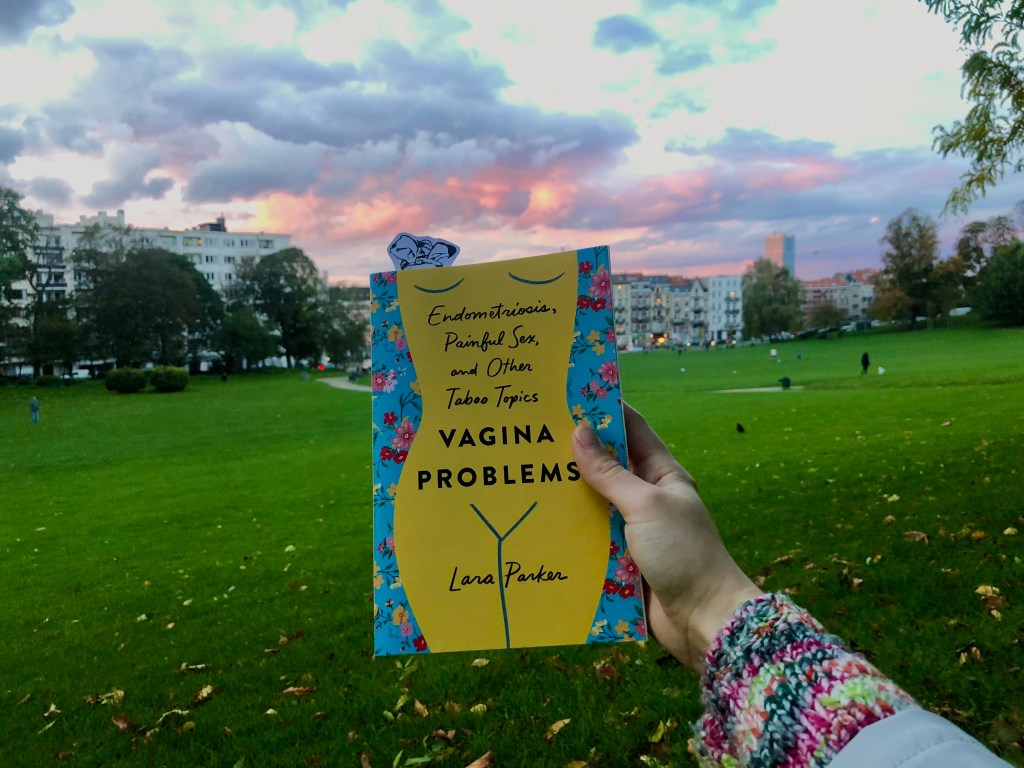
  • Reading Vagina Problems by Lara Parker

    Reading Vagina Problems by Lara Parker

    I love non-fiction – so much so that this blog is probably poorly named. Yet the book I’m going to write about in this blog was pretty difficult to read. It had nothing to do with the writing and a lot to do with the fact that it crossed the line from reading non-fiction to broaden my worldview to reading about my own reality. So while this is a blog about reading Lara Parker’s Vagina Problems: Endometriosis, painful sex and other taboo topics, it is not a review – the subject matter is far too close to home for me to be able to give an ounce of objectivity. 

    Vagina Problems was difficult to read because it made me think about things that I spent the best part of the last year trying not to think about. I’m not sure if it’s the Mirena coil or a perk of COVID-19 restrictions, but my symptoms have become increasingly unpredictable leading to multiple weeks of relative relief that I affectionately call ‘hormone holidays’. These weeks are by no means pain free but the pain is manageable, I can hike and concentrate and think about something other than pain. During these weeks, I again start to wonder if I no longer need to seek treatment for endometriosis, maybe it wasn’t ever that bad in the first place, maybe further intervention isn’t necessary. But Vagina Problems reminded me how much I continue to adapt my life around my own vagina problems. And how while it’s hard to remember pain after the fact, the moment it returns, it is totally life-disrupting. Every time I learn about an external factor that worsens my pain, like sex, running and now stress, I’ve been in the habit of removing that thing from my life. Unfortunately, removing stress isn’t an option and I’m sick of stripping away the good triggers. While I have come to terms with the fact that there probably isn’t a long-term solution to be found at present, it is still worth pursuing one, especially while I have the energy during these ‘holidays’. 

    “Hearing that voice inside my head that says, ‘You probably wouldn’t be in pain if you didn’t eat that cookie,’ and telling it to shut the fuck up. Because the truth is, I’d still be in pain. But I’d be in pain without experiencing the pleasure of eating a cookie. And that’s not the kind of life I want to have.”

    Lara Parker, Vagina Problems – p. 40

    Sometimes when I talk about the last year in Brussels, I frame the story as though endometriosis, vaginismus and pelvic floor dysfunction were the last of my worries, with Brexit, chickenpox and a sodding pandemic trumping the chronic problems. But as I anticipate moving house and watch a new housemate as she discovers the city, I realise that my pain is embedded in my experience of Brussels, my work and my house. “This is where I work,” I said as the metro pulled into the platform, “and that’s where I fainted a year ago… and that’s where I vomited once I came round.” Asked why I fainted, I shrugged and said “pain”. Every time I use my work toilets, I’m reminded of how many times I’ve been sick in them, how it’s one of the first places I experienced rectal bleeding, how often I found blood in that small room and was never entirely sure where it was coming from or why. And then there’s the house. That’s where I sat every Friday evening when I came home from work ill, just in time for the weekend. We used to laugh at it, that I was always unwell the moment the weekend started. It took a lockdown for me to piece together that my body starts to send me red flags to rest on Thursdays and that when I ignore them, something breaks the moment I relax. If this has been the good year for my symptoms, then maybe my gauge for goodness is a bit out of kilter. 

    “I start downplaying what’s going on, or backtracking on what I was trying to reveal … I feel the need to make others comfortable with a situation that I’m definitely not comfortable with.”

    Lara Parker, Vagina Problems – p. 131

    Also etched on this house are my failed attempts at dating again for the first time since my first laparoscopy several years ago. You can take Parker’s chapter on dating with endometriosis (titled ‘Hi, my vagina hurts, wanna date?’) and just staple it to my forehead so that people can read my thoughts. Perhaps it’s because we’re both white and date men, but it seems as though I’ve been on a very similar journey to Parker regarding pain, sex and communication. Like me, Parker’s pain during sex is not just limited to penetration or insertion, “just getting aroused can cause a shooting pain from my pelvic area throughout my entire body… it’s not exactly an aphrodisiac,” and like Parker, I’ve spent years fretting over when is a good time to break that news to a potential partner. I recently came to the same sucky conclusion as her: “I don’t think there’s ever going to feel like the right time because it will always feel like boiling-hot water burning your tongue after you spit it out”. And when that communication breaks down, or just doesn’t happen, sometimes it backfires and the other person comes across very, very badly. I’ve tried explaining this to friends and never found the words, but now I have Parker’s:

     “Maybe he was scared! Maybe I wasn’t communicating what the fuck was happening and not providing an opening for a conversation about it. He was confused, I am sure. And for that, I give him 12 percent of my sympathy. Because guess what? As confused as he might have been, so was I. And I was the one dealing with the actual fucking pain.”

    Lara Parker, Vagina Problems – p. 119

    When I think about my future in terms of treatment and any potential coupledom, I’m surprised to find them interlinked, after fighting against doctors’ assumptions of such a link for years. But they’re not linked in the way people always assumed. Let’s say I see this top doctor in Belgium and she is as skilled as the world says she is and she greatly improves my symptoms to the point that I can once again have an active and social personal life and have or even enjoy penetrative sex again? What if I entered a relationship after that point and my partner didn’t know what it took to get there – what if there even came a point where it was taken for granted because they didn’t know what a huge deal it was for me? Then on the other side, what if I see this doctor, and like the others that came before her, she can’t do anything for me? It’s hard to imagine having a functional relationship with someone who didn’t witness that process and know first hand that I didn’t chose the result. Although maybe that attitude is rooted in living in a world where women are rarely believed on testimony alone. 

    I am certain that these aren’t good reasons to start a relationship, and they’re definitely not reasons to have more surgery, yet one intense weekend reading Vagina Problems had me actively using a dating app and on a waiting list for a new gynaecologist after months of dithering on both. I’m still not sure if either of those things are good but somewhere in there, there’s hope. 

    You can follow Lara Parker on Instagram and buy her book here. At the moment she’s raising awareness about U.S. endometriosis experts who have donated to Trump’s campaign. I join her in saying that they cannot advocate for people with endometriosis when they are supporting racist and sexist policymaking. Doing so is to work directly against the patients they claim to care for. I encourage my U.S. readers (that’s 37% of you!) to cast your vote if you haven’t already and to know that a vote for Trump is a vote against pretty much everything good in this world, including access to safe healthcare. Elsewhere, the all party parliamentary group (APPG) report on Endometriosis has just been published – read it here