Tag: Creative Writing

  • Am I hysterical, an oversharer, ill or all of the above? #Periodically 1

    Am I hysterical, an oversharer, ill or all of the above? #Periodically 1


    I am a chronic oversharer. Sometimes this is good, but online I am very anxious about what I share and where I share it. Cyber-awareness is really, really important. The internet is such a great tool for sharing thoughts and ideas, and over the last few years I have really enjoyed blogging – but I’m always very careful to keep it relatively impersonal by writing about marathon training, my year abroad or, currently, reading. I’ve restricted my blogs with tight boundaries in the hopes of stopping myself from falling into the temptation of revealing too much about my personal life.

    But blogging is personal. I’ve written journals on and off since I was eleven and consistently since I was sixteen, but there comes a point when you want to share some of those thoughts and ideas. Some of the best blogs I’ve read have been born from the writer finding solace in a difficult situation by writing about it – a tale as old as time, right? One of my favourite examples being my dad’s brilliant cancer blog: Man vs Breast Cancer.

    For a couple of years now, I have been dealing with issues with my reproductive health. As we know there remain dozens of various stigmas and taboos around the subject of periods and female sexuality that would justify my silence over the subject, besides, for many people who menstruate, it is a very personal thing. But the other problem, perhaps the most difficult, is knowing when you’re making a fuss about nothing. Periods hurt, periods aren’t always pleasant, sex isn’t always good, pain is subjective and human bodies are not intelligently designed, they are flawed.

    According to a study from January 2017, painful sex is reported by 7.5% of women in Britain, and is linked to ‘poorer sexual, physical, relational and mental health’. Painful and heavy periods are also a common complaint among women all over the world – how and why is my pain any different? Is it?

    I’ve been in cahoots with my doctor about period, sex, post-sex and general everyday abdominal pain for nine months. I had, of course, diagnosed myself with several things on the internet; polycystic ovaries, fibroids, endometriosis, etc. Luckily, my GP has been brilliant. We swiftly ruled out polycystic ovaries, fibroids have never been mentioned, but the word ‘endometriosis’ kept being thrown about. My *sometimes* retroverted uterus added to suspicions and so I began the wait to see a gynaecologist. An ultrasound and a couple of pelvic exams (they’re a treat, aren’t they?) later and I’ve been on the waiting list for a diagnostic laparoscopy (keyhole surgery) for four months now.

    My doctors have both made it very clear to me; it sounds like it’s endometriosis – but there is a very high chance that it is not. The gynae also made it pretty clear that if it isn’t endometriosis then there’s not really *anything* else it could be. This had a huge influence in my decision not write publicly about it.

    There are two problems with this choice of inaction. On average it takes 7.5 years for someone to be diagnosed with endometriosis. I can’t keep my mouth shut for that long, are you mad? I don’t want to write about it after the fact, because after the fact might not be for a long time. I want to write about it while it is happening. The other problem is that if I don’t have endometriosis, it might be the end of the story for my doctor – but what about me? Just because in a couple of months someone might say to me ‘good news, it’s not endo’ does not mean that any of my pain, that has increased week-on-week for the last year, is going to stop.

    There is a hole in research about the female body, female reproductive health and female sexuality. This hole in the research is something which really interests me, and I see it undoubtedly occupying many of my writing ventures over the coming years. My fascination with the subject has wormed its way into every aspect of my writing recently, in almost every academic essay, its presence in my creative writing and as a theme throughout the books I’ve been blogging about on Fictitiously Hilary. I worry about what happens when we give young girls very little information about what is and isn’t normal about menstruation and sex, especially when our understanding of it remains limited.

    I don’t want to just document my experience, but I want to be involved in normalising conversations about the most intimate aspects of our bodies and our relationships and how the two are inherently connected. Until I manage to land a job that allows me to do this full time, for now I would love to occasionally use the platform of this blog to discuss what change is needed and how we can bring it about.

    Whatever happens when I have the diagnostic surgery, it is not going to be the end, it is more likely to open up one of two outcomes. Option one: how serious the endometriosis is, whether it’s a quick fix or a more complicated process. Option two: what the hell is wrong with my body then, because something ain’t right.

    Periods should not be debilitating and sex should not have to hurt. These are two things that I am dealing with at the moment and I can’t not talk about it – it’s important. It’s important because I know I’m not the only one.

    The App Clue is something that has undeniably helped me get as far as I have with my ‘diagnosis’ but having recently become a Clue Ambassador I am increasingly aware, thanks to the stories of other ambassadors, about the alarming levels of pain and discomfort people with uteruses are putting up with and have been putting up with since the dawn of time.

    I am nervous about sharing this, because I can’t shake the guilt that I might be making a fuss over nothing when others are really suffering. But at the same time, I am so fascinated and excited by what should be a revolutionary couple of decades in the understanding of female health, that I cannot turn my head and I cannot put my pen down. Trusting your body when it tells you that something is wrong is really important. Given how little we understand the female body, it is perfectly possible that people with uteruses who are turned away by doctors are suffering from conditions that haven’t yet been discovered. But the funding won’t go to the relevant research until we start having conversations about what is happening behind bathroom and bedroom doors.

    One thing I’ve discovered over the last year is that when you start talking about your concerns about your reproductive and sexual health, others start sharing their experiences. Sometimes this reassures you that you’re ‘normal’, other times it brings out other issues that you are flabbergasted no one is talking about. There are obviously people that really do not want to talk about it, and that’s OK, but for those of us that do – let’s crack on.

    I have essays and journal entries with all the nitty gritty details about my experiences so far that I would be willing to share. For now though, this post is just to test the water, to gauge the reaction, to see how many times I’m called hysterical or scolded for TMI. Or, alternatively, whether there is indeed a conversation here to be had.

    Please, if you’re interested in more blogs like this or on this subject, don’t be shy.
  • Final (probably) Revision Reads

    Final (probably) Revision Reads

    It is with a real mix of emotions that today I finished my degree as I come to the end of one really intense month of hard work and the end of four years of sheer joy. Given the intensity of the last three weeks in particular I haven’t had time to blog – something I expect I will have a lot more time to do over the next few weeks. But I have still been reading!

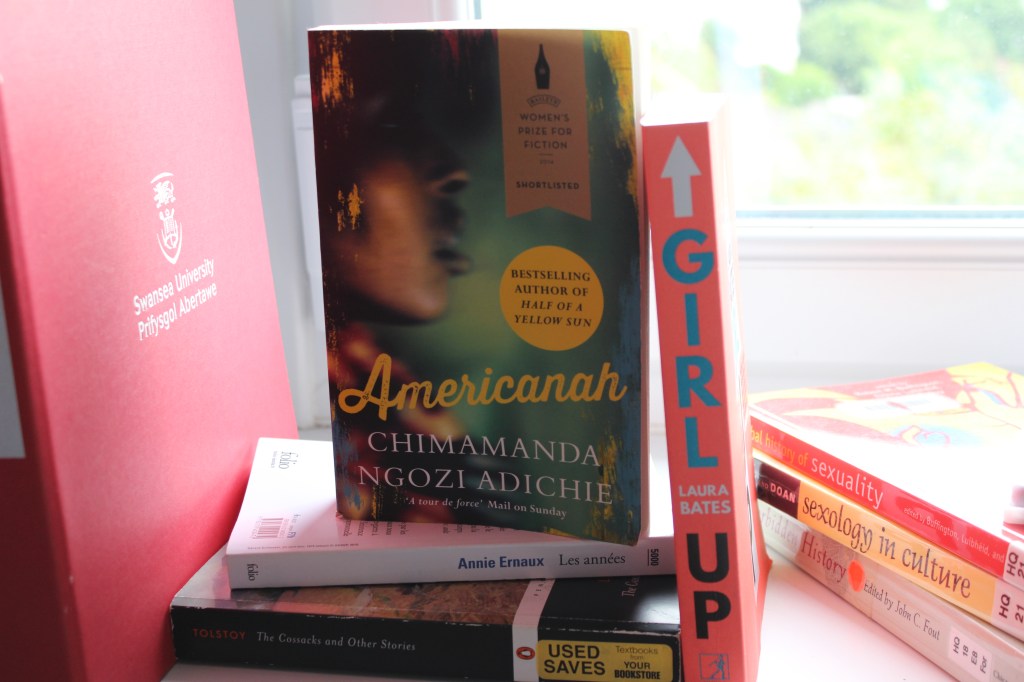
    During deadline and exam periods I’m always surprised to find that reading is actually something I do more of. I find reading the odd chapter of a novel or blasting through a non-fiction book totally different from anything I’m studying is a great way of blowing off steam in between revising vocabulary and proof reading essays. So here are my, potentially final, revision reads:

    The Cossacks and Other Stories – Leo Tolstoy

    It’s no news to this blog that I’m a big fan of Tolstoy. I asked for this book for Christmas in the hopes of being able to get more Tolstoy in a shorter burst compared to Anna Karenina and War and Peace. For short stories, they’re still pretty damn long… damn it Tolstoy. Regardless, I really enjoyed them, and I love how Tolstoy manages to make the most mundane of things incredibly profound and poetic:
    “No, the hero of my story, whom I love with all my heart and soul, whom I have attempted to portray in all his beauty and who has always been, is now and will always be supremely magnificent, is truth” – Sevastopol in May. 

    GIRL UP – Laura Bates

    While I haven’t read Everyday Sexism I have been a big fan of Laura Bates ever since I got Twitter and discovered the Everyday Sexism Project. Much like Doing It, I feel like I didn’t learn a whole lot new but the ideas in these books are incredibly valuable for teenagers and those involved in their lives. Honestly, it’s the kind of book I read and I think ‘my dad should read this’… more to come on that particular idea in a future blog. 10/10 for pictures of dancing vaginas – if I wasn’t going to pass the book on I would definitely cut several pages out as post cards.

    Les Années – Annie Ernaux

    I studied Cleaned Out in my first year and absolutely loved it. Why it took me so long to read another Ernaux book, and in French this time, I do not know. It’s such a cool and unique book. It’s often described as an impersonal autobiography and that’s exactly what it is. It became quite a nostalgic read for me, as many of the political, social and cultural events that Ernaux comments on throughout Les Années are subjects I’ve studied in French modules at Swansea – we’ve come full circle, eh?

    Americanah – Chiamanda Ngozi Adichie

    Without a doubt the most I have enjoyed a novel in a while. Americanah accompanied me through the last five days of intense revision and it totally transported me away from adjectival agreement and the passé simple tense. In the novel protagonist Ifemelu asks ‘why did people ask “What is it about?” as if a novel had to be about only one thing.’ It is the perfect way to respond to someone asking what Americanah is about – it covers so much in such a wonderful way. Despite the title the novel transcends location as it explores identity, race, gender, academia, social media and immigration in America, Nigeria and the UK, while maintaining a complex and meandering story of love and sex. Released in just 2014, it’s depressing how ironic the hope of Obama’s election in the novel feels now, reading from the reign of Trump, and it does give me pretty big blog success envy, but truth be told, Americanah was such a treat to read.

    Expect more blogs from me now I’m done revising, book recommendations for an unemployed graduate are greatly appreciated. I have also now finished my time as Deputy Editor and as a writer at Waterfront newspaper, which means this ‘fiction’ blog may soon have to become the platform for me to write on other topics, i.e. current affairs and feminism. A new section called Non-Fictitiously Hilary, perhaps? Thoughts?

    IMG_7694


  • Set texts from my degree at Swansea

    Set texts from my degree at Swansea

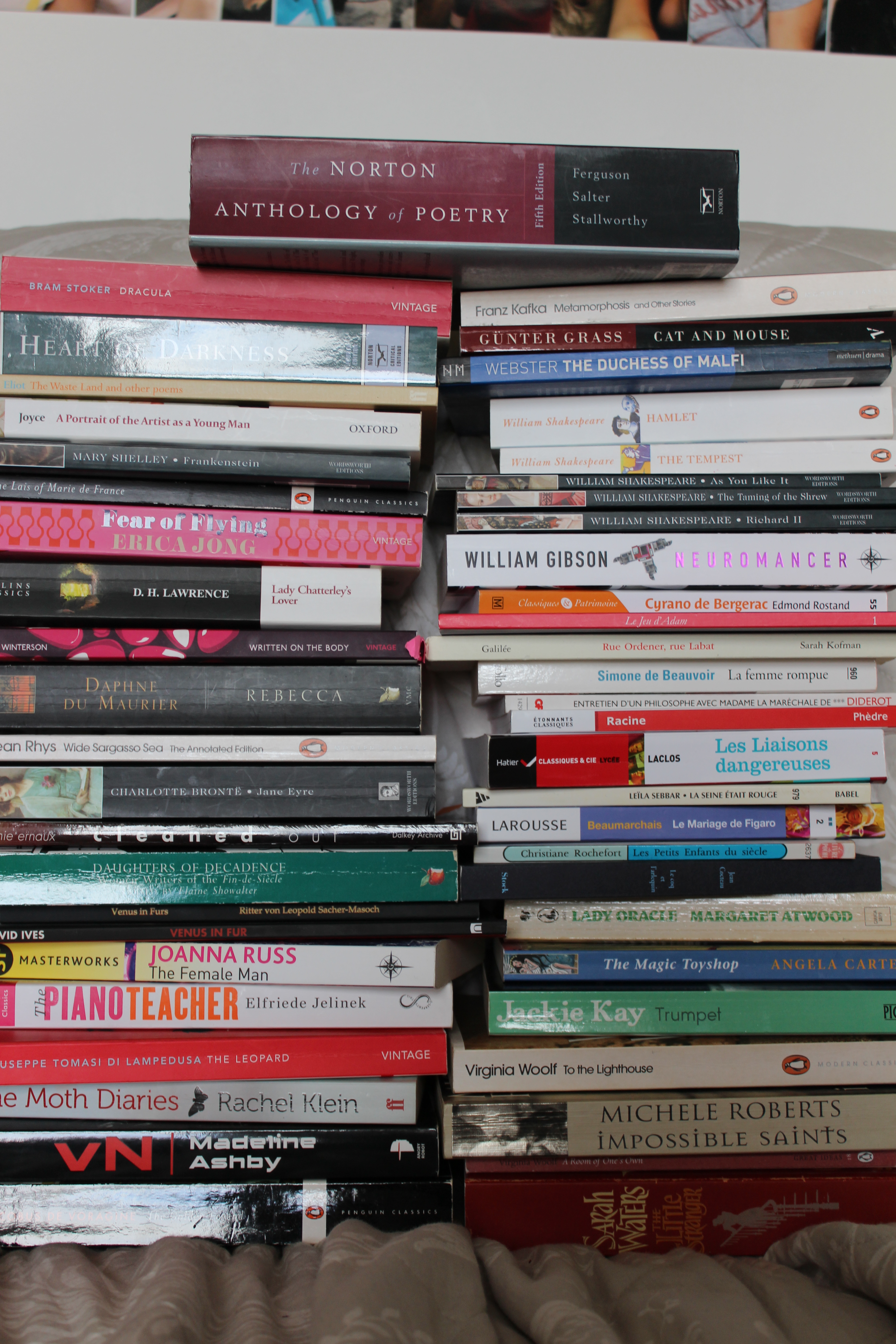
    Some say that your essays, or your certificate, or your experiences are the accumulation of your time at university. For me however, I would say my bursting bookshelves are the product of my degree (and demise of my student loan). This blog is a list of the 59 books from my reading lists over four years at university. To clarify these are the set texts I have studied and my dissertation texts, god knows how many other books I’ve read for fun, recommended and secondary reading, or those I read during my year abroad.

    Some are in French, most are in English, some are translations of other European languages. Some poems have probably been left off but chances are they can be found in the Norton Anthology. Some books, like Jane Eyre, reoccured throughout my degree haunting me like bloody Bertha. Others I would never have picked up if it hadn’t of been for a module I reluctantly took and I’m so grateful that university led me to them.

    They’re roughly in a chronological order, mostly by module, over the last four years. I can’t comment on every single book, that would make this a never ending blog. There’s also a long list of films I’ve studied but again, this blog will need to end at some point.

    I’m half way through the final book Neuromancer, and as much as I’m enjoying it, and have enjoyed this entire reading list, a little part of me is giddy with excitement over the fact that once I finish this last book, I am free to read whatever I want whenever I want, as quickly or as slowly as I like for the first time since I was 14! Eek! That’s such an exciting prospect! So without further ado, here’s my reading list from a degree in English Literature and French at Swansea University, and what a reading list it’s been.

    IMG_6982

    1. La femme rompue – Simone de Beauvoir
    2. Entretien d’un philosophe avec la Maréchale de *** – Denis Diderot My first philosophical text and I got an awful grade for the essay I wrote on it too… though I was also given kudos for attempting a harder text. Because kudos are exactly what every first year student wants.
    3. Against Nature – Joris-Karl Huysmans
    4. Tonio Kröger – Thomas Mann
    5. Metamorphosis – Franz Kafka This was the point in my degree when I became convinced I was living my dream of becoming Rory Gilmore. 
    6. The Cloven Viscount – Italo Calvino
    7. Cat and Mouse – Günter Grass
    8. Cleaned Out – Annie Ernaux This started a love affair with Ernaux. Absolutely love her and have continued to read her books in French but still need to read Cleaned Out in the original French. 
    9. The Garden of Secrets – Juan Goytisolo
    10. Norton Anthology of Poetry (Fifth Edition) I don’t want to talk about it… 
    11.  Lady Oracle Margaret Atwood Is any reading list complete without Atwood? 
    12. The Yellow Wallpaper – Charlotte Perkins Gilman
    13. Trumpet – Jackie Kay READ IT. READ IT NOW. 
    14. A Room of One’s Own – Virginia Woolf Woolf cropped up many times throughout my degree, in fact we recently translated part of A Room in our French grammar class which was a total joy. This speech was hugely influential on the world, but also on me. IMG_6994
    15. Daughters of Decadence: Women Writers of the Fin de Siècle – ed. Elaine Showalter
    16. Frankenstein – Mary Shelley
    17. Dracula – Bram Stoker
    18. Jane Eyre – Charlotte Brontë I REALLY don’t want to talk about it. 
    19. Wide Sargasso Sea – Jean Rhys
    20. Le Coq et l’Arlequin – Jean Cocteau
    21. Rue Ordener, Rue Labat – Sarah Kofman
    22. Les Petits Enfants du siècle – Christiane Rochefort Know those books you mostly like simply because of how passionate your lecturer was about the course material? No? Just me then. This was one of those… I can’t even read the title or hear Christiane Rochefort without reminiscing to that fortnight of second year classes.
    23. La Seine était rouge – Leila Sebbar I’d never heard of the Algerian massacre in Paris on May 8th 1945 until I studied this book. It opened up a whole part of history to me, it’s cool when a book can do that. 
    24. The Taming of the Shrew – William Shakespeare
    25. As You Like It -William Shakespeare
    26. Richard III -William Shakespeare These five were, clearly, part of a Shakespeare module. Since I studied Romeo and Juliet every year from year 6 to year 11, it was so refreshing to mix it up in the Shakespeare department. A lecture on Richard III actually led me to watching House of Cards so that was cool. 
    27. Hamlet -William Shakespeare
    28. The Tempest -William Shakespeare
    29. Charles Perrault’s Fairy Tales
    30. The Bloody Chamber and Other Stories – Angela Carter
    31. The Golden Legend – Jacobus de Voragine Maybe it’s the former Catholic School Girl in me but I really enjoyed studying some of these stories. 
    32. The Lais of Marie de France Cropped up many, many times in English and French modules alike. 
    33. Chaucer’s Clerk’s Tale
    34. The Duchess of Malfi – John Webster
    35. Rebecca – Daphne du Maurier
    36. Impossible Saints – Michèle Roberts Ditto to The Golden Legend but perhaps because I am a former Catholic School Girl… 
    37. Heart of Darkness – Joseph Conrad Let’s not… 
    38. A Portrait of the Artist as a Young Man – James Joyce The books around this part of the list come from a Modernist module, a module which came from Hell. Portrait was the solace in the storm though as I enjoyed it more than anything else in the module even more than To The Lighthouse! 
    39. To the Lighthouse – Virginia Woolf
    40. Le Jeu d’Adam 
    41. L’école des femmes – Jean Baptiste Molière
    42. Phèdre – Jean Racine I just really enjoyed revising this for the exam… is that weird? 
    43. Le Mariage de Figaro – Beaumarcharais
    44. Les Liaisons Dangereuses – Pierre Choderlos de Laclos Love, love, love. 
    45. The Magic Toyshop – Angela Carter
    46. The Little Stranger – Sarah Waters Was so excited when I saw Waters on the reading list for this module. I had tried and failed to get her into my dissertation so jumped at the chance to write about her. 
    47. The Moth Diaries – Rachel Klein
    48. The Female Man – Joanna Russ
    49. vN – Madeleine Ashby Rekindled a love for Sci-Fi that I forgot I had! 
    50. Neuromancer – William Gibson
    51. Cyrano de Bergerac – Edmond Rostand
    52. Venus in Furs – Leopold Sacher-Masoch When it comes to S&M everyone seems to focus on de Sade, so it was really interesting the learn and understand the origin of Masochism. 
    53. Venus in Fur – David Ives
    54. The Leopard – Guisspe Tomasi di Lampedusa
    55. The Piano Teacher – Elfriede Jelinek Disturbing but really damn enjoyable. 
    56. Blood Wedding – Frederico Garcia Lorca
    57. Lady Chatterley’s Lover – D. H. Lawrence
    58. Written on the Body – Jeanette Winterson
    59. Fear of Flying – Erica Jong These final three texts are my core dissertation books… so while they weren’t set by the university they’ve been a huge part, if not the biggest part, of my final year at Swansea. I now have a total love-hate relationship with Lady Chatterley’s Lover but I am more in love with Fear of Flying than I think is healthy… 

    diss books