Category: Miscellaneous

  • Brexit and my body

    Brexit and my body

    Like many, life has been a complete stress fest for reasons mostly out of my control in the last few months so I thought the enforced downtime of my Christmas quarantine would be a good chance to write a blog or two. Problem is, I’ve just been sitting in my parents’ loft working and then listening to Brexit unravel, again. This perhaps explains where the following blog came from.

    When is a good time to emigrate? The answer probably isn’t weeks into a painful treatment for endometriosis, a month before the UK is scheduled to leave the EU just as the world is about to enter a pandemic. You can guess what I did. In my defence, I couldn’t have known about the pandemic. 

    I mentioned a few blogs back that I moved to Belgium for a job. What I didn’t mention was that when I interviewed for the job I had one hot water bottle tied around my waist, another shoved in between my legs and during the meeting I squeezed my stressball in half. I was in a hell of a lot of pain and I was interviewing in the full knowledge that it was perfectly possible, likely even, that if I got the job then my body would not be able to hack a 40 hour work week, especially with such a big change of scenery. I tried it anyway, to varying degrees of success. There are weeks when I feel like I should never have doubted myself or my body, and then there are weeks when I regret not raising a white flag. I am still not very good at listening to my body when it tells me it’s struggling, except and always in hindsight. 

    There are plenty of things that haven’t helped me manage endometriosis over the last 18 months, my own foolishness and the pandemic included, but would you like to know one thing that has consistently complicated things? The British Government and its insistence on dicking about with Brexit. 

    When I first moved to Brussels I was an intern, which unfortunately leaves you in a unique kind of limbo in Belgium. When I say limbo, I mean there are very few grounds on which you can access health insurance like the rest of the working population. I learnt this, unfortunately, when I passed out a few weeks into my Brussels adventure. I was able to access great healthcare, but it was out of pocket. Now the out of pocket prices aren’t astronomical (relative to countries like the U.S, not as much to the free-at-the-point-of-use NHS) but even on a decent intern’s salary and with my body’s record, I knew paying out of pocket wasn’t sustainable. 

    Shortly before I moved, I renewed my European Health Insurance Card (EHIC). I did it almost as a joke, but when another Brexit day came and went without anything happening, I decided to see if my status as an EU citizen had any last minute perks. It did, my EHIC gave me health insurance as if I were a regular employee in Belgium, not because I was an intern, not because of the NHS, just because I was an EU citizen. Problem was, I had no idea at what point Brexit would turn off the coverage. The insurers in Belgium said they didn’t know yet, so I wrote to my (conservative, Boris-championning) MP in the UK, whose response was unsurprisingly useless.

    When your body has become an incredibly uncertain place to live and suddenly your healthcare is reliant on a precarious political situation, you begin to become quite scared of your body in new, very unnerving ways. This anxiety over if and when my health insurance might stop made my doomed mission of avoiding medical intervention that much easier because I relied on the fact that my health insurance was limited in ways I couldn’t fully know. Regardless, my European health insurance got me through the chickenpox and other unexpected gifts from 2020. Yet every time a doctor referred me for an outpatient treatment or investigation, a new gynaecologist or a colonoscopy, they recommended I wait until either the Brexit negotiations were clearer or until I had a job with health insurance.

    Fortunately, my employment situation became more secure and my health insurance should now be unaffected by the end of the Brexit transition period, though I can’t say the same for my right to live or work in Belgium. I am so lucky but I can’t help think of the Brits who will move to Brussels for internships, which are already out of reach to many since they have a reputation for being poorly paid, and how they are going to do so without any health insurance options, especially if there is no deal. At one point when I was trying to sort this whole mess out someone advised me, “just don’t get sick”, a deeply disturbing attitude that I regretfully expect a lot of interns to adopt in the coming months. What’s more, through my work I have had the chance to see the innovations that come from European funding, especially related to health. My skin crawls at the idea that British researchers and innovators won’t have access to these opportunities anymore. 

    So when my MP wrote to me in October 2019 that “the PM has secured a new deal which will allow us to avoid a No Deal Brexit and leave the EU with a deal … If you need any specific support relating to your condition, please do let me know,” not only was he apparently lying about the avoidance of a No Deal Brexit but he was ignorant of the fact that the specific support relating to my condition that I needed was for my government to create an environment where I could make the best decisions for my health based on my body’s needs, without factoring in Brexit negotiations. All I needed was the basic commitment from my government not to use human lives as political pawns. 

    My situation was nothing compared to the precarity Boris Johnson’s government consistently plunge lives into every day but I hope it’s yet another reminder that negotiating policy has real-life consequences before the (likely bad) policy is even made. Everyone keeps talking about the uncertain times we’re living through because of the coronavirus pandemic, which is undeniably true, but let’s not forget that through the Brexit negotiations, the British government has continually chosen to create more uncertainty, for reasons I can only attribute to delusions of grandeur. 

    I know a lot of people have news fatigue at the moment but we can’t let a bad Brexit slip through because of this, I recommend you give Femi Oluwole a follow for some hard truths. I’ll be writing to my MP again but maybe yours will be more helpful than mine?

  • Becoming a Podcast Person

    Becoming a Podcast Person

    A million years late to the game, I have finally delved into the wonderful world of podcasts. I think there’s always been a lot of content out there that intrigued me but I never knew when exactly to listen to podcasts. I prefer working and writing in pin-drop silence, in my downtime or on the train I read, when I drive I sing and when I walk the dog I listen to music and *sometimes* pretend I’m in a OTT music video… I was pretty set in my ways and didn’t much like the idea of mixing those habits up.

    In the end, it took a podcast I couldn’t resist to finally get me to reassess when I could make time for podcasts. What was it? About Race with Reni Eddo-Lodge. I’ll get into the why and wherefore in a moment, but for me, About Race was a gateway drug into the world of podcasts. I tweeted asking for recommendations a few weeks ago, but please, let me know what else is good. For now though, here are the podcasts I’ve started with.

    (Oh, and if you’re interested, dog walking is now podcast time. It’s fine, I can do the music video thing in the car too).

    About Race – Reni Eddo-Lodge

    Earlier in the year I read Eddo-Lodge’s debut non-fiction book Why I’m No Longer Talking to White People About Race. You’ve probably heard of it because it’s been a huge success. It is brilliant. The history of race in the UK is long and complicated, rich and relevant, and I somehow got to university before it was ever really mentioned to me in an educational setting – that’s maddening.  While I loved Why I’m No Longer it left me wanting more… And then the podcast came along and was even better than the bloody book.

    https://twitter.com/renireni/status/994464605312311296

    About Race is a discussion about the racial history of the UK from the ‘recent past’ to now with political, cultural and academic guests who explore the ins and outs of key events in British race relations, how we can learn from disasters, repeat success stories and so much more. Guests range from Akala to Lily Allen’s mum Alison Owen, Diane Abbott to Gabby Edlin, Owen Jones to Meera Syal, Laurie Penny to Nish Kumar. It really is amazing and is essential listening if you want to better understand 2018 Britain.

    Here’s hoping a second series will be coming soon!

    My Dad Wrote a Porno – Jamie Morton, James Cooper & Alice Levine

    Surprise to no one, when I mentioned I was dabbling in the world of podcasts, this was recommended to me by a number of people, I can’t imagine why… I’ve known about it for years but I’ve always been intimidated by the fear of never being able to catch up. Again, surprise to no one, catching up hasn’t been that difficult – how could it be when it’s so funny? My Dad Wrote a Porno is pretty well-known now (they’re doing live shows at the Albert Hall) but in case anyone doesn’t know the premise; Jamie’s father, “Rocky Flintstone,” has self-published his erotica Belinda Blinks. Jamie and his friends then rinse the novels on an extraordinarily popular podcast. What’s not to love?

    Banging Book Club – Hannah Witton, Lucy Moon & Leena Norms

    While I’m not a book club fan myself, there was no way I could avoid a podcast on books about sex. I’ve just been dipping in and out of this one as and when I’ve read the books they cover. So far, I’d say it’s pretty banging.

    Project Pleasure – Anouszka & Frankie

    Having followed Project Pleasure on Twitter for a while, when I finally opened up to podcasts it was at the top of my list. I’ve really enjoyed what I’ve heard so far – sex positive conversations where female pleasure is a priority. Sex educator Alix Fox features occasionally, as they discuss sex ed, porn, masturbation, sexuality, periods and lots more of the good stuff.

    Unexpected Fluids – Alix Fox & Riyadh Khalaf

    This one is much less intimidating because I actually found it around the time it came out (recently) so there’s not as much pressure to catch up. It’s a podcast about bad sex – again, right up my street isn’t it? So far, the first couple of episodes have been, as the title would suggest, more about icky/sticky/funny sex than the depressingly painful sexual chit chat I spend so much time talking about, which is a much needed break. Alix Fox is one of the hosts and Hannah Witton features, suggesting that the world of British sex podcasts is a rather small one. This does mean you occasionally get the odd identical anecdote.

    My Gilmore Girls inspired mantra for dating is: “every bad date is a good anecdote for the next,” and Unexpected Fluids applies this to sex. Except it’s more, “every bad hook up is a good anecdote for a BBC podcast.” Standard.

    Ctrl Alt Delete with Emma Gannon

    I won’t lie, most of my motivation for this podcast came from the fact that Dawn O’Porter features on multiple occasions and I love her. Reni Eddo-Lodge also features but I’m yet to listen to that episode. The talk with O’Porter that I’ve listened to so far, was particularly interesting to me because like in the more personal episodes of About Race, there’s a lot of talk about freelancing and I need as much advice as I can get. All the conversations about going freelance, from this podcast, About Race and the one below, have been really morale boosting which is so refreshing when so many people tell you, “you’re totally doomed.”

    https://instagram.com/p/Bf0rOlcH7Fu/

    In Good Company with Otegha Uwagba

    Again, you might’ve heard of Uwagba because of her hugely successful “Little Black Book” – a career handbook for creative working women. She’s also the founder of Women Who. Her book is still on my TBR for now, but I was led to her podcast by About Race, which signal boosts other great podcasts at the end of each episode. Again, I’m here for the freelance chat, but it’s also great to hear real, gritty, serious and amazing success stories from women in creative businesses.

    https://www.instagram.com/p/BexpyuKHjjD/?taken-by=oteghauwagba


  • Is there more to #Bookstagram than judging books by their covers?

    Is there more to #Bookstagram than judging books by their covers?

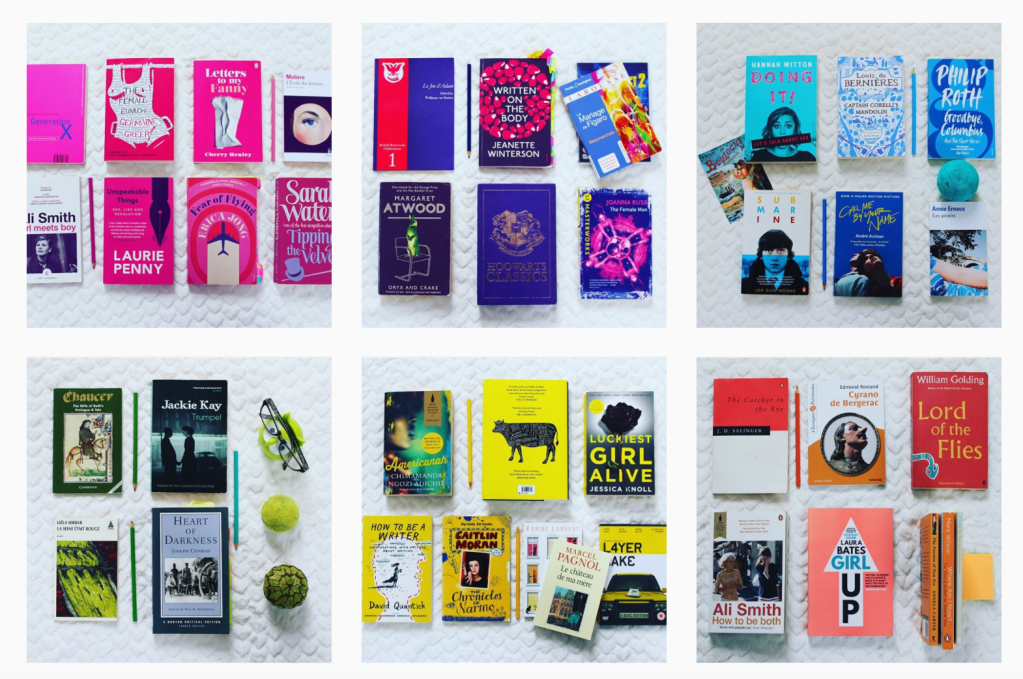
    If you have the misfortune of following me on Instagram, you might have noticed that since the New Year I’ve been making a pathetic, desperate and not entirely successful attempt at being accepted into the enigmatic world of #Bookstagram. Social networks have always fascinated me, I wrote 5000 words on Twitter for a project at school when I was 17, but with my latest adventure I didn’t expect a social media niche to feel so much like a hobby.

    What is Bookstagram, you ask? It is essentially a hashtag, or a group of hashtags, on Instagram where people share pictures of books. The Bookstagram tag itself boasts more than 18 million pictures of books, bookshelves and book lovers with their books. Other hashtags like #Bookish, #Bibliophile and #Shelfie also have hundreds of thousands, if not millions, of regular bookish users. Now most people when trying to enter the wicked world of an Instagram community will make a separate Instagram account. I however couldn’t be bothered with flicking between accounts, and expecting my venture with the fad to only run for a limited time I have, much to the annoyance of my family, just used my ‘personal’ account for this latest venture.

    My interest in ‘joining’ Bookstagram came from the question that kept hitting me as an observer: “is there more to Bookstagram than judging books by their covers?” In my experience so far, yes, but also no. It’s true that there are definitely accounts that seem to only share pictures of books they have never read (but that are indeed very pretty). Sometimes this can be with the really successful accounts that are inundated with advanced copies from publishers, so it is an understandable and perhaps unavoidable TBR situation.  There are, however, many more who are using the social media site to promote books they love, discuss books they hate, have sometimes very serious literary debate and explore how book publishing is going to survive in a digital age.

    That’s what I think is really interesting about the Bookstagram ‘craze’ – it’s giving new life to an ancient art form. When Kindles and other e-readers began to gain popularity a few years ago, I was one of many people throwing hissy fits about how you can’t beat a real book. After a while, I began to accept that e-readers must be the future of reading, but then I discovered Bookstagram. Maybe it’s just a big cooperate conspiracy by big publishing houses to sell books, but Bookstagram has put a twenty-first century twist on an potentially outdated art form. I may even be as bold as to say that it is saving the art of reading (not writing, reading) by making art of reading – and I don’t think there is anything wrong with that.

    The other thing I’ve learnt is that it’s bloody fun. Trying (and often failing) to think up and execute creative ways to photograph books that have already been shared thousands of times is an exciting challenge. While I’m not sure I can compete with the big-leagues or that the move will be permanent for my Instagram page itself, I have really enjoyed my foray into the Bookstagram universe so far. I think it also puts pressure on publishing houses to get really creative with their covers and it seems to be working. With every reprint of a book I already own I am getting serious book envy. The only major downside I have noticed, and perhaps experienced myself, is that members of the community seem to put a lot of pressure on themselves to read huge amounts annually and monthly. That ain’t good – quality over quantity, always.

    If you want to see what I’m talking about check out the #Bookstagram feed on Instagram, follow me or even better follow some of these brilliant account that post engaging and stunning bookish photos and entertaining captions on the regs – they are all super interesting and have book collections that will make you drool:

    Lotte: @lottelikesbooks

    Rima: @pardonmywritings

    Jack: @that.english.guy.who.reads

    Teisha: @girlwritesreviews 

    Jen: @bluestockingbookshelf

    Chrissy: @blackgirlsreadtoo

    Zoë: @readabilitea