Category: Pain Management

  • Reading My Broken Vagina by Fran Bushe

    Reading My Broken Vagina by Fran Bushe

    Much like with Lara Parker’s Vagina Problems, I don’t think it’s entirely appropriate for me to ‘review’ Fran Bushe’s My Broken Vagina because the content is so close to home. I’ve also seen Bushe’s one-woman show Ad Libido three times, discussed it several times on this blog and written about it during the same module of my MSc that I discussed in my last blog. I’m a big fan and completely biased, so instead of reviewing My Broken Vagina, here are some thoughts I had while reading it.

    My Broken Vagina is a frank, funny and warm book where Bushe describes her experience of feeling like her vagina is broken and her quest to fix it: spoiler alert, the only thing that’s broken is sex education. As soon as I started reading My Broken Vagina I felt like I was being hugged by Ad Libido. Each of my three viewings of Bushe’s show marked significant chapters in my own relationship with my broken bits but having its wisdom captured in a written form that I can return to and share beyond the limits of the theatre feels very special. Just like her play, Bushe’s book is laugh-out-loud funny, genuinely educational and wonderfully moving. As an added bonus, it’s filled with amazing, poster-worthy illustrations. 

    Among many important points that come up in My Broken Vagina, is one that I am always particularly fascinated by: ‘the conversation’. That is, the great pleasure of telling a potential new intimate partner that they might need to change their expectations of sex because of sexual pain. Perhaps it sounds simple but it’s been something of a minefield for me for many years and I was thrilled to find it in Vagina Problems and now My Broken Vagina too. It’s refreshing to see it being discussed openly because advice about talking to a partner about sexual pain nearly always assumes you’re in an established, monogamous and heterosexual relationship. It’s likely I relate to Bushe and Parker’s musings on the subject so much because we’re all discussing experiences of being single with sexual pain as white, cis women dating men, but there are definitely similar threads running through discussions of ‘the conversation’ that I think are worth talking about. Take a look at these quotes from My Broken Vagina and Vagina Problems:

    ‘Yeah, haha, and by the way, I might never be able to have sex with you. But I’m still pretty funny and I can make decent banana bread.’

    Lara Parker, Vagina Problems – 114

    ‘At what point on a date with someone new, do you say, “Hey, I know we are probably going to go back to mine and bang it out/make sexy magic, but I want you to know … I might find this very painful”.’

    Fran Bushe, My Broken Vagina – p.36 

    Recently, I got over my fear of ‘the conversation,’ by coming to the remarkable discovery that it doesn’t matter. It doesn’t matter for two reasons. First of all, it is a complete distraction from the actual important bits of getting to know someone and figuring out if you even want to get intimate with them:

    ‘I nodded when I was supposed to and laughed on cue, all while thinking about what it might be like to tell him that I might not ever be able to have penetrative sex with him.’

    Lara Parker, Vagina Problems – p.115

    ‘The fear of having this conversation with a stranger not only meant I had never had a one-night stand, it also meant I’d stay in bad relationships longer than I should.’

    Fran Bushe, My Broken Vagina – p.37 

    Secondly, it doesn’t matter because no matter how you present the information, you cannot control the other person’s reaction. Nothing has ever been more out of your control and, if I’m totally honest, a person’s reaction to that revelation can often be a good test of character. The last time I told someone I was dating that sex might not be what they were expecting or used to but that it could still be fun and good if they kept an open mind, the guy in question went quiet for a moment and became very focussed on the beer bottle in his hand. I was about to panic babble when he suddenly became very animated and asked me why his ex-girlfriend had instructed him to stuff a head of garlic up her vagina to prevent UTIs. It cued internal howls of laughter and shook out all the anxiety I had about ‘the conversation.’ Shock therapy? There is no way I could have anticipated that response (nor any way I could have answered his question.) 


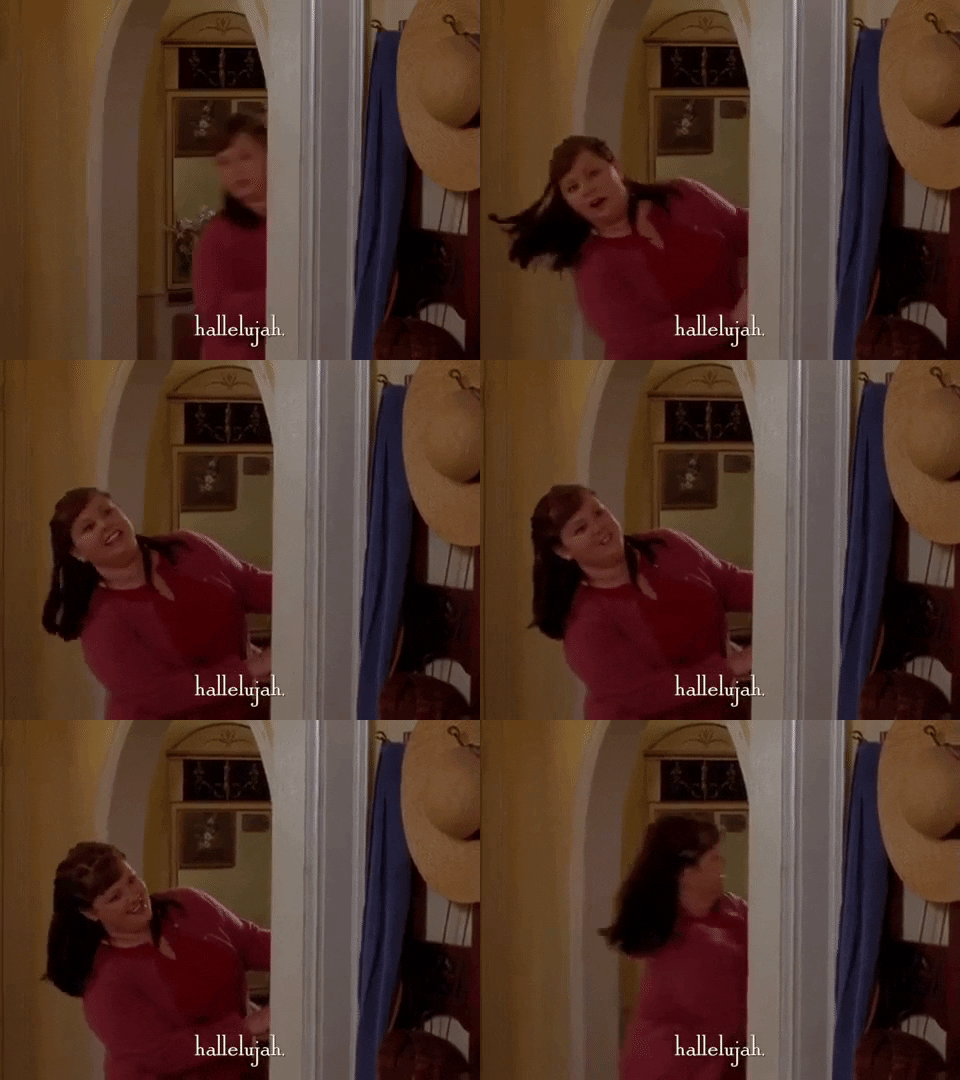
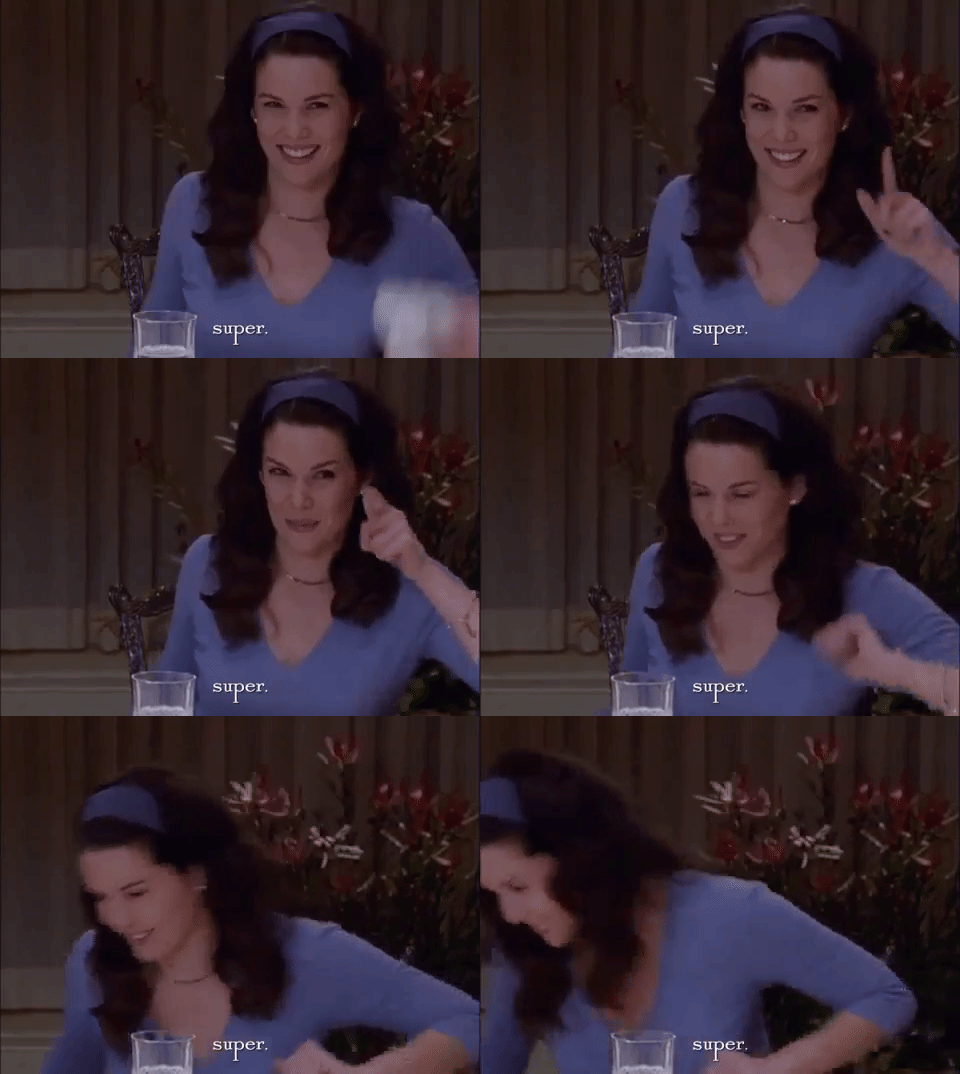
    This subject and many others are built upon in much funnier ways in Bushe’s writing. Bushe’s play came to me (steady on) by chance when I was still feeling very much alone in my experience of sexual pain. The Gilmore Girls gif I used to describe how Ad Libido made me feel the first time I saw it is still better than any words I’ve found to describe that feeling. The idea that some scared teenager discovering their body might find My Broken Vagina before sifting through the heaps of unhelpful and incorrect information and advice Bushe and others like myself have had to sift through warms my soul. I wonder how my former Catholic all-girls school would feel about a sudden library donation? I think I’ll find out, because at the heart of My Broken Vagina is a lesson we can all do with reminding of from time to time: that there’s a big difference between feeling broken and being broken.

    You can buy My Broken Vagina from all good bookshops now and until 19 June you can stream Ad Libido online here – I think I’ll be getting my fourth viewing in! P.S. Speaking of vaginas, if you’re in London get to the Vagina Museum for what looks to be an amazing exhibition, ‘Periods: A Brief History,’ featuring the amazing Hazel Mead. Wish I could get there!
  • Prospects of living with and without endometriosis

    Prospects of living with and without endometriosis

    Last month, one single doctor’s appointment had three very significant firsts. Two of these firsts, I knew were coming. I spent the days before the appointment trying to dissuade myself of its significance, knowing from past experiences that keeping my expectations low is a necessary assurance. It was impossible though, impossible to deny that this was the first time I was seeing an endometriosis specialist and the first time I was seeing a gynaecologist who wasn’t a man. 

    The third, surprise first, was that they, the doctor and midwives, made a plan for me. For the first time, the plan isn’t just ‘do x, if it doesn’t work then I can’t help you’. It’s a plan for investigation, treatment and pain management, there’s even a plan for supporting me while I wait for other parts of the plan to be put in motion. Parts of the plan were presented to me unprompted, word for word in the way I had written them on my wishlist before the appointment. It was quite overwhelming and has left me in a confused haze. I’ll write about the plan itself another time maybe but this blog will instead address how I am mediating my peace with chronic pain with a new prospect for relief. 

    During my masters, the first chapter of Alison Kafer’s Feminist, Queer, Crip (2013) was on the reading list for a class on body politics. The chapter, and eventually book, left a profound mark on me and I find myself unable to resist going back to it time and time again. Kafer describes the temporal qualities of queerness and disability, whether or not they overlap and how, or whether they have been the same thing all along. Straight time can be seen as a normative pathway, an expected route through life. Illness is an unavoidable obstacle, usually painted within a curative, diagnostic or prognostic timeline – how long have you been like this? When will you be better? How long until you make a full recovery? How is life different pre- or post-accident or illness? There is a compulsory nostalgia for the lost able mind/body’ (42). In crip and queer time, deviations to the normative pathway are welcomed and celebrated. ‘Rather than bend disabled bodies and minds to meet the clock, crip time bends the clock to meet disabled bodies and minds,’ (27) Kafer writes. 

    With chronic, hard-to-diagnose conditions like endometriosis, the spirit of crip time is helpful. It’s helpful because it allows you to stop constantly comparing your present experience with a past before you were unwell or a future when you are cured. It is liberating to accept that your timeline isn’t curative and is instead more crip in nature. With cure-all hope off your radar, energy can be spent on accessibility, accommodation and prosperity. Throughout the pandemic, disabled people and people with chronic pain or fatigue conditions have spoken about how much more accessible work, events and experiences have become thanks to a need for people to work from home en masse. I know I am not the only one that fears that the idea of going back to ‘normal’ (cough curative time cough) also means a return to struggling to fit my body into a normative schedule that never worked for me in the first place. 

    My own appreciation for crip time is part of the reason I recently decided to live on my own (that and the important fact I had the resources to do so for the first time). Living with other people, I found, applies a certain pressure to dealing with chronic illness, both in the fact you can’t help but compare the activities of your day with those immediately around you but that there is also a pressure to be less sick to make others more comfortable. Lara Parker writes about her decision to live on her own with endometriosis in Vagina Problems. She writes, ‘it somehow makes me feel worse when someone is there and forced to witness it all. As badly as I crave someone being there with me, telling me I can get through it, it also often feels easier to face it alone… I can’t tell them how to help me or what to do because there is nothing I can do’ (48). For me, living on my own hasn’t exactly been easy (mainly due to problems caused by the pandemic and poor plumbing) but in terms of allowing myself to be really sick, allowing myself to rest, allowing myself to enjoy feeling good when I do feel good – it’s a freedom I didn’t know I was missing.

    But, and here comes a big but, endometriosis is part of a family of chronic, incurable conditions that have historically been under-researched, underfunded and out of the spotlight due to the people they affect – in this case, it is women and people assigned female at birth. It is possible that with adequate research, time and funding endometriosis could become a treatable, curable, even preventable, condition. Did I just apply a curative timeline to the condition itself? I think so.

    So there I was, a year or so after beginning to accept that endometriosis was going to be an ever-present part of my life and finding ways to be happy and comfortable with that fact, sitting across from my new doctor, a professor working on radical and innovative new methods of diagnosis and treatment of endometriosis, listening to the first treatment plan I’ve ever been offered. Part of the plan involves being in a clinical study – my data, images of my insides, will contribute to finding better ways to diagnose endometriosis. 

    I’m not going to bullshit you, I am both thrilled and frustrated by the whole thing. I’m frustrated that it comes to this, frustrated that this all ends in even more surgery, frustrated that I am once again setting my watch to a curative clock, frustrated that despite finding ways to accommodate endometriosis into my life, I am still attracted to the idea of living without it. Thrilled that by following this plan someone else might not have to go through so many pointless, harmful procedures as me, thrilled to have a doctor who, for the first time, knows what she’s talking about, thrilled that I might be able to have a sex life again, that I might be able to run again. 

    There are limits to all of this. I am incredibly grateful and excited that this could result in a significant and long-term reduction in pain but I’m not sure I really believe it will happen. That is to say, although the new plan might put me back on a curative timeline, I’m taking it with a pinch of salt. A big one. Doctors have made me promises in the past but I try not to take them to heart anymore, some things just aren’t on the cards for me and that’s OK. In many ways, it’s the safest attitude I’ve ever had, interested and active in the plan, invested in its results but confident that if it fails, I’ll be more than fine. For now, I’m finding an unexpected comfort in the knowledge that while some recent pain days have been so awful that I feel like I would do anything to eradicate endometriosis from the universe, that I wouldn’t be who I am today if it hadn’t manifested in my body. Maybe all this is a way to queer crip time, by occupying crip and curative temporalities simultaneously. 

    Like many my thoughts recently have been with India as it faces a brutal wave of COVID-19 and with Palestinians threatened with yet more violence. If you’re an EU citizen, I urge you to sign the European Citizen’s Initiative ‘No Profit on Pandemic’ to urge the EU to make coronavirus vaccines a global public good. Donate to a number of important charities helping on the ground in India via this fundraiser set up by students at one of my alma maters here. For educational resources as well as ways to help Palestinians, I recommend this helpful carrd.

  • Going digital: pelvic physio & biofeedback | Pleasure Moans #4

    Going digital: pelvic physio & biofeedback | Pleasure Moans #4

    Thank you so much for all the love following my last Pleasure Moans blog and the guest post I wrote for Hysterical Women about finally being diagnosed with endometriosis. If you haven’t read it yet, check it out here

    When I first started writing about investigating my gynae health I wrote, ‘I don’t want to write about it after the fact, because after the fact might not be for a long time.’ Well, it’s a good job I took that attitude because since I got the endometriosis diagnosis in April I’ve been absolutely useless at writing about it, or at least sharing what I have written about it. This is particularly stupid because after so much nonsense I finally seem to be getting somewhere. A positive blog, at last!

    I’m in the middle of (another) Gilmore Girls binge so bare with the GG gifs.

    Two big things have happened since I shared the news of what was then a tentative diagnosis. Firstly, I had the post-op where my gynaecologist put to bed any fears that it still wasn’t really an answer by explaining that I have stage 1 endometriosis, freckled in tiny dots mostly on one side of my uterus/recto-uterine pouch. I even saw pictures (which I won’t share, but don’t worry there’s plenty of oversharing coming up). He continued to relieve my doubt by explaining how low stage endometriosis is sometimes (but obviously not always) more painful or as painful as high grade endometriosis because of where it sits: on the nerve layer. To try and stop it getting worse I am getting a Mirena coil (IUS) fitted at some point this summer – I have a lot of thoughts on this which I’ll share another time in a #Periodically blog.

    The second thing is that I’ve started pelvic physiotherapy. My symptoms of painful sex are explainable by the fact that endometriosis was found in my recto-uterine pouch but a few doctors I’ve seen have suggested that there also appears to be some pelvic floor dysfunction kicking about, hence why I was referred to a women’s health physio. Without a shadow of a doubt, this has been the most positive, interesting, logical and, dare I say it, empowering, part of my medical path so far and a reminder of why the NHS is so bloody brilliant.

    My first appointment was almost an hour long and for good reason. My physio took 50 minutes getting to know me, my medical history and my experience of pain, before a 10 minute pelvic examination. What this meant was that during the verbal consultation we hashed out a hypothesis: that pain, likely caused by endometriosis, had caused the muscles around the top of my vagina to go into spasm creating yet more pain and what feels like a bottleneck in my vagina, explaining why my primary issue is deep pain rather than ‘superficial’ pain. The pelvic examination, which involved gripping my physio’s finger with my fanny (no way to make that sound any less weird), confirmed her suspicions and then some. It seems that the upper part of my pelvic floor is not just in spasm upon penetration, but all the damn time.

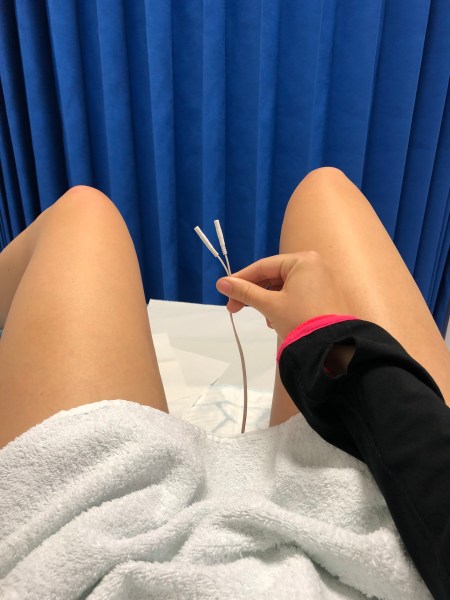
    Turns out, this isn’t an all too common occurrence and so my treatment plan is a bit experimental at the moment but the point is: there is a plan! The plan is biofeedback. It sounds cool because it is. It involves putting a small probe (yep) in my vagina, which is wired up to a monitor that allows me to see and hear my muscle activity. In pelvic physio it’s mostly used to strengthen muscles to improve bladder and bowl function but in my case I’m using it to try and learn how to relax the muscles involved.

    img_8827
    Nothing says ‘relax your vagina’ better than the horror of wires coming out of it…

    It’s a weird thing, because it doesn’t actually do anything to you but it enables you to understand how your muscles are working and what control you have over them in a way that is otherwise impossible. It’s really easy to understand too. Once it was in (I insert and remove it myself to save some awkwardness) my physio asked me to clench/pull up/engage my vagina and the number (microvolts) went up. The issue was that my number didn’t descend low enough when I relaxed. I’ve been doing to this for a couple of sessions now and while I can make the number jump down low, I can’t get it to stay there – so that’s what we’re working on. I’ve posted a video of the unit in action on my Instagram story/highlights if anyone’s interested in seeing how it communicates with you.


    There’s a range of verbal cues used to help someone relax their pelvic floor that of course don’t seem to do anything for me, so it’s a case of trying a bit of everything to find something that works. And for once, I’m actually really hopeful that I will.

    You’d think I’d be used to oversharing by now but believe it or not taboos run deep and I’m still conditioned in ways that made me hesitate about posting this blog, let alone illustrating it. But in my experience personal accounts of deep dyspareunia are few and far between, especially treating/easing that pain, and so it feels important share this story, including pictures of my cyber fanny, just in case it’s of any hope or help to someone else.

    If you’ve tried biofeedback or pelvic physio, for painful sex or something else, and have tips and tricks about how I can get the most out of it please get in touch – I also finally made a Facebook page for the blog so give that a like if you’re feeling friendly! In the mean time, I’m going to keep trying to interpret my vagina’s microvolts…