Category: Health

  • Down a different rabbit hole… #Periodically 30

    Down a different rabbit hole… #Periodically 30

    For whatever reason, the area between my legs has always been a place of curiosity for me, perhaps not helped by my discovery of the vagina-brain connection theory discussed in Naomi Wolf’s Vagina. Recently, and with help from my psychosexual counsellor, I’ve realised that this ‘curiosity’ might have meant I always had a certain ‘vulnerability’ to something like vaginismus. Perhaps it was always lying in wait and it would just take an unfortunate combination of events to trigger it.

    But it’s not just the vagina that I’ve been curious about β€” for most of my life, the uninary system has caused the most trouble. The exploration into gynaecological causes of my pelvic pain over the last couple of years has overtaken a bit, especially since when I raised the subject of urology with my doctor last autumn, he said, “you don’t experience painful periods or painful sex unless there is a gynaecological problem.”Β It was only last winter, when I was clearing the loft with my mum and considering starting counselling, that I found some note cards from 2007 that made me wonder if my bladder might be playing a role in my present situation.
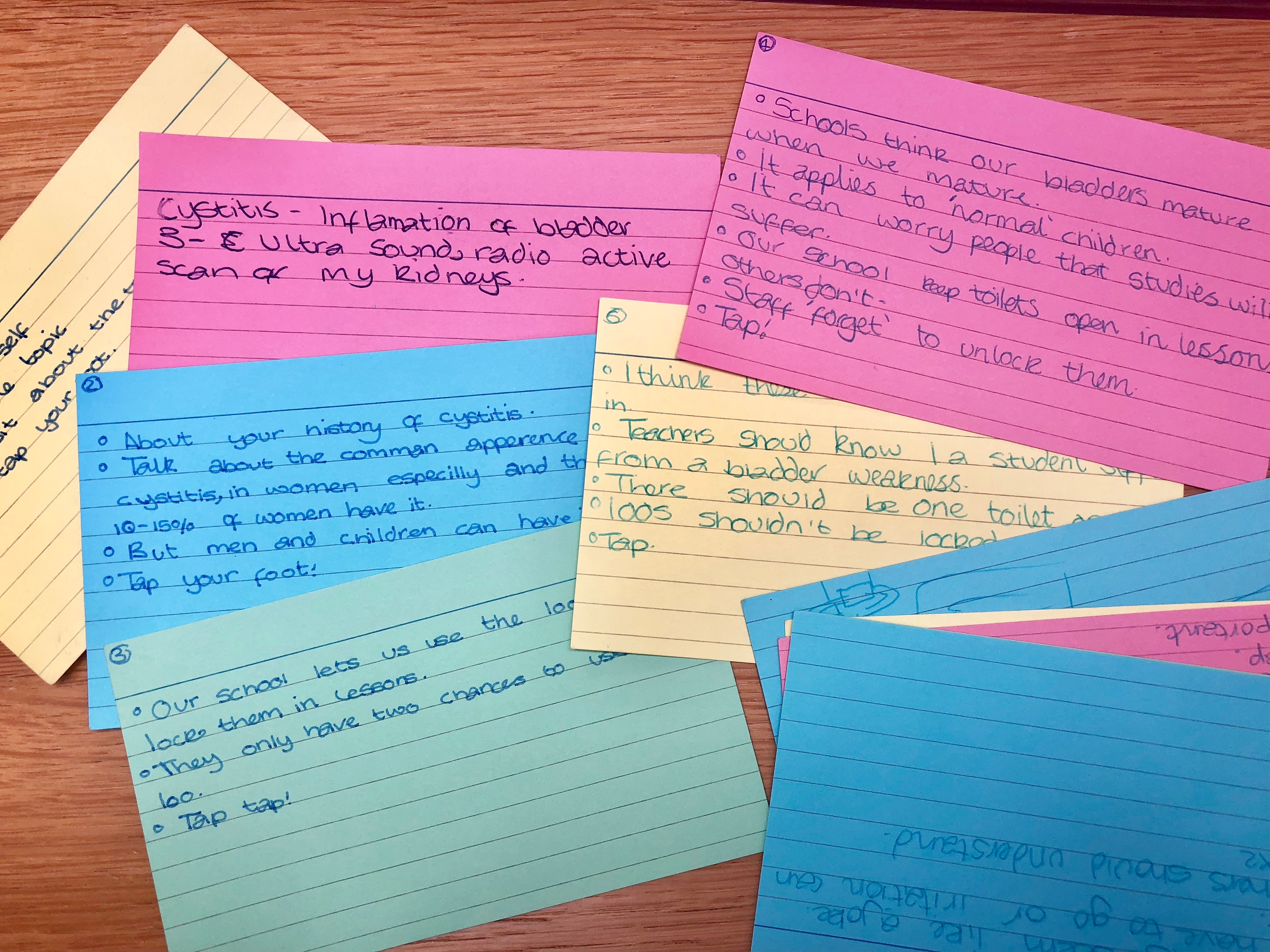
    IMG_2888
    Hilary’s obsession with bodily fluids circa 2007

    As part of a public speaking exercise, I chose to talk about cystitis and toilet access in schools. What inspires an eleven-year-old to give a speech about urinary tract infections (UTIs)? A long and complicated history with them and bladder weakness, even at eleven. I had a few kidney scans as a kid but the general consensus from my doctors back then was, “she’ll grow out of it.” Lo and behold I did not. The UTIs subsided during puberty, but once I started having sex they returned. I had a reputation as an obsessive pee-er as a kid, I planned my day around when and where I was going to wee, a habit I still sometimes catch myself practising now.

    Throughout this whole process investigating my bladder for something like interstitial cystitis seemed like such an obvious path to take and it’s finally happening. Last month I saw a urologist and, as always, I was armed with a list of things I thought relevant to mention, and for the first time ever, all the points on my list came up as a result of the doctor’s questions. I didn’t have to suggest anything myself. Dr K was immediately nodding and it was like my body was doing all the right (or wrong) things to have been sent to this department.

    Dr K has referred me for (yet another) ultrasound, took a urine sample and then started mentioning some elusive “other procedure” and because I’m a moron I didn’t actually ask what this third procedure was. And then a letter came in the post while I was on holiday informing me that fairly soon I’ll be having a camera up my urethra (flexible cystoscopy). OH GOOD.

    As always, I’m excited to explore another orifice (lol) but I’m worried about traumatising my body with another pelvic procedure, especially since I’ll be conscious for this one. I was given almost no information about what to expect or how to prepare other than to “bring some small change and a urine sample” β€” are the two connected? I rang the department to try and find out a little more and was told “it’s just like a smear test,” which is really helpful because a) I’ve never had one as I’m under 25, and b) pelvic examinations have been so painful in the past that I was diagnosed with vaginismus. So I wouldn’t say I’m feeling totally relaxed about the whole thing, but when I look back on the last two years with fresh urological eyes, there are a lot of unanswered questions. Like the fact my pain started around two memorable events, only my doctors chose to focus on one; a) a period so painful I left work to go home and vomit/cry and b) having a drink spiked and feeling like I was hungover for three months because of what turned out to be a bladder infection.

    My GP isn’t convinced that the answer to all my problems lies in my bladder, and neither am I. Going back on the pill certainly hasn’t ‘fixed’ me but my body’s reactions to it and the adjustments in how I take it have confirmed that there is undoubtedly something hormonally abnormal going on in my body. And yet I can’t shake the sneaking suspicion that a piece of the larger puzzle might be in my bladder.

  • I changed my mind #Periodically 29

    I changed my mind #Periodically 29

    Maybe it’s because the idea of pain management came up directly after a flare-up, or maybe it’s because the drugs were actually working, but about six weeks into my trial with the low-dose anti-depressant amitriptyline, in an attempt to reduce my pain, I began to feel like this pain management route wasn’t for me. I sat on it for a couple of weeks and it wasn’t a decision I took lightly β€” I was well aware that maybe I was feeling like I didn’t need the drugs because the drugs were working. Except that wasn’t true at all, I was still in pain.

    The only noticeable difference was that my bizarre dreams, which I’ve always had a lot of, all became nightmares. I’ve heard that anti-depressants can mess with your dreams or stop them completely, the latter is a pretty scary idea for me. As a writer, I need my imagination to be relatively unhinged and out of control. The nightmares I can handle, but the idea that upping the dosage might mean I stop dreaming at all did not sit well with me.

    I knew if I went to my GP and said, “no I haven’t noticed any difference in my pain,” then her response would be to up the dose, as is standard procedure. But the very notion of how anti-depressants work as a means of pain management has bothered me ever since my GP first mentioned the idea. She said she was prescribing them, “essentially, to stop you feeling pain.”

    As nice of an idea that is, I don’t consider it to be a practical long-term solution, especially when I feel like there are still stones that have been left unturned (i.e. urology). Plus I don’t want toΒ stop feeling anything, I just want toΒ be in less pain, if that makes sense?

    I’ve now started with a psychosexual counsellor who is trying to make it dawn on me that my chronic pain may well be just that β€” chronic. I’m not too hot on accepting this “truth” just yet, but because of it, pain management is definitely something I shouldn’t shy away from. I need it for the sake of my mood, my work and my relationships (of all natures), but I think I’d rather open my world up to alternative pain management options before I put all my eggs in the amitriptyline basket.

    I discussed this with my GP and she agreed that it sounded like prescription pain management wasn’t the right course for me yet after all, and has insteadΒ finallyΒ granted my wish and referred me to a urologist. This means a lot to me β€” I’ve had issues with UTIs, my bladder and kidneys since I was two and while none of my current doctors are wildly convinced it’s got anything to do with my pain, for me, it feels like a really obvious path to explore. Here’s to owning your own health journeyΒ within the NHS!

  • Back in the Saddle (not that one) #Periodically 28 – Fitness in Mind

    Back in the Saddle (not that one) #Periodically 28 – Fitness in Mind

    The pelvic pain that these blogs have been documenting has forced me to give up several things that I took for granted in the past. One of them, some of you will know, is running.

    FourΒ years ago now (where the hell did they go?!) I got drunk, fell down some stairs and signed up for the London Marathon 2015. It was the start of a pretty unconventional “fitness journey.” I somehow taught myself to run, trained for a marathon and completed my first marathon a year to the day after my first run. I wasn’t fast, but I had become something I had always feared: a runner.

    IMG_0299
    2015

    As much as I said “never again” after London, when the charity Worldwide Cancer Research asked if I wanted to run another marathon, this time in Paris, I couldn’t resist saying yes.

    “It was a mistake for many reasons,” I usually say at this point in the story. Not because I got seriously injured or anything, but because the Paris Marathon was hot, gruelling work – this time I really meant it when I said, “never again”.

    So after the Paris Marathon in 2016, I found myself with a new luxury at my disposal: running for fun. The entire time I’d been running it had been part of some grand marathon training plan, but as I moved backed to Swansea for my final year of university I had the freedom to run for however long or far I wanted to.

    Much to my surprise, I did continue to run. But never very far. I was just popping out for a mile run, it wasn’t exactly hard work but it was really nice. After a few months, I started to try and push it up a bit more, branching out to two miles or, god forbid, three. That’s when I started noticing a new pain, one that I associated with my period and, by this point, sex. No matter how much I stretched or how much water I drank this pain would show up around the half-mile mark and become unbearable over a mile. So I stopped running.

    Problem is, I didn’t start doing anything else with my body and consequently managed to age about 37 years in the process. Until…

    It was actually my counsellor who sent me in the direction of Fitness in Mind, which makes a lot of sense. I’ve lost complete control of my body and exercise is a big part of that. Fitness in Mind is a unique space where physical activity and peer support are combined to help people get into or back into exercise, particularly if they’ve been struggling with problems elsewhere in their life. It’s run by several sports clubs across the country, and lucky for me, the Brentwood Centre happens to be one of them. Even more amazing than that, the 12-week course of daily exercise classes isΒ free.

    It was exactly what I needed, right when I needed it. I joined in week two and have been doing yoga and Mixed Martial Arts for the last eleven weeks. I struggled a lot with the Machu Picchu trek last year, but a successful ski trip in March left me with fresh hope that maybe exercise was less likely to hurt now. If I’m totally honest, I was expecting to discover that exercise didn’t actually cause any pain, that I’d just imagined it as an excuse to mooch about. When the gentlest of yoga stirred up the pain in my side, I was pretty gutted – I hadn’t imagined it after all. But I carried on, crucially I didn’t “push through the pain” because in my situation that could potentially involve a ruptured cyst, but instead I did what every instructor and activator on the programme told us to do, “listen to your body and do what you can.” So I pushed myself in yoga but never to the edge and I did everything in MMA except the kicking (which my body immediately said “no” to). It’s so obvious and so simple, but there was something really nice about having someone else tell me that.

    Surprise to no one, given the new sensitive version of Hilary I’ve become on the pill, I found the first few weeks quite challenging and not just physically. First at the discovery that exercise still hurt and then at the realisation that it wasn’t the end of the world. I wasn’t blubbing in the middle of yoga, but it was nice to know that I could have if I needed to – there was always peer support on hand. I’m still not “over it” but I think part of the last few weeks has been me realising that for whatever reason, fair or not, I’m no longer a runner. I hope that’s not a permanent fact, but it is what it is for now.

    IMG_6642
    2017

    The yoga has been so rewarding. After surgery on my abdomen last summer, I got out of the habit of using my core and have completely ignored it since. It hurt reawakening those muscles but I feel better and stronger for it. The MMA has been a laugh. I am no good at it, that’s for sure, but it’s been incredibly cathartic to hit a bunch of things for an hour a week.

    What makes this course what it is is undoubtedly the people. Participants and leaders alike – everyone just made it the safest space with zero judgment and zero stress. It was just a calm environment that allowed me to forge a much-needed new relationship with my body. Sure, I got a concession card at the end of the programme that gives me access to cheaper classes, but that is just a tiny perk in comparison to rest of this course’s benefits. It’s no secret that Brentwood has a fairly ageing population and admittedly I was one of the younger participants on the course but that only made the experience better. I met some incredibly interesting and patient people, none of whom made the assumption that because I was younger I could do more. There was no competition.

    However, I can’t believe how few people my age are using this amazing resource.Β Millenials of Brentwood, do you know that Fitness in Mind exists? Well, now you do. The next programme starts on July 2, sign up here or find out more on their Facebook page.Β 

    I haven’t lost a million pounds or transformed my body but I have had several overdue epiphanies, regained some strength and made some amazing friends. After a year of doing nothing more than walk the dog, that’s a huge achievement.

    Thank you Fitness in Mind for all your help!Β πŸ’™

    IMG_0937
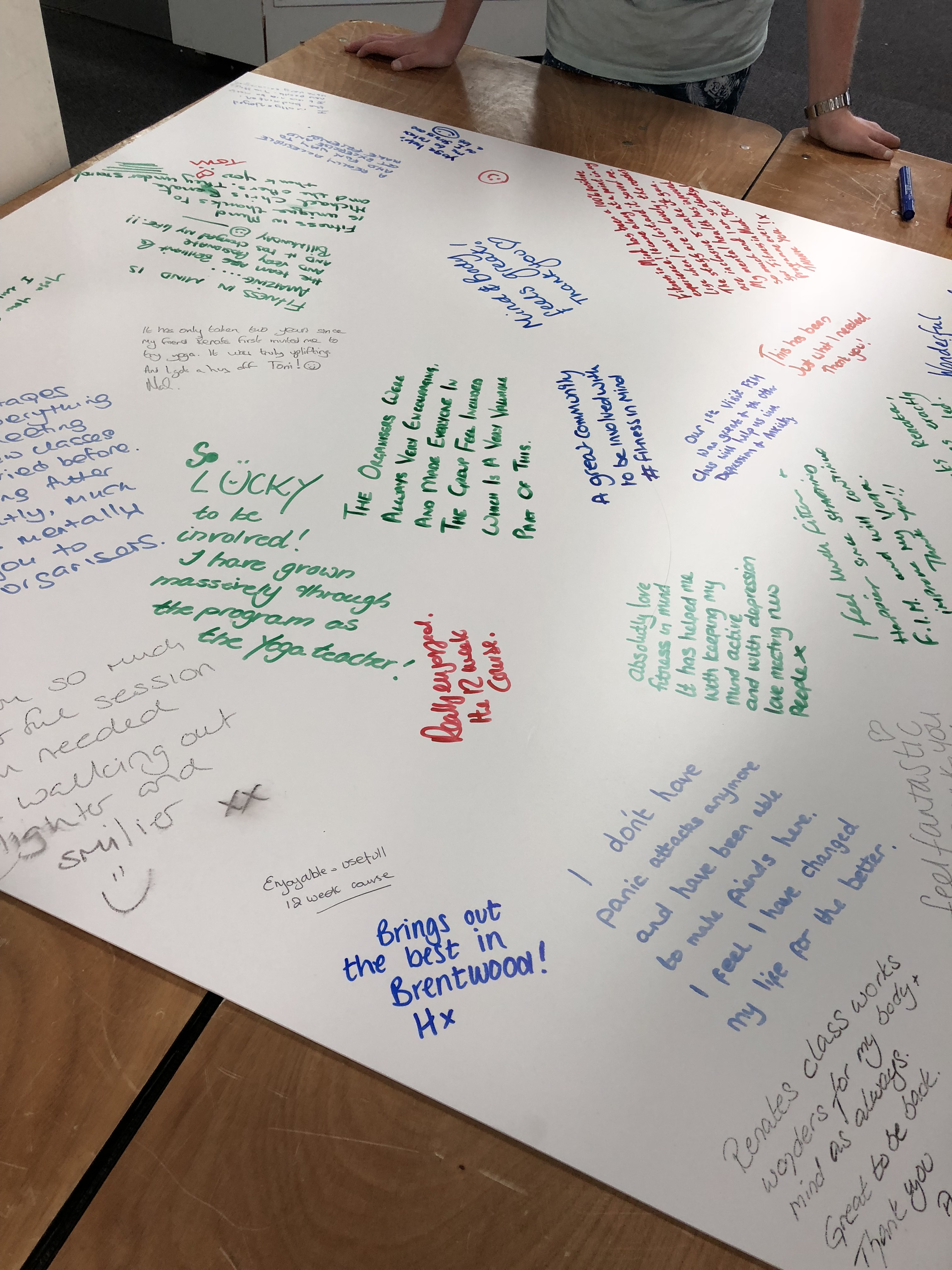
    Happy, happy testimonials!