Author: Hilary Webb

  • Gynaecological Whiplash #Periodically 15

    Gynaecological Whiplash #Periodically 15

    I feel like I should start this blog with a “Previously on #Periodically…” but it might just be easier to read Periodically 10, 11 and 12 if you’re new. If you (understandably) can’t be bothered, here’s the gist: in August I had laparoscopic surgery to look for endometriosis, they found nothing but a regular (functional/ovulation) cyst on my right ovary and said there was “no gynaecological cause of pain”. While my belly button took some recovery meanders, I readied myself for my first doctors appointment since moving back to Essex and to look beyond gynaecology (towards bowels and bladder) to find a cause for my pelvic pain. Since then I’ve processed the news and the language issues I was worrying about in Articulating Pain – saying “dementors” instead of pelvic pain has stuck pretty firmly in my vocabulary.

    I must confess, trying to find the words to articulate how confused I am at the moment is proving difficult. Every time I process one fact, something contradicts it and I’m in a new hole of confusion and disillusion. So bear with me. 

    October started with September’s late period and a whole load of nauseating, black-out pain. And it really surprised me. I was surprised because by linguistically and medically disassociating my pain from my menstrual cycle, I think I thought the gynaecological symptoms would disassociate themselves too. Foolish, of course, but that period was a bit of a wake up call.

    Before my first GP appointment I had my symptom spiel ready, I’d checked that my discharge letter from Swansea had transferred and I was ready to start the process once again. Dr C, my new GP, listened to my symptoms, felt my abdomen, read the “no gynaecological cause of pain” letter, then turned to me and said “I am not convinced”. Excuse me? “I am not convinced that it is not gynaecological. You don’t experience painful periods or painful sex unless there is a gynaecological problem”. He ordered an ultrasound and some blood tests and said he would refer me to a gynaecologist.

    I was pissed off. I’d been jokingly forecasting that the doctor was going to refer me to a gyane in this appointment for weeks but I had been joking. I was mad, and my general attitude was “it has taken me 12 months to get to where I am now (which is nowhere) and now we’re going to start all over again from the same place”. Basically, I sulked for a fortnight. Until…

    This week, I headed to the ultrasound with my mum, confused as to why they hadn’t told me to drink a litre of water like last time. The reason I didn’t need any water was because it happened to be an internal ultrasound. Now they had my attention – I’d be moaning for months that it seemed strange to me that I’d never had one of these. While Dr T, who carried out the ultrasound, and the chaperone described the device as a “wet tampon”, I would describe it as a very solid USB dildo that’s plugged into a computer being watched by two doctors and your mum. To my surprise, it hurt almost as much as sex and has left me in the same horrible post-sex pain, but perhaps we now know why.

    I can’t believe I’m writing this. I have a cyst! Two actually, on my right ovary. Yep, what the fuck? Sorry I can’t be more eloquent about this but I am so beyond confused and conflicted at this point that the words in sentence putting is falling out of nick. (What?) One is a small 2cm functional cyst – potentially an ovulation cyst but where I was in my cycle would suggest otherwise. The other cyst however is over 4cm and looks like an hemorrhagic cyst, meaning it has been bled into, which is, get this, potentially an endometrioma or endometrioid cyst. Hmm, those words sound familiar, don’t they?

    Once I had my nickers back on my mum and I expressed our shock upon this discovery to Dr T, explaining the fruitless laparoscopy results just two months earlier. Dr T said: “what and the laparoscopy didn’t find any endometriosis? That’s funny because all your symptoms point towards that”. We all laughed and I went home with the promise that we’ll check to see if the cyst is still there and whether it has grown in six weeks.

    I say laugh but I mean a sort of hysterical confusion and shock induced gurgle. Now, to answer some question my friends have hit me with since the Great Cyst Discovery of October ’17:

    What does this mean? I don’t know.
    Why didn’t they find it in the surgery? I don’t know. It’s possible that it wasn’t there, or that cysts have come and gone and during the lap things just happened to be clear.
    Is this PCOS? I don’t know.
    Is this endometriosis? I don’t know.
    Will they take it out? I don’t know – seems unlikely given my favourite sentence “sometimes you just have to live with it” was uttered during this appointment.
    If they do, would you want to go through surgery (belly button nightmares) all over again? I don’t know.
    Did they actually do anything in the laparoscopy or did they just cut you open, have a cup of tea and then stitch you up (badly)? Maybe. No. A lot of my frustration earlier this week was directed at the surgeons in Swansea, but I know that’s unfair. They knew what they were doing, things must’ve been clear in August. Or maybe the functional cyst they saw was not as functional as they thought.

    I don’t know whether to be mad, happy or upset – I am just very confused. I guess I can say “ovulation pain” rather than “dementors with knives” again now? Plus there’s the fact the whiplash might continue if in six weeks the cyst has disappeared without a trace. I almost begin to get that fuzzy “I’m not imagining it all!” feeling, before I begin to wonder if I imagined the whole surgery in the first place.

    So things are once again painfully up in the air, but for now I am just grateful that despite my obvious doubt, Dr C listened to his gut.

    A bit lost? Don’t blame you. Find the rest of the #Periodically blogs here. Or if it’s a little too TMI for you, I blog about books too here and, finally, last week’s blog can be found here.

    wth

  • What’s in a name? Thank you Hillary Clinton.

    What’s in a name? Thank you Hillary Clinton.

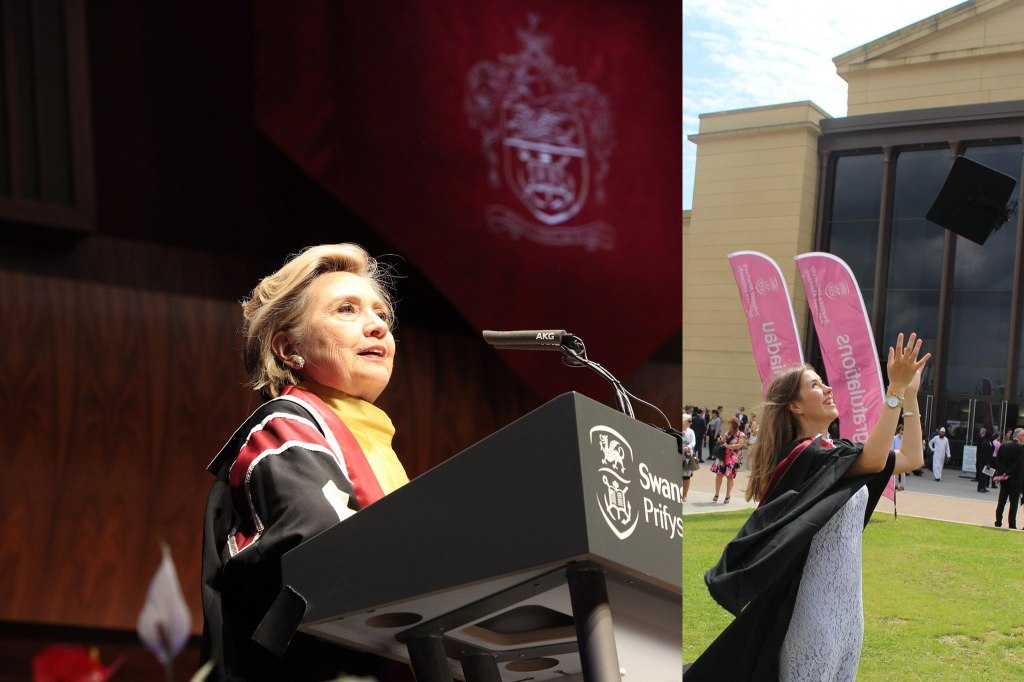
    Like Hillary Clinton, I graduated from Swansea University in 2017, but that’s not all we have in common. We both have Welsh ancestry and we share a name, though mine is spelt properly (obviously). When it was announced that Hillary Clinton would be receiving an honorary degree from Swansea and delivering a speech, I applied for a press pass in the off-chance I might get one so early on in my career.

    To my surprise, this past weekend I had the extraordinary opportunity to attend the commemoration ceremony as a member of the press. I returned to my alma mater and experienced my first *real* press room. While the site I was writing for didn’t end up using my piece (ah, freelance life!) I got to catch up with friends and colleagues still in Swansea, experience a major landmark in the university’s history and find myself in a strange void, somewhere between student journalism and the real thing. Update: my article didn’t get published on the site because it in fact got published in print! Read it here and see if you can spot the irony in the byline… 

    https://www.instagram.com/p/BaOi3DGBAEk/

    As I scrawled my not-yet-mastered shorthand during Hillary’s speech I couldn’t help but get a little nostalgic. I had graduated on the same stage just three months earlier. A stage in a hall on a campus with which I had almost no sentimental attachment. My time at Swansea was spent on Singleton Campus and I had groaned on announcement that we had to graduate on the shiny, new Bay Campus. Now however, I have a genuine memory associated with the Great Hall on Bay Campus. I got to work independently with old and new colleagues, while watching a hero deliver an important speech on children’s rights that will also give my university recognition that will undoubtedly help struggling graduates like myself.

    My family have often wondered about the origin my burning advocacy for women’s rights. I have always and will always stay steadfast in saying that it comes from my mum. During Hillary Clinton’s speech however, I started to wonder if the former Secretary of State had something to do with it too. While my parents insist I’m named after a (rather depressing) Beaches character and my mother’s confidence in having ‘never met a stupid Hilary,’ I think I grew up associating my name with a very different source. One month and one day after I was born and named Hilary, the other Hillary delivered her monumental speech on women’s rights in Beijing. From then on, my name was associated with advocacy of women’s rights as human rights. While most of my friends associated my name with Hilary Duff and Hilary Swank, I think I must’ve been listening to the radio on 5 September 1995, because now I think about it, the only other Hilary I knew as a young child was Hillary Clinton. I mentioned this to my mum this afternoon and she spoke of how when she told the nurse my name the reply was ‘is that with two Ls like Hillary Rodham?’

    In her speech at Swansea Hillary spoke of how things had almost come ‘full circle’ with her return to Wales, where her ancestors began. Returning to Swansea not as a student but as a professional human being (boohoo!), things felt remarkably full circle for me too. What’s more, Hillary Clinton’s speech was about the children’s rights, where she drew attention to the fact that children are not simply ‘passive observers’ of what adults are up to. She spoke mostly of sad, negative examples of where that foolish assumption shows itself, but I think I have a slightly happier example of it. I grew up with a woman fighting for the rights of women, saying things that were revolutionary at the time. Luckily for me, she happened to share my name which perhaps made me listen a little closer. Hillary Clinton is one of many empowered women that I’ve been able to look up to, but one I didn’t full appreciate until now.

    So thank you Hillary Clinton, for giving me a genuine connection to Swansea University’s Bay Campus, God know’s not many Singleton students can say they have one. And thank you for saving it until after I graduated. I never expected a connection to the campus of my graduation to be conjured up after the fact, but I think you’ve given me some much needed self awareness in this period of Graduate Blues. An awareness of what my own name is starting to mean to me, an awareness of my sudden place in the professional world and an awareness of the importance and impact of role models on children. While it took me until your speech to realise it, you have undoubtedly influenced the course of my life so far, all because I was once a child paying attention to what adults were saying and doing.

    Read my last blog here

  • History in Context: From hating history to, well what exactly?

    History in Context: From hating history to, well what exactly?

    I despised history lessons when I was at school. For the most part, it was limited to British history and I was more interested in the rest of the world. For the other part, I took the attitude ‘why are we focussing on the past?’ or, as the SSX Tricky character would yell, ‘the past is gone, now is all there is!’ Of course every right minded person, usually my dad, would fire back with ‘you have to learn about the past to stop us from making the same mistakes’. From where I was sitting, however, humankind kept making even worse mistakes than those I learnt about in history class, so it couldn’t be that effective. Tired of this age-old philosophical argument, I instead just decided to adopt the easier excuse; that I thought history was boring (of course that only pissed off people (my dad) tenfold).

    The moment I didn’t have to study history I stopped, or at least, I thought I had. In fact I found I got sort of a thrill out of how irritated saying I ‘hated’ history made people. While I was done with history, history it seemed, was not done with me.

    I remember the moment, in A Level English where my teacher Miss O’Neil, started talking about how the character of Serena Joy in Margaret Atwood’s The Handmaid’s Tale was based on a real woman, Phyllis Schlafly, from the age of Thatcher and Reagan. ‘It’s context like this that will really push your grade up in your coursework’. I remember thinking, ‘cool, what is this mysterious context business?’ like it was a new found entity. I plodded my way through A Level revelling in the moments where I got to bring in context or even ‘cultural context’ to explain why a novel was written a certain way, or the parallels that could be drawn between the book and the ‘real world’.

    Then I got to university and something truly horrible happened. In our first and only compulsory module (that didn’t go well for me for other reasons) Monsters and Transformations, the slide show in the introductory lecture paired the words ‘history’ and ‘context’ together. Historical context? What is that supposed to mean? As the module progressed I began to become more and more suspicious that historical context might actually be the same damn thing as context. You can imagine my horror, in learning that one of my favourite parts about my chosen subject was actually rooted, in its entirety, in my least favourite subject.

    Eventually I accepted it. In fact, I started to really enjoy it. I even opted in for French modules our lecturers called ‘cultural modules,’ that I now realise were often European and French history classes. When my sister finally agreed to read Harry Potter last year she said it was under the condition I read something with history in it, and gave me Captain Corelli’s Mandolin. Did I still think history was boring? Did I really never read historical novels, I asked?

    I loved The Handmaid’s Tale and that was packed full of historical context, as was Nineteen Eighty-Four which I studied alongside it. The same was true with The Scarlett Letter and King Lear. Even biblical books like Impossible Saints drew me in (questionable re: history, though) and hell, my dissertation was packed full of context of the 1960s and 70s, if that counts as historical yet. OK so maybe I like historical novels, but not ones about war? Nope that wasn’t it. Milan Kundera’s The Unbearable Lightness of Being led me to read Anna Karenina, which set me on a path to War and Peace and The Kossacks. To my horror, I’d become a Tolstoy fan, which meant that war clearly wasn’t the problem. In these French cultural modules we studied art, literature and film in context, meaning we would explore cultural artefacts from one specific period or place, and I loved it. When Les Misérables was made into a film, I loved that even more and read A Tale of Two Cities (even though I would quickly learn that it was about a different French Revolution).

    Last month I finally read Captain Corelli’s Mandolin, and surprise to no one, I really enjoyed it (except the ending, don’t get me started). The entire time I was reading though it I was thinking, am I over my hatred of history? Last month I went to the Imperial War museum, it was certainly heavy in content but boring it was not. I’ve been to Anne Frank’s house, I wasn’t bored, insensitive or uninterested. If I went back to school now to study history, would I still be distraught with boredom?

    Honestly? Yes. Sitting down and learning about history is not how my brain processes the past. I need history in context. Learning about the past for past’s sake doesn’t fire me up, I need human stories to realise it. The worst parts of history don’t hit home until you understand the impact they had on someone’s life. Take Captain Corelli for example, before I read it I had no idea of Italy, Greece or the Ionian Islands’ involvement in World War II. The novel only gives you four or five perspectives and of course there are so many more, but really understanding how transformative one event can be on one person’s life, gives you a crazy amount of perspective when you zoom out and think about how many different lives were effected by the same event. Even the best events from history, like the sexual revolution, they’re no good without the personal stories. When I’m reading a novel with a real context, I find myself googling and reading simultaneously, and for some years now, that’s how I’ve learnt to enjoy learning about history.

    Last week I had the extraordinary opportunity to hear Margaret Atwood speak at New Scientist Live. Known for her science and speculative fiction, often set in dystopian futures, I always associated her work with the future. She talked about how she couldn’t have predicted how relevant her novels would have become, given the election of Trump and its effects of reproductive rights and the environment. Talking about how his election ‘framed’ the Hulu adaptation of The Handmaid’s Tale, Atwood said how if Hillary Clinton had been elected the show would have been the same but it would have been viewed differently. “Even if you’re writing a historical novel, you’re still writing about now,” she said. This was after I’d written this blog but I had to come back and add that quote in. I think it would be equally true to say “even if you’re reading a historical novel, you’re still reading about now”.

    That’s what I’ve learnt from historical novels. History is relevant and interesting and not boring because it’s always, however subtly, applicable to the current world. So if you ever hear a kid saying they don’t like history, I strongly recommend giving them a good book. Because any good book tells a story about a place, a people and a time and historical context is just part of that. (Hey that’s sounds like Christian in Moulin Rouge, another example of history sneaking into my world without me knowing).

    IMG_7229
    Thank you Margaret Atwood, for putting this blog in context