Author: Hilary Webb

  • Persistence – #Periodically 17

    Persistence – #Periodically 17

    Long time no #Periodically, but don’t fear I’m back with another exciting instalment of “WTF is happening in Hilary’s pelvis” – I’m sure you were all anxiously waiting.

    So we left off with the discovery of two cysts, one functional (good), one hemorrhagic (bad) on my right ovary. The protocol is to wait six weeks to see if they go or grow. I also had a blood test taken the day after the first internal ultrasound and was informed there was something in those blood results that I needed to see a doctor about, but typically (#ToryBritain) the first available appointment was six weeks away. Conveniently though, it was scheduled for the day after the follow up ultrasound.

    I had a couple of really rough weeks in the middle of the wait for “answers”. I was both stressing about what was wrong with my blood (who tests for PCOS and Ovarian Cancer, says something’s wrong but doesn’t tell you what?!), dealing with a sudden and random horrible outbreak of acne and a flare-up of top-notch pain. I was pretty miserable company for a fortnight (sorry friends and family – thank you for not disowning me).

    Let’s throw it back to November 2016 for a second, where the first blood results I had to search for a problem revealed nothing. I did have slightly higher levels of androgens (male hormones) than normal, but nothing that warranted suspicion of PCOS (Polycystic Ovarian Syndrome). So when they found the cysts and something in my blood this November, I couldn’t help but wonder if I had just noticed symptoms of PCOS really early, and the androgens were now at a higher level and had been picked up in my blood. So what does any sane person do in this situation? I GOOGLED. I’m actually glad I did as I quickly learnt the surprising fact that despite the name, polycystic ovaries does not involve many cysts. It involves much smaller bubbles of fluid that grown on the ovaries in abundance. I don’t have that, so I relaxed. But my hairy disposition and sudden acne break out didn’t help calm my PCOS suspicions.

    Now because life is cruel, the six weeks came around and I was due on my period the exact same day as the internal ultrasound. While offering some potential technical problems, it also meant I was super on edge as I tried to suppress my PMS in the hope of postponing my period (this actually worked remarkably well but it also postponed and intensified my PMS, would not recommend). The internal ultrasound goes smoothly albeit painfully, and the sonographer immediately says “oooooh no,” as she sees that the hemorrhagic cyst is still there. “That should have gone,” she said. Problem is, it didn’t grow either, which, she explained, means it’s unlikely I will be referred for any kind of treatment. So I have a “persistent hemorrhagic cyst”.

    The next day I show up bright, early and menstruating for my blood test results. Happily, it was nothing too serious, just that my iron levels are a tiny bit low, which is consistent with having too heavy periods. Unfortunately, I hadn’t seen this doctor before, and having to explain all my symptoms all over again mid the hormonal meltdown I was having, resulted in some really attractive sobbing as I explained the last few years of pills, pain and frustration. This sobbing only worsened when she informed me that contrary to what I’d been told, Dr C never actually got around to referring me to a gynae in Essex. I explained to her that a big part of my frustration is that in 2015 I ran a marathon, in 2016 I ran a marathon but in 2017 I need a lie down after a dog walk. Not being able to have sex isn’t great either obviously, but exercise is a really great way of feeling like you have some control over your body, it’s difficult losing that control.

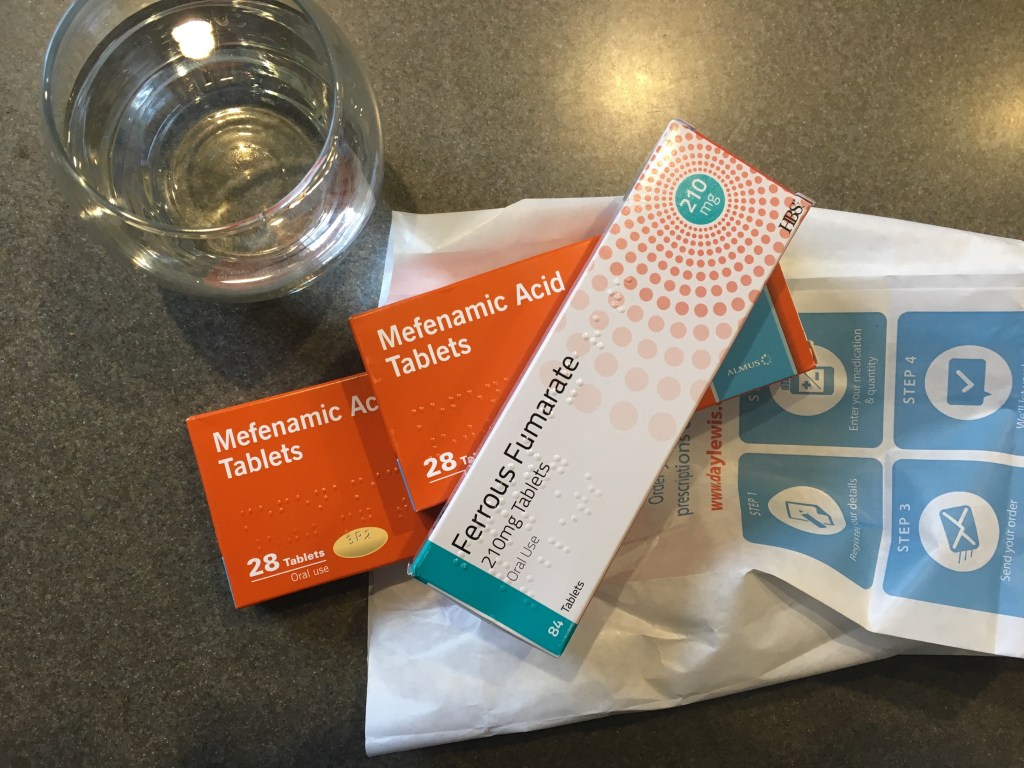
    However, the sobbing seems to have worked as Dr E has referred me to a local hospital, which should be quicker, and like the God she clearly is, she gave me something. I remain a little perplexed that no one has ever even offered me the medication she prescribed before, as its literal purpose is lightening menstrual flow and potentially easing period pain. It’s non-hormonal and I take it only when I’m on – pixie dust, clearly (Mefenamic Acid IRL). I can’t say I’ve noticed a huge difference thus far, but my period pain has been a little more manageable. I can’t take ibuprofen with it, which makes me nervous that if it doesn’t work then my main source of pain relief is out the window, but we’ll give it a good ol’ college try.
    FullSizeRender
    The latest venture.

    There are lots of frustrating things about this situation, but the two I’ve learnt this week are that the combined pill might stop the cysts from growing in the first place but that no doctor wants to put me on it because of DVT and breast cancer risk factors. The other is that both the sonographer and Dr E’s response to my pain outside of my period has been to say, “yes, sometimes cysts can be painful”. Trying to communicate to them that whatever is causing my pain, cyst or otherwise, is really painful often is proving difficult.

    So with a bit of persistence, like the pesky cyst, I’ve managed to get something to help with period pain, iron tablets that should help with sleepiness, and hopefully a decent and quick referral. It’s not exactly good news, but it’s something.
    Confused? Start the saga from the beginning here

  • Review: The Cincinnati Tin Trunk – Richard Hopkins

    Review: The Cincinnati Tin Trunk – Richard Hopkins

    Those who have been around for the long haul might remember that in my 2016 Favourites I mentioned the first book written and published by my friend Richard Hopkins – Interleaving. It’s now my pleasure to let you know that the second book in what is going to be a trilogy is out now!

    “Readers are taken on a historical treasure hunt”

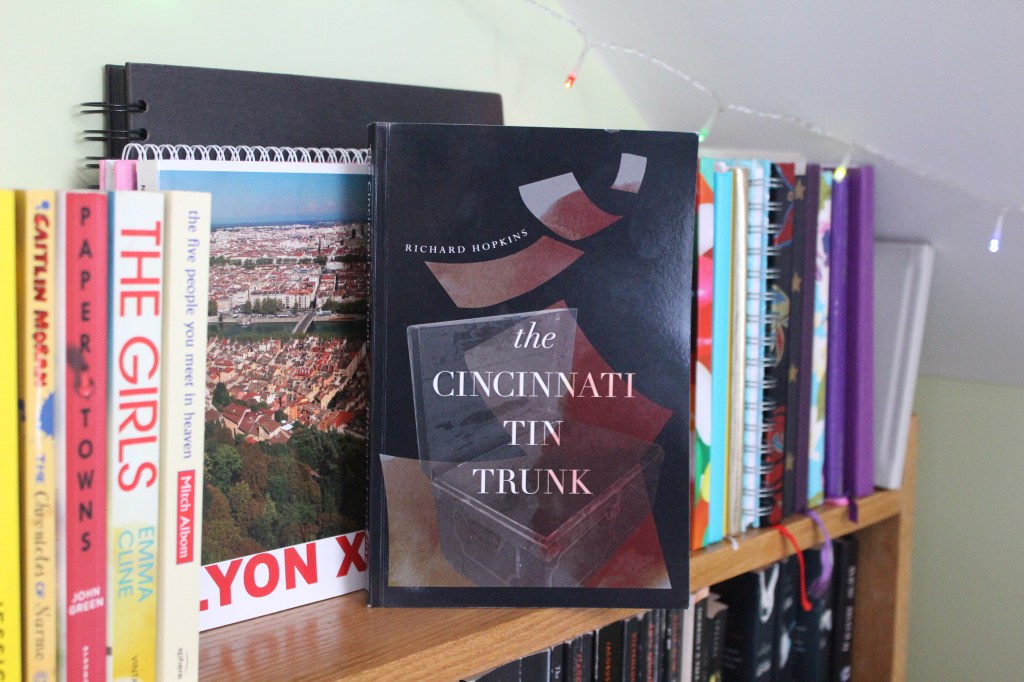
    It’s always nice to be able to give a friend’s projects some airtime, and it’s even nicer when I really enjoyed the book. The Cincinnati Tin Trunk is like Interleaving in many ways, and totally different in others. I’ve talked before about how my relationship with historical fiction has been a bit rocky, but Richard’s books are a really great way to ease yourself into history – by literally immersing yourself in the past. Inspired by the life and work of a real nineteenth century Dutch photographic Assistant, Nicolaas Henneman, the novel follows the journey of one twenty-first century historian’s physical, literary and photographic quest to learn more. Together with Tom, his wife Libby and adult daughters, readers are taken on a historical treasure hunt across the US, Holland, France, the UK and back again.

    Both a product of its time (2016 – yikes!) and a captivating exploration of early photography, nineteenth century life and migration The Cincinnati Tin Trunk can’t help but take you on a walking tour of Henneman’s life. Like Interleaving Richard drops you into London, both then and now, and guides you around the places that you might otherwise not have noticed. The book is both a form of escapism and a reminder that every story have many sides, some of which still need to be uncovered.

    Despite the fact that the characters are all new in this second instalment of the trilogy, it does what all good middle trilogy books do – it leaves you pondering about the third. Once again the profits from the book are going towards charities that help homeless people in London. Both Interleaving and The Cincinnati Tin Trunk are available on Amazon in Kindle and paperback format, so check them out if you’re interested!

    The book I reviewed last week (Tigerish Waters)  is also giving its profits to charity – Christmas presents with a side of social justice anyone?   

    IMG_9837


  • Review: Tigerish Waters – Sophie Reilly

    Review: Tigerish Waters – Sophie Reilly

    Launching this week is a stirring book written from the front line of a bright young woman’s battle with her mental health. Tigerish Waters is the selected writings of Glasgow-born Sophie Reilly, edited by her brother Samuel Reilly after Sophie took her life last year. This striking combination of poetry, prose and fiction is both an upsetting marker of a waste of talent and a celebration of a short but thoughtful life.

    Knowing the context around Tigerish Waters you might not expect the book to be so funny, but Sophie’s voice and style is a lot of really wonderful things, and comic is one of them. Having suffered with a plethora of mental illnesses including Anorexia Nervosa, Bipolar Affective Disorder and Emotionally Unstable Personality Disorder, her writing speaks of unfathomable pain and hardship as well as total euphoria. By articulating her relationship with her mental health through drama, poetry, short stories and diary entries, Tigerish Waters offers insight into a gritty reality of extreme highs and the lowest of lows.

    The dark, ironic and humorous style leaves you wanting more from this talented young writer, but then you remember the context of the book’s publication and it all begins to feel desperately sad. Throughout, Sophie talks about the future, specifically about when she’s written a play or a memoir or a novel. “Nobody who attempts or commits suicide wants to die” she writes, and we think of how a book was always supposed to be part of Sophie’s future, but the reality is not how anyone, least of all Sophie, would have wanted it to come about. And yet, the publication of Tigerish Waters does come with barrels of hope. All profits made by the book are being donated to the Scottish Association for Mental Health (SAMH). The book passes comment on the “non-existence” of Dundee’s mental health services and the counter-productive support Sophie felt she received. Tigerish Waters has the power to serve as a real wake up call to a revolution that needs to happen with the treatment of mental illness in Scotland and beyond.

    For me personally, I was deeply effected by the normality of Sophie’s life. At first glance it is all very relatable. In her diary entries she talks about Gavin and Stacey, Harry Potter, Orange is the New Black, even her crush on the show’s star. She expresses her concerns about the overbearing presence of social media on girls’ self-esteem and she hesitates over whether or not she really needs a smartphone. She was a normal young woman with a promising future (she had been accepted to study Theology and Literature at St Andrews). If one ever needs a reminder of how mental health issues can and do impact everyone and anyone, Tigerish Waters is a prime example. In one diary entry Sophie calls us to take pride in our mental health issues. Taking inspiration from some of the triumphs of the Gay Pride movement Sophie titles the essay “Mental Health Pride”. It is a confident approach to mental illness that could have a really positive effect in my opinion, and I hope that message will be another positive thing to come from Sophie’s life.

    “If one ever needs a reminder of how mental health issues can and do impact everyone and anyone, Tigerish Waters is a prime example.”

    For me, the two most poignant parts of the book were the short play “Before the Snuff of the Lights” and the poem “Birth & Growth.” While both play an important part in telling Sophie’s story, they are also standout for their quality and creativity. (Update: I just heard a performance of “Before the Snuff of Lights” at the book’s London launch, which only affirmed my opinion that it is really extraordinary and mindful piece of writing.)

    It is easy to get swept up in the circumstances of Tigerish Waters’ publication, when perhaps the emphasis should be on the phenomenal talent the lies in the sentences and verses of Sophie’s writing. Anyone who has ever lived and wondered why will find something in this book that makes them say “I thought it was just me.” From that, I hope they will be motivated to demand help, receive it and share their unique voice with the world.

    Tigerish Waters, the selected writings of Sophie Reilly, edited by Samuel Reilly, is available on Amazon for £6.99. Published by Mad Weir Books, all profits from the book will be donated the Scottish Association for Mental Health.